Why are we nevertheless concerned with the further development of this topic?
Because the aim is no longer to replicate the human brain. So-called strong AI is still a long way off, but development in special tasks is progressing all the faster - in self-driving cars and intelligent factory robots as well as in language assistants or automatic translator functions in real time. The aim of such weak AI is to solve specific application problems intelligently and automatically. Significant progress has been made here in recent years.
The reason: humans have taught machines how to learn. Today, computers often start out working quite modestly and then learn with the help of huge amounts of data that they process. As a rule, patterns are learned that are usually classified with a high hit rate without any knowledge of the context.
Our data feeds the AI systems
Machine learning is the name of the method that is perhaps the most exciting breakthrough between computer science and neuroscience, between big data and the cerebellum. A few years ago, work began on replicating the architecture of the human brain in artificial neural networks (ANNs). ANNs consist of a large number of electronic nerve cells, known as neurons, which send information to each other via directed connections. However, these connections are not rigidly defined, but are adapted on the basis of sample data - the network "learns". This gives the CNNs the ability to react to patterns that cannot always be predicted 100%. The quality of the classification is further improved by combining the patterns that are recognized from different data sources.
Google's Neural Image Caption Generator (NIC), for example, is an artificial neural network that combines image recognition with speech recognition. The network is able to identify individual objects in an image, relate them to each other and recognize actions. This has resulted in the following image descriptions: "A group of young people playing frisbee." Or: "A herd of elephants trotting across a field of dry grass."
In the past, artificial intelligence did not have the computing power or sufficient amounts of data to train AI. Today, machines can use huge amounts of data (keyword: big data) for autonomous learning. This data comes from a wide variety of sources:
- Millions of tweets, photos, videos, voice signals, messages from Facebook or other media
- Data from the Internet of Things
- PDM/PLM and CRM systems as well as ERP systems
The more examples are available as training data, the better the AI can develop. The flood of raw data available today will grow into a tsunami in the coming years. However, in order to be able to make sense of this wealth of data, it must first be collected, consolidated and presented to the network in a high-quality form. The prerequisite for this is a functioning and, above all, comprehensive data management system in companies.
Data hub as an enabler technology for the intelligent company
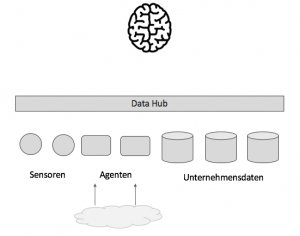
The data relevant for AI comes from several isolated and heterogeneous data sources. Behind each of these are different data structures and volumes. In addition to structured data, it must also be possible to process unstructured data such as sensor data, log files, photos or spoken word. For intelligent companies, the aim is to bring together all relevant company data seamlessly in a data map. This map, which contains the collected knowledge about the company, represents the overarching context for future AI developments.
These requirements can be realized with the concept of a data hub. The data hub brings together all source data - both structured and unstructured - in a stable database. In addition to pure data storage, it provides several functional services, e.g. for the qualitative cleansing and enrichment of data as well as the integration of additional data sources. This means that new services and sources can be dynamically connected to the knowledge base at any time.
Such a flexible hub, via which data, information and services can communicate in any order and arrangement, enables a continuous exchange of information and its optimal use for all necessary participants in the value chain.
In this way, processes can be controlled across the board and (partially) automated, not least through the use of AI. The data hub is an enabler technology for the intelligent company.
Conclusion: Comprehensive and powerful data management system as the basis for the further development of AI systems
Since its birth in 1956, artificial intelligence has become increasingly important in companies. With the help of enormous amounts of data and massive computing power, it is now possible to achieve what was impossible just a few years ago: computers recognize cancer as well as doctors; intelligent robots work in areas that are harmful to human health; and machines make credit and investment decisions on the internet. The only prerequisite for the (further) development of AI in companies is comprehensive and powerful data management. This can be achieved with a data hub as an enabler technology.1