
The more structured this process is and the more concrete the use of information is, the more efficient learning becomes. Data products help with this.
That Data has immense value creation potential is beyond doubt. Large companies, for example in the automotive industry, have been systematically tapping into this potential for years. However, many companies only make rudimentary or haphazard use of their data treasures.
One of the main reasons for this is that there is usually a lack of organizing principles. However, if you want to generate added value with your data, you need exactly that: order. Data products can create this order.
Focus on utility value
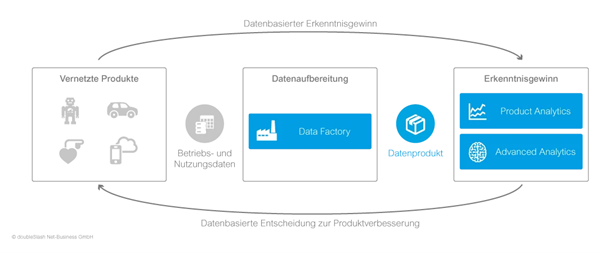
If a data asset is treated like a traditional product - with responsibilities and embedded in organizational structures that focus on its utility value, target groups and further development - a data asset becomes a data product. A data product is a concrete output that is based on the processing, analysis or interpretation of (business) data (data assets).
A data producer organization created in this way leads to a learning process on two levels: The company learns a lot about itself, and the data products are subject to a continuous improvement process that increases their benefits.
To achieve this, the pure user data, the data assets, are enriched with user-relevant metadata. For example: What area does the data belong to, at what interval is it updated, what confidentiality is it subject to? Metadata makes it easier to search for data products and assess whether they might be suitable for my use case. If you have a specific problem to solve in your company, you may find an approach here without having to "reinvent the wheel".
A data product owner is assigned to each data product. The data product owners ensure the good quality of the data and manage their products. They maintain close contact with the data suppliers - development teams, data engineers or data scientists - and with potential users, to whose needs they align the product. They develop new product ideas and support their products throughout their entire life cycle.

Ensure high quality
The function of the data production organization is to develop functioning, high-quality data products, make them usable for the company and operate them in a stable manner over the long term. It structures the wealth of data and systematizes its collection and processing. This has several advantages:
- It prevents a proliferation of data that would otherwise elude targeted use in the long term.
- It ensures the consistently high quality of the data products.
- Thanks to high data quality, it improves the quality of decision-making in the company.
On this basis, the capabilities of machines and devices can be improved, as can the relationships between customers, products, services and companies. New, data-based value creation models can be developed in a targeted manner and internal processes and their benefits can be optimized.
Data products can be divided into three usage scenarios:
- Data as a service: Here, the data is also the value-creating product, for example weather, stock market or address data.
- Data enhanced products: The data is used here to enrich another product and thus make it more valuable.
- Data as Insights: Data is used here to better develop and market other products.
The data product approach is decentralized in principle. Nevertheless, a central authority is required. It prevents overlaps and inconsistencies and ensures a uniform definition of taxonomy and terminology. At the same time, such a classification authority can and should link the data products of different domains with each other and ensure uniform standards for data products and their quality across the board.
A central data catalog makes data products findable and usable. It contains both source data and processed (intermediate) data products. A data marketplace that only contains processed data products may also be useful in order to make them available to specialist departments.
Prerequisite: Cultural change
Important: Companies should not only look at their data products from a technical perspective, but also create new functions within the company to drive forward the handling of data products.
In order for a data producer organization to generate optimal benefits, the solutions described must be accompanied by a profound change in corporate culture. A culture in which knowledge is used to secure one's own position is counterproductive. To be successful in the digital age, swarm intelligence must be given high priority and knowledge must be shared.
Systematized learning processes create transparency
Once introduced, the data producer organization helps companies to get to know themselves better. They learn more about their processes, employees, customers and products by analyzing the data assets provided in data products and gaining insights from them.
Another learning process takes place at data product level. The systematic organization of responsibilities and processes around a data asset almost automatically leads to a continuous improvement process: the data producer organization iteratively improves the benefits of the data asset.
At any rate, experience shows: Data product owners who develop good, value-adding data products quickly become popular contacts. This is because the more often useful applications are created from the previously free-floating data, the greater the desire in departments and business units to use these opportunities for their own purposes.
Authors: Marc Mai and Nicky Grassmann