Similarly, companies whose digital products do not require physical production or sales have so far come through the crisis better than their non-digital competitors.
This situation has brought the topic of digitalization even more into focus. In this article, I would like to look at what exactly it means to develop a company into a "digital company" and what the success factors are.
What distinguishes a digital company from a non-digital company?
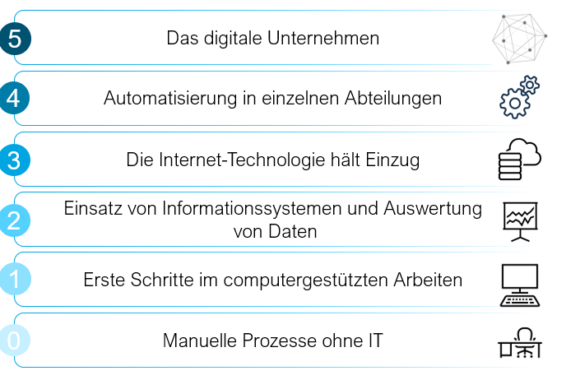
Unsurprisingly, there is no black and white here, but different gradations of the degree of digitization. Very vividly illustrated by Konrad Krafft these stages in his article "How the fully digital company works".
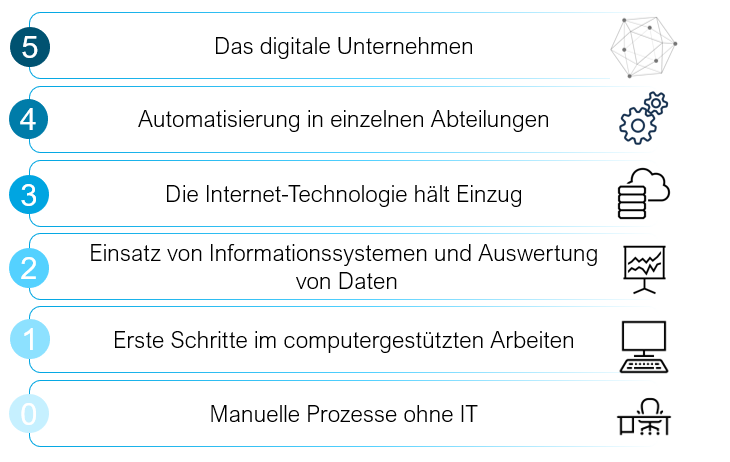
It is clear that digitalization is having a major impact on the Degree of digitization of internal structures of a company - regardless of the products or services it offers. However, experience has shown that there is a correlation between the digitalization of a company and the degree of digitalization of its product range. This is because digitalization builds up data skills that also enable the development of digital products. For example, the development of predictive maintenance services requires a high level of expertise in data integration, data transformation, analysis and prediction. A digitized company is therefore advantageous in two respects: it can bring innovative products to the market and these too manufacture more cost-efficiently.
And what does digitalization mean?
Digitization is not the creation of a digitized state on the basis of a non-digitized state, but the Upward movement on the scale of digitization levels.
First things first: the digitalization of a company is not a technology project and, above all, it is not exclusively a "matter for IT". Digitalization is a change for the entire company, consisting of people, processes and technology. There is no doubt that technology plays a key role. But if people and processes are not the driving force, the project is doomed to failure from the outset.
So what does a company's management need to consider when embarking on a course of digitalization?
Step 1: Why do I want to digitize my company?
In our experience, expectations of digitalization seem to diverge significantly between different companies and sectors. The reservations about digitalization are just as varied. There is no uniform understanding.
So I have to be clear about this myself, what goal I am pursuing with digitization. Am I simply hoping for business improvements such as higher sales or lower costs? Or do I assume that this will refresh the product portfolio and leave the competition behind? Will digitalization enable me to create completely new business models and make me crisis-proof? Or do I even want to enable a better life for employees and the environment? Without a clear idea of what I want to achieve, a digitalization project will always remain vague and struggle with acceptance problems and resistance. It is therefore advisable to clearly define your own goal and communicate it within the company.
Step 2: Where do I stand and where do I want to go?
Be aware of where your company stands on the digitalization ladder. It is not realistic to want to reach the fifth step from the second step without any detours.
Also be aware of which Digital experience level prevails among the company's management and employees. Depending on this, completely different motivational factors will play a role in taking the workforce and management along on the journey.
Step 3: Start with small steps
Digitization should not mean that planning and design work is carried out for many years before the company is turned upside down in a mammoth project. The most important thing is achieve success as quickly as possibleThe aim is to bring benefits and demonstrate that it is worth continuing along this path.
Creating networks, increasing transparency and consistent automation promise rapid success.
Example: Creating a networkCompany or product data that is required in different processes can be reused by networking producers with different consumers. A classic example is central sales figures, on which the decisions of several departments are based. This prevents discrepancies in the data status between departments and avoids the effort of repeated data procurement and preparation.
Example of increasing transparencyIf a central information system makes it clear to everyone on which key figures company decisions are made, this increases employees' trust in the company management.
Example of the introduction of automationIf the monthly invoice receipts are recorded and processed digitally, this frees up time for accounting that can be used for other purposes.
At doubleSlash, it has proven successful to Involving employees themselves in the identification of such potential. As part of our innovation process every employee can contribute ideas on how to improve their working environment, for example. This ensures acceptance from the outset and digitalization is not "pushed through".
Step 4: Continuously develop culture, organization and technology
The main thing now is to keep at it. Digitalization must be pursued continuously and purposefully. The digitalization of individual processes is just the beginning; the competition is constantly evolving. Digitalization must therefore be anchored in corporate strategies and values.
The central fields of action are:
Establishment of a "data culture":
Sharing knowledge within the company through networking between people has long been an important competitive factor. The consistent further development of this is the willing, natural sharing of data between departments and functions. It must be clear to everyone involved what benefits they or the company derive from the fact that data is available in a technically and semantically correct form. Without a recognizable benefit, there will be a lack of acceptance.
But that alone is not enough if this data is not handled profitably. Developing data skills should be a mandatory part of the program for every employee of a data-driven company. This includes being able to interpret data correctly in context, understanding its relevance, but also being able to interpret it simply and without contradiction. visualize to be able to.
Development of data governance:
The organizational framework forms the procedural basis for how data is handled in the company. It defines responsibilities for data, the life cycle, takes into account different protection requirements and can, for example, also define service level agreements for data provision (e.g. the availability or correctness of data). An introduction to data governance by Danny Claus is here to find.
Data governance in particular is often perceived as a deterrent, as it gives the impression that such frameworks are overloaded. We have found that an iterative, agile approach also leads to success. It is not possible without a minimum level of regulation, but the case-specific introduction poses fewer hurdles. In this way, all responsibilities and quality specifications can be defined for a central company process and the data involved without these having to apply to the entire company.
Introduction and improvement of the required technology:
The choice of technology is based on the requirements that arise from the digitalization of processes. It will not work to purchase a ready-made data management or analytics solution in the hope that it will add value.
It is essential that the technology used is understood and accepted by the people who come into contact with it. The approach of the "user-centered design" can ensure this acceptance. We will present this in more detail in due course.
Even though digitalization is omnipresent, the understanding of what it means is very broad. Every company must therefore decide for itself where it stands, where it wants to go and set out on its own path. As long as People, processes and technology equally considered and the goal is not lost sight of, can also be achieved with small steps have already raised potential become. The way is then paved for further steps in the form of a Digitization strategy.
More about our Data Driven Services
Sources:
1 https://www.cio.de/a/wie-das-vollstaendig-digitale-unternehmen-arbeitet,3574107
2 https://www.computerwoche.de/a/innovationsgeist-systematisch-foerdern,3545849
3 https://staging.blog.doubleslash.de/data-governance-das-fundament-fuer-die-datengetriebene-digitale-transformation/