
In many cases, the aim is to digitize when it comes to new, trendy technologies such as blockchain or artificial intelligence. As a reflex, marketing departments immediately try to communicate how their own company or product intends to use the new technology. It is often only much later that the question of the Sense and purpose. A company needs a vision that helps all employees to understand what image the company has of itself in the future.
The question of where a company wants to develop always arises sooner or later. Without this vision, there is no clear strategy and therefore no fixed course. The result: a course without a clear direction that costs an unnecessary amount of money.
Many companies lack the orientation they need to formulate clear digitalization goals and derive a strategy from them. We have therefore embarked on a search for Principles and patterns to help discuss aspects of digitization and, on this basis, to develop the Vision for your own company to find.
This has resulted in Five principles of a digital companywhich help to draw up a sketch of the future for your own company.

Source: own presentation
The principles are divided into two organizational principles that are primarily concerned with culture and three that are to be understood as technological domains. This already shows that digitalization cannot be a purely technical topic. For many companies, new ways of working that go hand in hand with digitalization mean a major change. Cultural change.
Team purpose - focusing on customer benefits
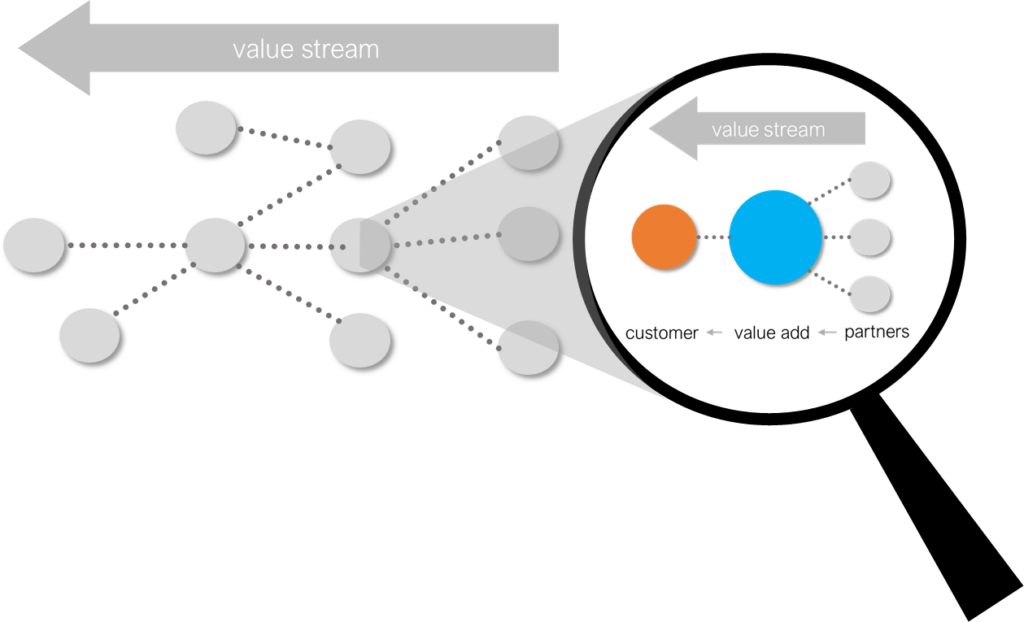
Having a task as a team is nothing new in any company. What is new, however, is the independence that is required of teams in a digitalized world. They are expected to find their own vision and focus based on set framework conditions. Each team contributes to the overall value creation of the company by offering its customers added value. This Service concept must run through the entire company, with customers being understood as both external and internal customers. Of course, the team cannot do all the work itself and needs other teams to do it. This creates a Network of customers and suppliers within the company, replacing the traditional hierarchy.
Source: own presentation
Focusing on the customer - whether internal or external - is also a Focus on added valuethat your own team creates. This is the only way to make customers happy in the long term.
Agile development - planning with knowledge gain
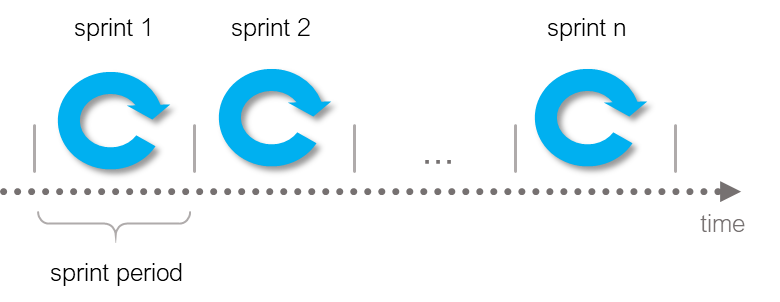
Thinking agile is not just a question of method, but a fundamental attitude. Does everything really have to be 100 percent thought through before you set off? We think: No. The important thing is that you know where you want to go - that you have a Vision and goals has. The essential next steps are derived from this. You can also name and formulate subsequent steps, but you should not be deterred from taking the first steps anyway. Otherwise you will quickly lose sight of the most important thing: the customer. In an agile approach, the customer is spoken to after each step.
Agility means adaptability. This means adapting to the customer's needs, but also questioning your own needs and deriving the next steps from them. Experience is gathered at every step and insights are derived from this. Small but quick steps are an essential feature of agility.
Source: own presentation
Data driven - creating access to data and increasing knowledge
Transparency and comprehensible decisions are of central importance for a company to function smoothly. Every employee - and now also the machines - collect vast amounts of data and information that represent a huge potential for knowledge - knowledge that is a tremendous asset for companies.
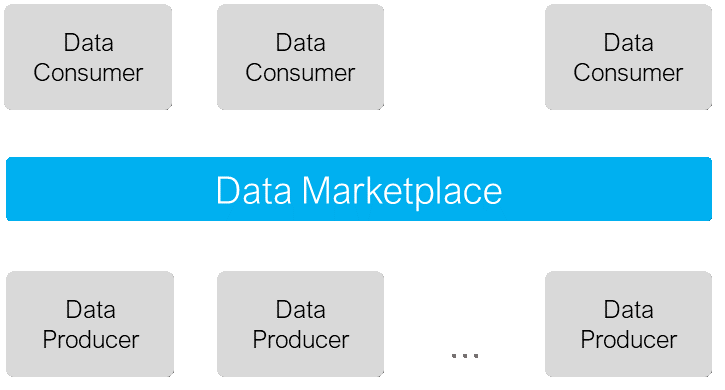
Data to share is not a matter of course in many companies. An awareness must be created that one's own data can also be valuable for other employees in the company. To make sharing easy, it is crucial that cultural and technical barriers are removed by ensuring that everyone in the company is happy to share data and has a easy access to the data has. Service departments usually have extensive information about how the products are used by customers. This data can help to optimize products so that they satisfy customer needs even better. Up-to-date information from production can help the sales department to stay in even better contact with the customer, as it can proactively inform the customer about the production status.
About Data governance guidelines ensures that data is not misused. An easy-to-use catalog for data with useful additional information can serve as a marketplace that employees can use to find the data that is important to them.
Source: own presentation
In order to make their own data even more useful for decision-making, teams need the ability to Analysis and further processing of data. When teams provide information that has already been analyzed in addition to the raw data, so-called data products and Data Meshes.
Connected - a network of added value
Even with the principle of transparency, the sharing of data creates a Connection between the teams created. The principle of teams also establishes customer-supplier relationships that lead to a complex network of value creation. We have made networking a principle because we see great potential in the networking of both teams and machines. True to the motto "The whole is more than the sum of its parts", networking creates Synergies and flexibility for the company. If this principle is pursued consistently, then a Network for sustainable value creationin which everyone involved benefits.
Automation - humans and algorithms in harmony
If sufficient data is available and teams and machines are networked, then there is also new potential for automation. Automation brings Speed and quality into a company's processes and will be essential in the future in order to remain competitive. On the other hand, despite major advances in artificial intelligence, many algorithms lack the necessary flexibility to react appropriately to unforeseen events. For this reason, it will be particularly crucial for success that the Interaction of algorithms with people works smoothly in a team.
The main prerequisites for this are,
- that the teams themselves decide which tasks they leave to the algorithm and which they can do better themselves.
- that the teams are open to the possibilities of technology.
After all, at the end of the day, the only thing that counts for automation is what brings added value and benefits - and not technology as an end in itself.
Every day, many companies embark on small or large projects to get a little closer to their vision of digitalization. These five principles are not a solution, but they can be the Orientation to avoid being lost in the multitude of questions that every project repeatedly raises.
Our personal experience is that, especially with Culture and organization so that all employees can be taken along on this journey. No one should be left behind in this transformation.