The digital transformation promises more efficiency in existing processes and equips companies for the digital future and new value creation models. The success factors on this path were the topic of this year's slashTalk at doubleSlash. The slashTalk forms the bridge between the specialist department and IT. This year, participants were given insights into digitization projects from practice and were able to exchange ideas with other experts.
The slashTalk 2017 focused on the digital transformation of business processes, the necessary prerequisites for success, their benefits and challenges during implementation.
Digitization is culture
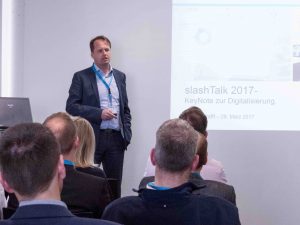
doubleSlash Managing Director Konrad Krafft spoke in his keynote presentation about the fact that Digitization the unstoppable Evolution in business to automate and simplify processes and minimize sources of error - but above all to be able to scale and save costs in the long term.
A major challenge here is the necessary Cultural change within a companywithout which digital transformation would not work.
Apart from the fact that companies in the future will always Develop new business models to survive on the market, but above all they also have to Fast and agile implementation of these business models. Agility is therefore a key success factor for digitalization. Companies are moving in the Field of tension between their need for stability and the need to adapt agilely to market requirements and implement innovations quickly. Agility, according to Konrad Krafft, is something that software developers definitely possess. Companies should therefore make their processes as agile as software development.
Importance of the digital transformation
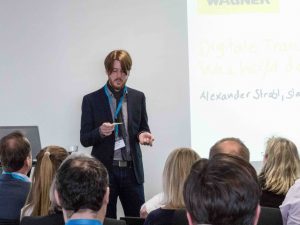
In his presentation, Alexander Strobl, Head of Digital Transformation IT at Wagner, got to the bottom of the question of when a digital transformation is really successful. His conclusion: digitalization only makes sense if there is real added value. His presentation showed whether added value is a given in a digitalization project. 7 factors for a successful digitization project:
- Has relevance
- Easy handling
- Works everywhere
- Solves my problem
- Uses what is already there
- Connecting people
- Scales as required
Andreas Müssle, Business Unit Manager Key Components & Service at Zeppelin Systems, gave an insight into a Concrete digitization project and the cultural change that comes with it. His learnings:
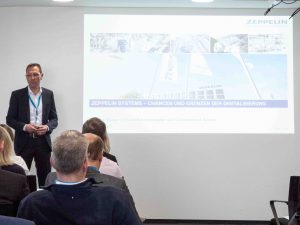
- You need Perspectiveto break away from existing processes and develop new digital processes. Talking about what is possible is not enough. It's about taking the initiative and demonstrating what is feasible.
- Existing processes are replaced by new procedures - the changes usually affect several departments at the same time. The willingness to do this and the Necessary openness are critical to success.
- Familiar areas of responsibility must be abandoned and new ones developed. To do this, it is important that employees Added value of restructuring see. Experience shows that this can only be achieved visible results and with considerable Stamina works.
He argues in favor of High agilityThis approach to implementing digitization is very helpful or even essential. This is because there are often parameters that are not yet known at the beginning and only crystallize in the course of project implementation. They need to be picked up on and integrated into the further procedure.
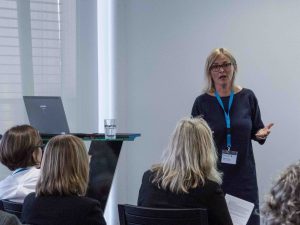
Melitta Arkossy, Exhibition Manager at Messe München GmbH, spoke about the need to digitalize processes within her company and to develop new business models as a result. In this transformation process, a number of Knowledge and experience that are crucial for successful digitalization:
- Specialist departments and IT must come together early and regularly to jointly formulate goals and requirements.
- A way must be found how different systems networked with each other and can communicate with each other. It is important early on Suitable interfaces not only on a technical but also on a professional level.
- An early start with the Change management is just as important as the support of the management.
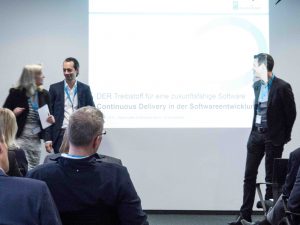
Daniel Lehle and Sebastian Sturm, software developers at doubleSlash, showed how the Software development now professionalized has. Above all Continuous Delivery a role: a method in software development with the aim of making all code changes continuously, quickly and in high quality to be able to deliver. Using concrete examples, they showed what software development with and without Continuous Delivery can look like and where the added value for companies lies arise. A Recommendation for actionwhen it makes sense to use the method was also included:
- Projects with a long duration
- Need to react quickly to external influences
- Large project teams
- High complexity due to business logic, many interfaces to other systems or many interfaces in your own system
- When other systems need your own for integration
- The Data Hub - Modern data platform for optimal use of business dataSandra Rueß, Business Consultant at doubleSlash, spoke about the Sensible connection of different data pools in a digital process and how the Connection of intelligent services can lead to a useful gain in knowledge.
- Christian Geser, Software Architect at doubleSlash, showed in five minutes that the Use of microservices agility not only in development but also in functionality, and they work together as a high-performance team in one software.
- Markus Wingler, Software Architect at doubleSlash, dared to take a risk with the intelligent configurator a look into the future: The Linking with AI services configurators will become "intelligent". They build on current knowledge and will potentially revolutionize services.
- Michael Rotter, Business Consultant at doubleSlash, took the participants into the world of Big Data and influence in the US election campaign. The insight: Predictive analytics not only influences politics or police work, but also makes our everyday lives easier.
The digital transformation promises more efficiency in existing processes and equips companies for their digital future. In the process, one crystallizes again and again Key success factor The better business departments and IT work together, the more successful the digital transformation.
On the one hand, this means that marketing, sales and service have to deal with Technologies and software to deal with. Conversely, it is becoming increasingly important for IT to Needs of your specialist department to know.
On the one hand, this often requires a rethink and a necessary cultural change in companies. On the other hand, perseverance and a strategy of small, agile steps are required.
Find out more about successful software projects here