Since then, there has been a completely new understanding of how people interact with AI-controlled RAG bots (Retrieval Augmented Generation) and what is possible with them. Companies are also increasingly recognizing the revolutionary impact of generative AI on the business world and are considering how they can use the technology profitably for themselves. Because one thing is clear: those who act quickly now and successfully integrate AI into their business processes will secure significant competitive advantages. A higher degree of automation and improved cost efficiency can be clearly identified through the use of RAG chatbots. On the other hand, those who miss the boat risk falling behind their competitors. It is therefore essential that companies understand how ChatGPT and generative AI can strengthen their competitive position.
The use of ChatGPT in business processes can be done in various ways, with one promising option being to enrich the chatbot with the company's own knowledge. This can be achieved by creating a knowledge database that the language model can access to answer questions. Such a system is also known as retrieval augmented generation.
Are you wondering how you can optimally integrate ChatGPT and RAG chatbots into your business processes? Discover our Data-Driven Servicesthat help you to exploit the full potential of your data.
What is Retrieval Augmented Generation?
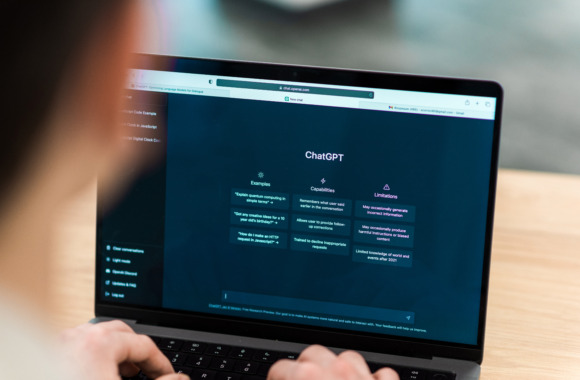
Retrieval Augmented Generation (RAG) is a process in which a user's input into a Large Language Model (LLM) such as ChatGPT is supplemented with additional information. Typically, the chatbot accesses a knowledge database for this purpose. The LLM can then use this information to answer the user's question.
It forms a kind of alternative search engine for the content of documents or articles. Instead of filtering relevant content using keyword searches or keywords, I "talk" to the documents. The method has three significant advantages:
- I use the already mature linguistic understanding of a model like ChatGPT3.5 and don't have to train and tune LLM from scratch.
- The chatbot's knowledge can be expanded at will. An elaborately trained language model like ChatGPT3.5 already knows a lot, but with RAG I can theoretically train virtual experts for different domains.
- Searching for content becomes interactive and intuitive. I can talk about the content I am looking for and have facts explained to me. When searching, it is not the exact terms that are decisive, but the meaning of the content.
In this blog article, we would like to present RAG's methodology in more detail and show the potential of chatbot-supported knowledge management.
RAG-Chatbots: The fusion of retrival-based and generative models
RAG chatbots currently combine the best of retrieval-based and generative models. While retrieval-based models search a database to find the most relevant answer, generative models can create answers dynamically. The fusion of these two models makes RAG chatbots very versatile and efficient.
Put simply, such systems consist of two components:
- A generative language model
- A knowledge database
As a language model, we imagine the common OpenAI chatbot ChatGPT for an example. Vector databases are usually used as knowledge databases, which is why we also assume a vector database in our example.
What is a vector database?
A vector database is a special type of database that stores data as high-dimensional vectors. These vectors are mathematical representations of characteristics or attributes. Each vector has a certain number of dimensions, which can range from tens to thousands, depending on the complexity and granularity of the data. The vectors are usually generated by applying a transformation or embedding function to the raw data such as text, images, audio, video, etc.
The main advantage of a vector database is that it allows you to search for similar data quickly and accurately. This means that instead of using traditional methods of database querying based on exact matches or predefined criteria, you can use a vector database to find the most similar or relevant data based on its semantic or contextual meaning. This makes a vector database ideal for finding similarities in unstructured data such as text and images.
The following procedure is used to save large quantities of text documents in a vector database:
- The text is extracted from a document.
- The text is divided into smaller pieces by a so-called splitter.
- The text pieces are transferred to an embedding model.
- The embedding model creates vectors from the pieces of text and links them to their respective text content.
- The vectors are stored in a vector database and refer to their respective piece of text.

A RAG system makes use of this process by also converting a user's question into a vector (1). The vector does not represent a pure combination of alphanumeric characters or words, but semantic information. In this way, the chatbot gains a certain linguistic understanding of the question.
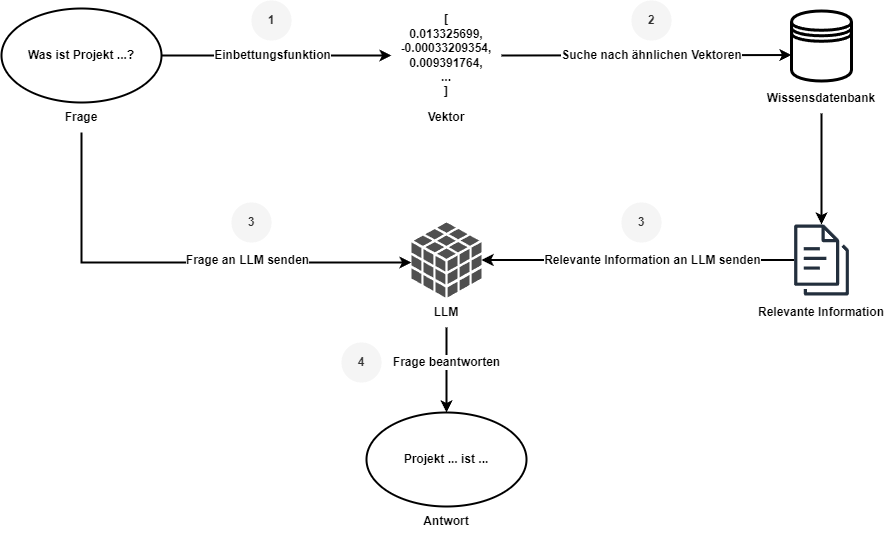
The system then searches the knowledge (vector) database for vectors that are similar to the question (2). If it finds one or more similar vectors, it calls up the associated pieces of text and attaches them to the user's question as context before the chatbot receives the question. The pieces of text provide background knowledge that the chatbot needs to answer the question. From now on, the chatbot no longer only sees the user's question, but also the question and the context (3). The chatbot then attempts to answer the user's question using the context available to it (4).
In theory, a RAG chatbot can therefore answer all questions on a topic, provided the answer can be found in an inventory of documents.

The strengths of RAG: overcoming the weaknesses of purely generative chatbots
- The knowledge base can be changed at will. Information can be added, removed and updated and the chatbot always accesses the latest information.
- Domain knowledge is reproduced more reliably. While ChatGPT without RAG tends to hallucinate when reproducing very specific information, the results with RAG are more relevant if they are contained in the knowledge base.
This makes the productive use of chatbots in the business world even more flexible and efficient, opening up new fields of application.
Potential of RAG-supported knowledge management
The methodology of RAG-powered knowledge management could revolutionize almost any industry by having the ability to quickly and accurately retrieve profound information from vast amounts of text. RAG chatbots combine the capabilities of search engines with text generation, enabling them to respond to queries with complex answers based on individual knowledge bases.
The use of RAG significantly improves knowledge generation and reproduction processes. There are no limits to the fields of application and industries:
Healthcare
Automated diagnoses and findings: RAG can assist physicians and medical staff in interpreting patient data by extracting relevant information from medical records, research data and clinical guidelines to produce accurate diagnoses and findings.
Legal services
Legal case processing: A RAG-based chatbot can help lawyers and legal staff research laws, precedents and other legal documents to make informed legal decisions.
Industry and manufacturing
Maintenance and repair: Through integration with machines and devices, operating instructions and maintenance instructions can be easily retrieved to support technical staff with maintenance tasks. Chatbots can provide step-by-step instructions.
Education
Individualized learning materials: Teachers can use RAG to create personalized learning materials for students based on their individual needs and progress.
Financial services
Customer advice and support: RAG can be integrated into chatbots to support customers with banking transactions, financial planning and investment decisions.
E-Commerce
Product management: Product databases can be consulted to compare products, generate content and carry out analyses. Product development can be accelerated through semi-automated decisions. At the same time, a RAG chatbot can use a product database to answer customer queries.
How ChatGPT and RAG chatbots are shaping the future
RAG in knowledge management shows impressive potential. Implementing the technology should bring about a noticeable increase in productivity in companies. The processes that RAG improves are versatile and can be found across all industries.
The speed at which chatbots are currently developing is also impressive. Within less than a year of the publication of ChatGPT, there are already mature application examples that are driving forward interaction with vast stores of knowledge. In addition, there are further developments such as autonomous AI agents and multimodal chatbots, which open up further opportunities and expand the capabilities of chatbots. It will be interesting to see which paths the generative AI will still have an impact.
Good to Know
Would you like to use ChatGPT with your own data?
Then the doubleSlash AI platform is just right for you. Following the introduction to RAG chatbots in the blog article, our platform shows you how to put this concept into practice. It automates recurring tasks, connects your knowledge systems with generative AI and enables you to use data efficiently - right where it is generated.
The focus is on intelligent knowledge management: the platform seamlessly integrates existing systems with modern AI technology. This allows you to optimize processes, improve data access and harness valuable knowledge in a targeted manner.
Experience how easy knowledge management and efficiency can be - with the doubleSlash AI platform!