The same applies to data products: the paradigm goes beyond the simple provision of raw data, aggregates or key figures. Data products are the next step in the use of data.
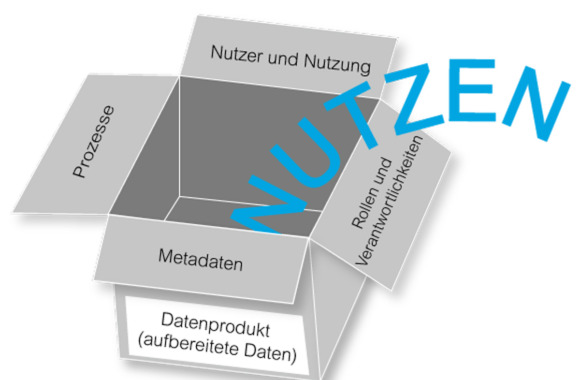
- A data product is a product that has been manufactured Data setthat generates a certain benefit.
- Product liability means that the data set is treated exactly like a physical product. There is a defined process and responsibilities for the creation, quality assurance, maintenance and further development of the data set.
- "Generating benefits" in this case means that the circle of users is known and the targeted use of the data set solves a challenge that the users have.
- In addition to the pure user data, a data product is supplemented by metadata that both describes its content and provides contextual information on the use of the data product.
A data product is not a software product that is based on data (this is referred to as a data-based product). It is not a report or a visualization of data. A data product is also not tied to a specific technology.
What criteria must a data product fulfill?
In short, a Data product so the following Criteria fulfill:
- Benefit and Utilization known, Rollers (like Product Owner and Data Stewart) occupied,
- Responsibilities and Processes established for the creation, maintenance and further development
- Metadata such as a description in the Data Catalog is available and up-to-date.
Data products can only be used correctly if these criteria are met.
Various scenarios are possible: data products can be used as "simple" data products (i.e. generated directly from raw data). However, data products can also be shared and reused. In this way, complex data products can also be created across several levels. The advantage: redundancies in data preparation are reduced (=> cost savings, performance gains) and inconsistencies are avoided (=> a clear calculation formula for each "sub-product"). The following graphic shows the combination of simpler data (sub)products to more complex data products.
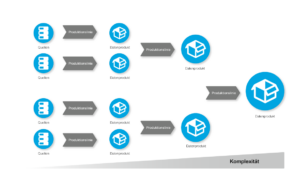
In our understanding of data products, the focus is primarily on the processed data as a result. The use of this data (e.g. through visualization) is downstream of the generation and provision of a data product.
This means that data products in their raw form are more likely to be used by a technical audience such as data engineers, analysts and scientists. The visualizations, algorithms, systems and products they create open up the usability of data products to the masses.
How does a data product generate a benefit?
However, the decisive factor for the success of data products is the consideration of the topic beyond the technical data. The critical point is anchoring the topic in the structural and process organization of a company. By focusing data products on a benefit and thus a specific group of users, a market economy of supply and demand is created. This automatically results in a focus on the high-quality data products that are really needed, as unnecessary or low-quality data products are simply not used.
The aim of every data product is to create added value. There are several ways to achieve this:
- Data products improve existing business processes: For example, the daily provision of bookings to a cost center and its "limit" can ensure that the cost center is not overbooked.
- Data products enable business processes that were previously not possible: E.g. live tracking of parcels at Amazon, DHL etc. by providing the current position of the parcel.
- Data products serve as the basis for making data-based decisions: E.g. as a basis for corresponding visualizations in management dashboards.
- Data products flow into data-based products as "components", thereby improving them: For example, displaying the availability (free/occupied) of a charging station makes charging with an electric car much more convenient, as waiting times can be avoided.
- Data products enable data-based products to make decisions independently: For example, a car can automatically recommend a suitable workshop visit if the tread depth of its tires has fallen below a certain threshold and they need to be replaced.
Data products are more than just processed data. We expand this core to include the facets of benefit, usability, organization and processes.
If the data product approach is applied consistently and successfully, data becomes (re)usable corporate assets.
They serve as the basis for data-based decisions or even make it possible to automate them. They are also used as a "component" in data-based products.
This will make data products a decisive competitive advantage for companies in the future - both for internal optimization and for offering better services and products on the market.
Would you like to find out more about data products? Read more details at: Usability of data products