
In this article, we present three central use cases that offer companies in the Catena-X network significant advantages:
- Traceability
- Sustainability
- Efficient business partner data management (Business Partner Data Management).
Traceability: safety redefined
What does traceability mean?
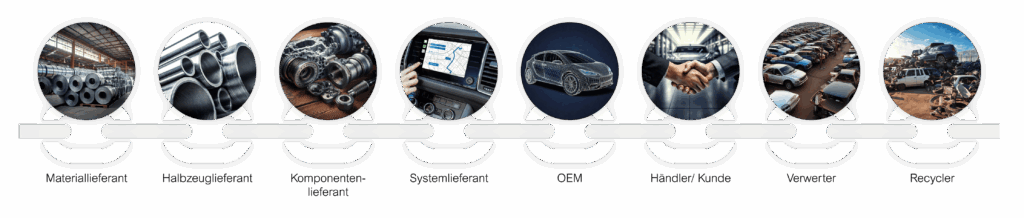
Traceability - or traceability - creates transparency along the entire value chain. It enables companies to track products, materials and components across all production and delivery processes. Digital twins make it possible to trace exactly when, where and how components were used. This end-to-end data chain increases transparency and improves efficiency throughout the entire supply chain.
It should be noted that traceability follows the "one up and one down" principle. This means that each participant only sees their direct suppliers and customers.
Example of potential: Early quality management
In a networked system like Catena-X, companies benefit from the new level of transparency and collaboration. If a supplier discovers a quality problem with a component, affected business partners can be informed in real time. Let's assume a supplier reports a defective component. Thanks to traceability, OEMs know immediately in which vehicles these parts have been installed and can launch targeted recall campaigns or rectify faults while they are still in production. This not only saves costs, but also maintains customer confidence.
In addition, the risk of product recalls can be drastically reduced. Potential problems are identified during production before they reach the end customer.
Sustainable production: the path to less CO2 with Catena-X
Sustainability as a central theme
Sustainability is one of the most important aspects of Catena-X, especially with regard to the reduction of greenhouse gas emissions. A central focus of Catena-X is the reduction of CO2 emissions. Through the standardized recording of the so-called "Product Carbon Footprint", companies along the supply chain can record realistic and comparable data on their carbon footprint - from raw material extraction to recycling. The idea is to collect real CO2 data from the extraction of raw materials through production to disposal or recycling.
Example of potential: CO2 transparency using the example of BMW
One example of this is the BMW iX. Together with its partners, BMW was able to calculate the exact CO2 footprint of the vehicle's iconic kidney grille along the entire supply chain for the first time. This transparency not only offers the opportunity to reduce emissions in a targeted manner, but also strengthens confidence in sustainable production methods. Companies can thus achieve their climate targets and at the same time meet the needs of their customers for climate-friendly products.
Sustainability is more than just a trend in the automotive industry - it is a necessity. Thanks to the standardized recording and comparability of emissions, companies can take targeted measures to reduce CO2 and comply with legal requirements.

Data management at the highest level: Business Partner Data Management (BPDM)
Efficient data management thanks to the Golden Record
Efficient data management is one of Catena-X's key strengths. With Business Partner Data Management (BPDM), the network offers a standardized approach to efficiently harmonize business partner data. The so-called 'Golden Record' combines information from different sources and ensures a uniform data status.
In the automotive industry, maintaining and updating business partner data is becoming increasingly complex. Constant changes to addresses, tax numbers or other important information make it necessary for all parties involved to have access to the same data. This is where the Golden Record comes into play. It harmonizes identical data from different sources and ensures that companies have access to up-to-date business partner data at all times. The Golden Record is supplemented by a unique identifier, the Business Partner Number (BPN).
Example of potential: Volkswagen and Cofinity-X
An impressive example of the benefits of BPDM is the VW Group. Volkswagen works with a large number of business partners worldwide, which represents an enormous challenge for data management. With BPDM via Catena-X, data processes become leaner - saving time and resources. Cofinity-X (an operating company for Catena-X Services) takes over the central management of business partner data and ensures that VW and other partners have access to up-to-date and valid data at all times.
This standardized approach not only helps to reduce effort, but also enables early warning systems that indicate changes such as new addresses or bank details. This enables companies to improve their data quality and meet regulatory requirements more easily.
Conclusion and outlook:
With its use cases, Catena-X offers the automotive industry a unique platform for optimizing its value chains. The three use cases described are just the beginning: with a solid database, further innovative solutions can be developed to make collaboration even more efficient.
Which use cases could make the difference in your company? We would be happy to assist you with onboarding to the data room and evaluate the right use cases for your company.
References:
- BMW CO2 measurement IX
- BPDM at VW