
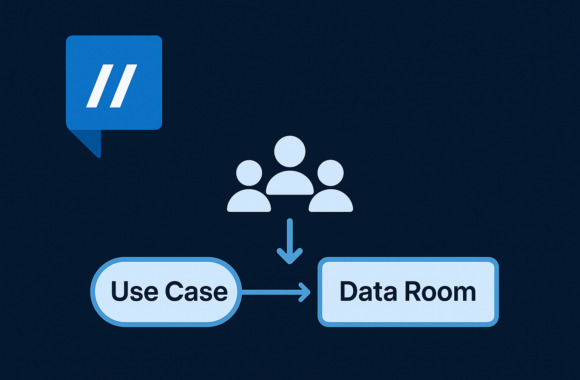
Unstructured Use Cases: Why We Need Transparency in Data Rooms
„What exactly do you do with data rooms?“—a question that comes up time and again, both internally and externally, whenever data-driven projects are discussed. The answer: quite a lot. It’s just that this isn’t always immediately apparent to outsiders.
Many of our use cases use the same basic data rooms - regardless of the industry. And yet there is still no clear overview of which use cases are assigned to which data rooms. This is exactly what we want to change.
A data room overview that highlights synergies
Many teams are developing innovative data-based use cases. Some deal with sustainability and carbon footprints, others with supply chains or machine statuses. What is often overlooked: These use cases are based on similar data structures - and therefore on the same data spaces.
Nevertheless, this knowledge is rarely shared. Why? There is a lack of a clear, comprehensible structure that transparently assigns all use cases to one or more data rooms.
In practice, this has several consequences:
- Redundant discussions about which data room is suitable for which use case
- Poorer reusability of solutions
- Hardly any systematic findings on patterns across data rooms
Our solution: A clear, visual overview that shows all use cases structured by data room and industry. This allows patterns to be recognized, synergies to be created - and projects to be aligned in a more targeted manner.
We have oriented ourselves to a simple grid:
| Use Case | Industry | Data room used | Maturity level (e.g. PoC, pilot) |
|---|---|---|---|
| Digital product passport | Mechanical engineering, car | Manufacturing-X | Pilot phase |
| Supply chain tracking | Trade, Automotive | Mobility, Logistics | Proof of concept |
| Predictive maintenance | Production, Energy | Industry 4.0 / Gaia-X | Productive |
The aim is not to lump everything together - but to create transparency. The assignment is deliberately flexible: a use case can be assigned to several data rooms, just as a data room supports different sectors.
Lessons learned from the initial feedback
Compiling this overview is not an end in itself—it has very concrete effects:
- Clarity in the project teamThe overview helps when new colleagues are onboarding or project managers want to understand the strategic context.
- More efficient communication with partnersIf it is clear which data room is affected, requirements can be clarified more quickly.
- Better scalingSimilar use cases can be transferred to new sectors more quickly because the data logic is already known.
Conclusion: Small overview - big impact
A use case is not a self-runner. Without context, its benefits are often limited to the individual project. By assigning them to data rooms, we make connections visible - and create the basis for reuse, strategic alignment and cross-industry scaling.
The overview is a first step. The next could be: Identify and assign further use cases together with you and iteratively improve the structure.
Do you want to structure use cases efficiently? Then check out our solutions for Connected Data Spaces.