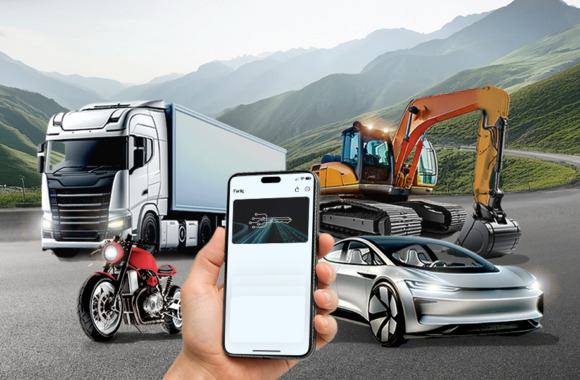
This revolutionary approach not only transforms how we access our vehicles, but also opens the door to a variety of use cases that make driving safer, more convenient and more connected. In this article, we take a deep dive into the world of digital vehicle keys and introduce you to 10 practical use cases that this innovative feature is already enabling. From fleet management to private car sharing - the possibilities are almost endless.
doubleSlash is part of the Car Connectivity Consortium (CCC)
The Car Connectivity Consortium, which sets the standard for the digital vehicle key, is a collaboration between the world's leading automotive companies, automotive suppliers and smartphone manufacturers. The CCC defines the standard for cross-platform end-to-end interoperability. The CCC digital key is based on a common specification that defines the technical implementation in terms of security, data protection and privacy. The smartphone and car can be offline for unlocking, locking and starting the engine, as no active internet connection is required or communication with the server takes place. The special feature: The digital vehicle key is natively available in the wallet (like a credit card, for example) and does not require any additional apps.
The specification for the digital vehicle key defines the following three main use cases, among others. These are the following use cases: Create (Owner Pairing), Share and Terminate.
Create (Owner Pairing):
The automotive digital key makes it possible to open, start and manage a vehicle using a digital key in the smartphone's native wallet. Instead of a traditional physical key, the digital key allows the authorized user to access the vehicle via a wireless communication interface, such as Bluetooth, Ultra-Wideband (UWB) or Near Field Communication (NFC). Owner pairing refers to the process of linking a digital key to a specific vehicle and its owner. It is a one-time process in which the digital key is securely associated with a specific vehicle and its owner. This ensures that the key can only be used by this specific vehicle and its owner and cannot be transferred to other vehicles. Cryptographic keys are generated in the Secure Element of the smartphone. All features of the system use standardized AES and elliptic curve cryptography.
Share:
The digital key can easily be shared with other people, such as family members or friends, via iMessage, for example. This makes it possible to lend or rent the car without the need to hand over physical keys. The digital key can be assigned for a specific period of time or a set schedule. Copies of the key can be shared with up to five other people via Apple's own messaging app iMessage, for example, even with restricted rights if desired. Shared keys cannot be shared again. The special feature: This also works natively in the Wallet and does not require any additional apps.
Terminate:
Unlike physical keys and key fobs, CCC Digital Keys can be easily terminated or blocked. The owner of the vehicle can revoke issued keys at any time via their smartphone or the vehicle HMI. For example, a user may decide that they or a friend no longer need access to a vehicle, or they may wish to disable any CCC Digital Keys linked to a stolen or compromised mobile device if the device has been lost.
Further details on the functions are described in detail in the following blog posts:
- Key as a Service (KaaS): An IT user story - Part 1 (doubleslash.de)
- Key as a Service (KaaS) - An IT user story about the digital key - Part 2 (doubleslash.de)
What are the practical use cases for the digital vehicle key?
CCC sharing in particular offers a variety of use cases, such as sharing the car within a family, temporarily renting it out to friends or making the vehicle accessible for delivery services or car sharing services. It enables flexible use of the vehicle without the need to pass on physical keys, while offering a high level of security and control for the vehicle owner. Another advantage is that once set up, all basic functions apart from sharing work offline.
Ten possible practical use cases for the digital vehicle key are presented below.
1. make fleet management safer
For example, you can define who can access which vehicle and when, as well as restrict access to certain vehicles for certain drivers. Another benefit of digital keys in fleet management is that they can help prevent vehicle theft and sales. The use of digital keys can make it more difficult to steal or use a vehicle without authorization, as access to the vehicle is controlled. This is particularly relevant for companies in the commercial vehicle and off-road sectors (see also: Digital Key: The key technology for commercial vehicle and off-road companies)
2. do sports without the vehicle key
Most athletes have their smartphone or smartwatch with them during their workout, whether they are jogging or swimming. There is no need to store the car key under a tire here. As the digital key can also be used with smartwatches such as the Apple Watch, sporting activities are conceivable without a car key.
3. repair - simplify handover and collection.
As the end user, I can give a garage access to the vehicle and ensure that only authorized mechanics are allowed to repair or service the car. The end customer can also collect the vehicle from the parking lot outside of opening hours once the repair has been completed.
4. parcel service - the vehicle as a mailbox
A digital key can be used to determine which doors of a vehicle may be opened, for example only the tailgate. Access can also be restricted to certain times, for example to allow access to certain vehicles only during working hours. This turns the vehicle into a personal packing station.
5. easy access to goods in the vehicle
The feature can also be used for private individuals: For example, there is fresh snow in the ski resort, but the deep snow skis are in the trunk in the valley. No problem if the key can be transmitted quickly and securely without a separate app, but natively from smartphone to smartphone.
6. make valet parking safer
Valet parking refers to a parking service where a parking lot operator or valet service professional parks a customer's vehicle and returns it when the customer picks it up. This is a very popular service, particularly in the USA. One drawback here is the possibility of theft or misuse: when the valet driver hands over the keys, there is always the possibility that the car will be stolen or misused for a joyride. This can be easily restricted or the digital key can be withdrawn again.
7. independent test drive at the car dealer
The customer is given access to the vehicle for a certain period of time with the corresponding driving profile. This can also be outside business hours or outside the relevant branch. For example, the car dealer can leave the vehicle in a parking lot and the customer can then test drive the vehicle for a limited period of time.
8. enable private car sharing / shared economy
In private car sharing, private individuals share their private car with other people who are also participants in the car sharing program. These may be friends, family or even strangers. The owner of the car makes the vehicle available for a fee and the users can then use the car for a certain period of time. The keys can also be handed over remotely. For example, a vehicle parked in Munich can be released within a few seconds from Stuttgart. In general, the digital key could make shared mobility much more convenient, safer and therefore more cost-effective and more in demand.
9. driving profiles especially for novice drivers
The digital key makes it possible to share driver profiles. For example, new drivers can be assigned restrictions. BMW's digital key solution, for example, has the following profile:
- Top speed of your BMW at 145 km/h
- Limit the acceleration of your BMW
- Dynamic Stability Control (DSC) cannot be deactivated
- Dynamic Traction Control (DTC) cannot be deactivated
- The "All Intelligent Safety functions" cannot be completely deactivated
- The maximum volume of the entertainment system is limited to 60-70 %.
Further restrictions could also be useful in this context.
10. use GPS fencing
A GPS range can be specified when the digital key is created. If this is the case and the defined geolocation is exceeded, the vehicle could become active and trigger a corresponding event - for example, if a rental vehicle may not be used across borders.
Conclusion: The potential of the digital vehicle key for the future of mobility
In an increasingly connected world, digital vehicle keys are more than just a convenient alternative to traditional keys. They serve as a catalyst for innovative business models while offering higher security standards. From car sharing and fleet management to improved emergency access, they open up a wide range of use cases that could fundamentally change our understanding of mobility. The technology is already a reality and has the potential to improve everyday life for millions of people worldwide. It is therefore worth keeping an eye on developments in this exciting area, as they could have a lasting impact on the way we experience mobility.
doubleSlash develops backend systems for the introduction of the digital vehicle key and integrates them seamlessly into your existing connected mobility system landscape - in accordance with the established Car Connectivity Consortium standards Release 2 and 3 and, in future, Release 4.