If we also consider the shortage of specialists in medicine, it is important for us to draw attention to the innovative use of high-tech medical devices and highlight helpful use cases in this area. This means supporting medical facilities such as hospitals and doctors' surgeries in the use of high-tech medical devices through networking and the expansion of digital services. This improves the effectiveness of MedTech devices and relieves the burden on doctors. In this article, we would like to shed light on the potential and expectations of digital services in medical technology and provide an insight into a few current use cases in a second part.
How do doctors and potential nursing staff rate the relief provided by digital services?
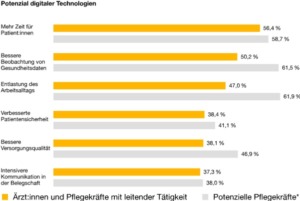
The physical and mental strain in the care sector is increasing. Digital services can make a significant contribution to reducing this burden. They offer the opportunity to relieve nursing staff and doctors and at the same time strengthen the independence of people who are ill or in need of care. According to a Civey survey commissioned by PwC, 62% of potential nurses* and 47% of current doctors surveyed see this potential for reducing the burden of digital services. [1]
*Potential nursing staff: 18-29-year-olds who have completed school in the last three years,
Unemployed people and people interested in nursing care
What do doctors of the "new generation" expect from digital services within medical technology?
Technological progress is advancing rapidly and the "new generation" in particular has been familiar with technology from an early age. Expectations and the demand for digital services are also increasing at work. This is also the case in the medical field. Doctors also expect technical progress with their medtech devices and want digital interaction to simplify processes, preferably as easily and conveniently as possible and in the same way as they are used to on their private smartphones and tablets. Doctors hope that the MedTech device they use will become smarter and smarter and have more capabilities. In other words, continuous optimization and expansion of the capabilities of their MedTech device. Doctors also expect their MedTech devices to function smoothly and reliably. Like any device that is on the network, MedTech devices are also exposed to a high risk of cyberattacks. The risk of being hit by cyberattacks such as viruses, Trojans and spyware must therefore be minimized as much as possible. With regard to the reliable operation of MedTech devices, the question arises "How does support work in the event of malfunctions?" As a user of the MedTech device, I would like to receive quick and easy support in the event of malfunctions or product-related questions.
The aim is to continuously develop high-tech medical devices in medical facilities with little effort and through digital services and to keep them user-friendly, up-to-date, safe and operational.
The expectations of medical technology described above give rise to many use cases - how can these be fulfilled? We look at this in the second part of the blog post.
Sources
[1] [Online]. Available: https://www.pwc.de/de/gesundheitswesen-und-pharma/fachkraeftemangel-im-deutschen-gesundheitswesen-2022.html