Take a look at the first part of our blog series.
It becomes clear that there are parallels to the automotive industry. Here, too, we have gained many years of experience in various customer projects and have recognized that similar use cases already exist and have been implemented by us. This provides the perfect basis for recognizing and implementing use cases in medical technology. A few of these use cases from MedTech are described in more detail below.
Use case 1: Automatic software distribution & security updates
ACTUAL state:
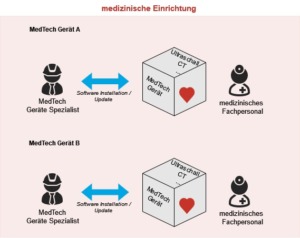
The healthcare professional wants a new function (software) on your MedTech device (installation) or the MedTech device specialist wants to update the existing software (update). Why are updates so important? Updates can be used to close existing security gaps in the system and software. Updates can also be used to carry out updates in the form of subsequent improvements. They therefore not only provide greater security and the elimination of errors, but can also extend the functionality of the software. These improvements include an optimization of the program execution speed, new functions, new design and improved convenience. [2] Security updates are the basis for protection against malware (viruses, Trojans, spyware...) and must be carried out regularly on MedTech devices. The installation of new software and the security updates described above are carried out manually by MedTech device specialists on site. This means that only one MedTech device can be accessed remotely at a time. This leads to high costs and the risk that they cannot keep up with the pace of implementing the latest security measures. This increases the vulnerability of MedTech devices. In order to see the current status of a MedTech device, each device must also be accessed individually and locally.
TARGET state:
How can the capabilities of MedTech devices be continuously optimized and expanded?
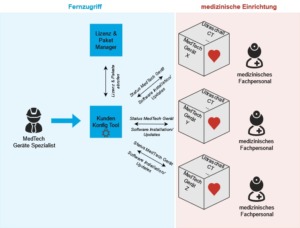
The installation and updating of software modules on the MedTech devices should take place remotely. To eliminate the need for manual installation of the software and improve efficiency. By using a "customer config tool" for installing and updating the software, the installation can be carried out automatically and on several devices simultaneously. In addition, the status (online/offline, functions, installation) of all MedTech devices can be viewed centrally via the tool.
Use case 2: Maintenance
ACTUAL state:
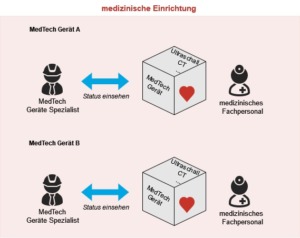
In order to determine the status of a MedTech device and to recognize whether errors/malfunctions are present, the service technician must manually look at each MedTech device individually and on site. After an error/malfunction or missing security updates have been detected, the security update or corresponding software package is manually installed on the MedTech device.
TARGET state
How can MedTech devices be protected and maintained?
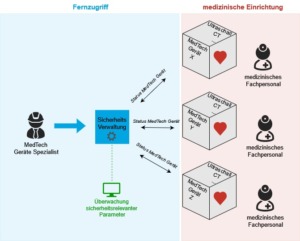
Regular security updates and the monitoring of system-relevant parameters of the MedTech devices can make a significant contribution to protecting the devices and thus guaranteeing reliable operation of the systems. The MedTech device specialist carries out the installation of security updates and management of other security measures remotely and automatically. The security measures include, for example, PKI infrastructure, encryption and secure configuration management. Security updates are installed via a central "security management tool". The MedTech device specialist can access this and carry out the installation on several devices in a controlled manner and simultaneously. This is intended to maintain an optimum level of security on the MedTech devices in the hospitals. In addition, safety-relevant parameters can be monitored centrally for all MedTech devices in order to prevent faults at an early stage and take appropriate corrective action. If errors/malfunctions or missing security updates are detected here, use case 1 comes into effect.
Use case 3: Advanced digital support
ACTUAL state:
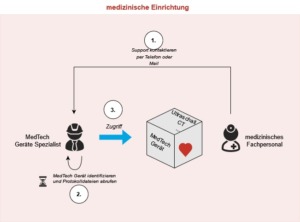
The medical staff contacts the support of the MedTech device specialist in the event of problems / malfunctions with the MedTech device in the hospital. In the event of problems / malfunctions with the MedTech device in the hospital, the support of the MedTech device specialist is contacted by telephone or e-mail. A lengthy process now begins for MedTech Support to identify the system (MedTech device) and retrieve log files. Virtual support is limited to remote desktop sharing plus phone call. In addition, visualization and performance issues sometimes arise during support.
Use case 3: Advanced digital support
TARGET state:
How should support be provided in the event of faults?
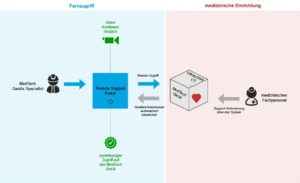
The support team has remote access to the MedTech devices and their status/error messages in the hospital via a portal. This is reliable and easy to use. To be able to help the medical staff effectively. This access should be available on request at any time to provide immediate support to medical professionals with technical or clinical queries. This guarantees maximum uptime. Access to the MedTech device is realized through a "Remote Support Portal". The request from the healthcare professional can be made directly via the system. For example, by clicking on a support button on the display of the MedTech device. In addition, the system information on the MedTech device in question is transmitted directly to the MedTech device specialist for support requests in order to simplify and speed up device identification and diagnosis.
What benefits does the use of digital services bring for medical facilities?
In order to achieve the best possible benefit from digital services, a number of points should be taken into account. These include technical aspects of digital services such as availability, user-friendliness, quality, data protection and security. However, aspects within the medical facility are also of great importance for the effective use of digital services. The introduction of digital services should be lived and communicated by top management. Depending on the company, a change in corporate culture and cooperation as well as good communication would be helpful. With the right use of digital services, medical facilities can not only be supported, but also benefit from a business perspective. [3]
 | Treatment quality can be improved
|
 | Process efficiency can be increased
|
 | Utilization of medical professionals can be reduced
|
 | Costs can be reduced
|
These benefits are the result of a 2018 study by Rochus Mummert Healthcare Consulting GmbH [5]
The use of digital services within medical technology can achieve the following, among other things: MedTech devices are constantly being further developed and their functions optimized, and the safety and support of MedTech devices are improved. Digital and user-friendly interaction with MedTech devices meets the requirements of the "new generation" of technology and relieves the burden on medical professionals. With the right partner at their side, hospitals and other medical facilities can use digital services not only to improve the quality of treatment and diagnostics for people, but also to improve process efficiency. It is clear that there are many more potential applications for advancing medical technology and supporting medical staff in their work. In other words, the potential of software, networking and digital services in medical technology is there, but it is far from exhausted.
Do you also work with medical technology devices? Perhaps you notice situations,
where your work can be improved by digital services and you are thus relieved. Or would you like to find out more about how digital services can optimize your MedTech devices? Feel free to contact us at doubleSlash.
Optimally orchestrate, optimize and manage medical technology devices
Sources
[1] [Online]. Available: https://www.pwc.de/de/gesundheitswesen-und-pharma/fachkraeftemangel-im-deutschen-gesundheitswesen-2022.html
[2] [Online]. Available: https://www.seo-analyse.com/seo-lexikon/u/update/
[3] [Online]. Available: https://www.johner-institut.de/blog/gesundheitswesen/digitale-transformation/
[4] [Online]. Available: https://digital-magazin.de/die-digitalisierung-in-der-medizintechnik/
[5] Rochus Mummert Study 2018, Copyright: Rochus Mummert Healthcare Consulting Gmb