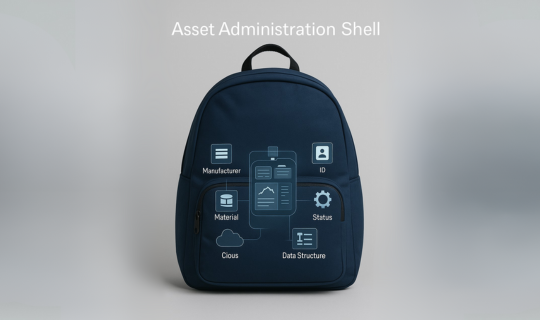
Imagine you have a favorite backpack. How would you describe it digitally so that everyone understands what it is and what it can do? Photos don't show everything. What about color, material or the actual contents?
This is where the administration shell (VWS), also known as the asset administration shell (AAS), comes into play. It is like a digital ID card or a digital information folder for something. Whether it's a sensor, a machine in a digital factory or your backpack - the administration shell collects all the important information about it.
What is inside such a "digital ID card"?
For the backpack, for example, we would make a deposit:
- Name: Backpack "Adventurousness"
- Manufacturer: Wanderfreunde GmbH
- Color: Deep blue
- Current content (optional): Laptop, lunch box (this information could be constantly updated).
The administration shell is therefore not the thing itself, but the digital description of it. It tells other systems or people: "Hey, this is my backpack, and these are its properties!"
Why do we need such a "digital ID card"?
Why the effort? Quite simply:
- Everything at a glance: In an Industry 4.0 production environment with hundreds of machines, it is otherwise difficult to maintain an overview. When was which machine serviced? Which parts does it need? The administration shell makes this information easily accessible.
- Better communication: Machines and software systems can "talk to each other" via the asset administration shell. They exchange information automatically - this simplifies processes enormously.
- Versatility: Regardless of whether it is a simple object or a complex system - the principle of the asset administration shell remains the same. It is a universal concept for describing things digitally - a central building block in the (I)IoT.
Differentiation from the digital twin
A digital twin is a living, digital copy of an object that synchronizes with the real object in real time. If you put a new lunch box in the real backpack, the digital twin knows immediately.
The administration shell is the ID card for this digital twin. It is the structure and the framework that organizes and provides all the information of the digital twin. Without it, the digital twin remains a pile of unsorted data.
You could say that the digital twin is the complete digital image of an object. The administration shell is the "blackboard" or "information system" on which the most important data of this digital twin is clearly displayed so that other systems and people can work with it. This makes using the digital twin child's play because the relevant information is clearly structured.
Who defines the administration shell? Is this an established standard?
The asset administration shell is an established and constantly evolving standard that is mainly being driven forward in Germany and Europe. The definition and further development is carried out by the Industry 4.0 platform (an initiative of the German government) and important associations and organizations such as the VDMA (German Engineering Federation).
The concept is part of the Industry 4.0 reference architecture model (RAMI 4.0).
The specifications define, among other things:
- How an administration shell must be structured: What information it may contain and in what format (the so-called metamodel).
- How to access the information: Which communication channels and interfaces are used so that systems can read or write data from an asset administration shell (APIs).
The aim is to create an interoperable (i.e. "talking to each other") environment in which products, machines and factories can communicate digitally - regardless of the manufacturer.
Does every (I)IoT project need to address this specification?
The use of the asset administration shell is particularly relevant and valuable in scenarios where:
- cross-manufacturer and cross-sector communication is necessary: When different machines or products from different manufacturers need to "talk" to each other or exchange data.
- A long life cycle of the product is relevant: If information about a product is to be consistently documented and accessible from manufacture through operation to maintenance and disposal.
- Digital twins can be implemented in Industry 4.0: Here, the asset administration shell is the backbone for the standardized description of the components.
- Complex systems or processes can be digitally mapped: To maintain an overview and simplify interaction.
Example:
- If you have a simple smart home project where only a few devices of the same brand are controlled via an app, the administration shell is probably not necessary. The manufacturer has usually created its own, simpler communication channels for this.
- However, if you want to connect a new machine from manufacturer A to an existing system from manufacturer B in a production hall and evaluate their status data centrally, then the asset administration shell really comes into its own. It ensures that the machine from manufacturer A offers its data in a format that the system from manufacturer B and the central control system understand, even if they were never designed to work directly with each other.
In short, the AAS is a key concept of Industry 4.0 - a powerful tool for interoperability, efficiency and sustainability in the digital factory. Not every small IoT project requires its full range of functions, but it is increasingly becoming the standard of choice for networking across company and system boundaries.l.