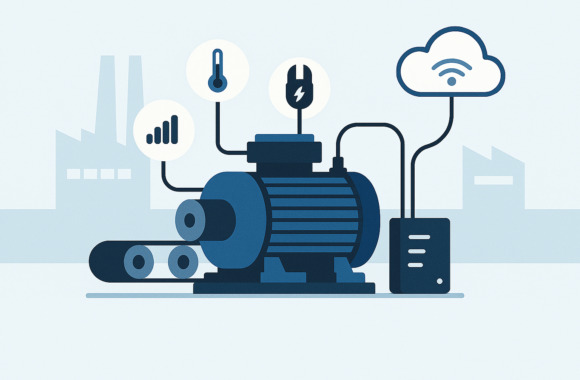


"We let ourselves be helped until we are stupid" is the wording of an article by Gunter Dueck that appeared in the FAZ in November. He takes a critical look at how companies are dealing with the challenges of digitalization. One of them is not to be passive, but to proactively seize the opportunities that increasing networking and digitization offer for your own company. One such opportunity created by networking and data analysis is the business model of proactive maintenance - Predictive maintenance. This means that potential defects and patterns can be identified at an early stage by continuously analyzing the machine data. A machine is serviced even before it breaks down. This saves costs and also opens up opportunities for new business models.
But:
What opportunities does predictive maintenance bring for your own business?
Which technology should form the basis for the new solution?
What best practices are there and how can they be sensibly adapted?
We are addressing these questions at the this year's IoT Expert Talk at our Munich branch together with our customers and dialog partners.
Does it make sense to use predictive maintenance in my company? Our business case template will help you answer the relevant questions. Download now
Innovative with predictive maintenance
A good distinction between Preventive maintenance and predictive maintenance, our speaker Stephan Pepersack from Microsoft Deutschland GmbH formulated in his presentation. What many companies are already implementing today is preventive maintenance. It is based on the Knowledge of the average consumption, wear and tear or service life of a part or product. Based on these average values, a corresponding service is scheduled - without knowing whether the service is actually necessary or which part may need to be replaced. A classic example is the maintenance light on a car after a certain number of kilometers driven.
Predictive maintenance on the other hand closes Real-time environmental factors and the behavior of the product in the application is included. Algorithms and patterns are derived from this to enable predictive maintenance.
Predictive maintenance in the cloud
Dr. Florian Plentinger gave an insight into predictive maintenance at the MAN Turbo & Diesel SEa subgroup of MAN SE and a leading manufacturer of marine engines. His approach: first and foremost, predictive maintenance involves Understand what makes the customer tick. In his case, he is usually interested in the entire ship, not just the engine. Networking enables precisely this Integration into a larger ecosystem. This is also shown by a look at the IoT maturity level of a company: The further networking progresses, the more optimization potential there is.
Here, too, the art lies in the Interpretation of the data. IoT merely enables the product or machine to send or receive data. But only when it becomes information can knowledge be generated from it and the right measures derived. One challenge here is to Period between the data collection and the action that follows should be kept as short as possible. This is because even within just one day, a small damage to a ship's engine that could have been easily repaired can increase to several hundred thousand dollars.
The use of predictive maintenance in turn provides knowledge about when, for example, a certain component of the machine will break down. Countermeasures can then be taken accordingly. Predictive maintenance increases the speed of response and action enormously.
Predictive maintenance is therefore the Enabler for new business models such as pay per useas this ensures high machine availability and running time.
Predictive maintenance: not hype, but essential for customer satisfaction
Stephan Pepersack from Microsoft started his presentation with an interesting study by Bain. It found that 80 percent of companies are convinced that they offer their customers good service. However, if you ask the customers, the answer is shockingly different. Here, only 8 percent consider the service to be good. This strong deviation clearly shows how great the Potential in aftersales are.
An equally interesting insight: Good service is characterized by the fact that it saves the customer time and effort. And this is exactly where predictive maintenance comes in: The aim is to be able to show up at the customer's premises with the right tool and the right spare part at the right time.
His learning: Predictive maintenance is not just the hype of recent years, but essential for customer satisfaction.
Pepersack also provided the key points of a Value Propositionwhich should be at the end of a planned predictive maintenance project:
- Reduction of planned maintenance thanks to real-time analysis and alerts from sensor data.
- Shorter maintenance and repairsas the service technicians are already familiar with the problem and know how to fix it.
- Fewer SLA offensesas the machines have a higher availability and therefore cause fewer penalties.
- Fewer calls to the hotlinesbecause the better availability leads to fewer complaints.
- Replacement and repair on Warranty
As a result, this leads to more customer loyalty. Because satisfied customers stay and don't churn.
Microsoft understands itself here with the Azure cloud platform as an enabler for offering predictive maintenance services and making them usable for customers. There are also specific projects between Microsoft and doubleSlash as integration partners.
More about the partnership with Microsoft
Dr. Dietmar Tilch, Director Industrial Technology - Condition Monitoring Systems at ZF Industrieantriebe Witten GmbH showed in his presentation why it is worthwhile for component manufacturers to enter the field of predictive maintenance.
At his Example of wind turbines It becomes clear: maintenance or breakdowns are extremely time-consuming and costly in this case. A technician has to climb up the wind turbine just to identify the problem, which involves considerable effort. In addition, there is a high time investment for traveling to and from the site, as wind farms are usually located in remote areas.
The networking of the turbine creates enormous added value here. The collected data can be used in particular to Predictions on the behavior of the wind turbine gearbox are made. On the one hand, this means knowing in advance which part needs to be replaced in the event of damage. On the other hand, the inclusion of behavioural and environmental information such as temperature, wind and load enables proactive intervention to actively prevent damage, e.g. by optimizing operating conditions to prevent overloads.
The Networking enables remote monitoringso that the service technician only has to climb onto the wind turbine to replace or repair a part in the event of actual maintenance or damage.
The potential of predictive maintenance is expanded when a Feedback of findings into further product development takes place and the data is used to Optimal control of the wind farm so that the wind turbine only ever runs up to an acceptable stress level. In this way, the performance, reliability and service life of the main components can be increased and unscheduled maintenance can be avoided.
ZF is thus taking on a pioneering role in predictive maintenance.
Tilch is convinced: Condition monitoring is just the beginning - the supreme discipline is predictive maintenance. The ingredients for this are Domain knowledge for interpreting the data and a instruments with which analyses can provide the broadest possible benefit. can unfold. Here we offer Cloud-based solutions numerous advantages. In addition to our own expertise, cloud solutions can be intelligently combined with partners to create a complete solution. larger "ecosystem" expand.
One thing became very clear from the presentations: art, Turning data into informationis the basis for predictive maintenance. With their lightning talk "Strategies on the way to becoming a "data-driven" company in a networked ecosystem", our colleagues Marc Mai, Markus Beller and Walter Melcher showed how big data becomes smart data, i.e. data from which value is created.
Companies' databases harbor great potential - also with regard to predictive maintenance. The only problem is that companies are often unaware of this:
- ...which data they have in detail
- ...where this data is stored
- ...the quality of the data and how up-to-date it is
- ...who owns the data and
- ...who accesses the data
In order to realize this potential, a Data strategy. For doubleSlash, there are two approaches with which the data potential can be developed: Either from the data to the use case (bottom up) or via the use case to the data (top down).
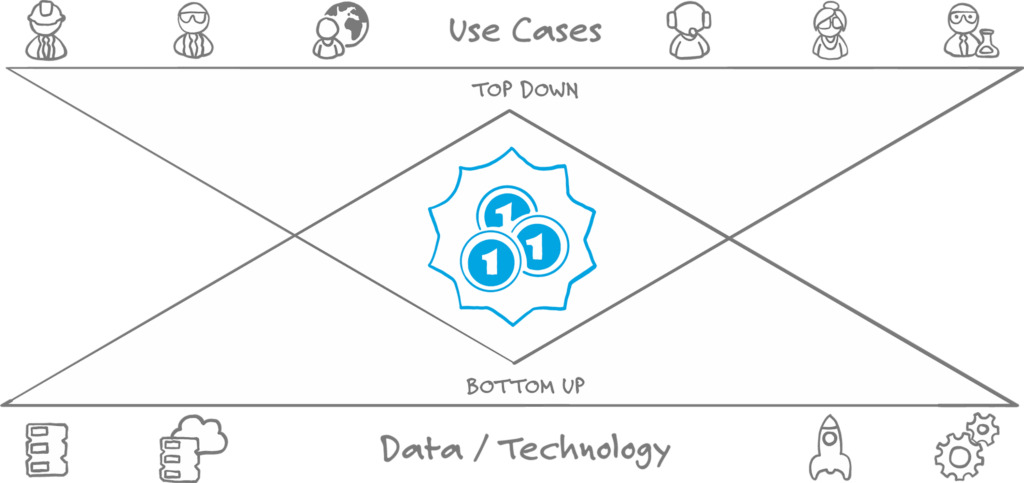
At the Bottom up approachwhich is the simpler one for many companies, the focus is on the existing data:
- What data pools are there in the company?
- What technical data is stored there?
- What is the technical quality of the data per data set?
- What professional data can the technical data be summarized into?
At the Top down approach the questions come from the technical side:
- Which requesters are there in the company?
- What are the requesters' use cases?
- What technical data is required for each use case?
Once a picture has emerged of how data supply and demand interact, it becomes interesting, because gaps can be filled by Enriching external data from the digital ecosystemi.e. other companies.
In a car, for example, this could be the display of weather data in the vehicle. The data from an external weather provider is integrated and, together with the vehicle's (own) position data, ensures that the weather forecast can be displayed at the relevant location.
The model goes one step further when companies become aware of what data they have and how this could be used by other companies to offer new services and added value for customers. One example of this is BMW CarData - a business model that enables third-party providers such as workshops or insurance companies to offer customized services. This is how BMW made the transition from data requester to data provider via its own data platform.
Platforms such as Strava, a social network for cyclists, which now provides processed tracking data for the design of future city models, show how smart data can expand or change business models. Another example is ChargeNow, BMW's charging service. After integrating numerous charging infrastructure operators, the company has decided to participate in the digital ecosystem and announced that it will also offer the service to other car manufacturers. The advantages: More revenue through more customers, faster scaling of the platform and stronger positioning of the brand name.
These examples show: If you want to create success from data, you should Rethinking the market and the competition, knowing the value provided by its data and using existing platforms.
In this way, the path from big data to smart data can be completed in 3 steps:
- Getting to know your own data world
- Getting to know the digital ecosystem and
- get to know the customer anew.
Find out more about predictive maintenance