"What is networked today must act intelligently tomorrow" - the Internet of Things (IoT) has long been part of our everyday lives. Whether in production, in buildings or in the field: networked systems are changing our world. But what is considered "state of the art" today may be outdated tomorrow. For companies, the question is not just whether IoT should be used, but how it should be used strategically to create real competitive advantages.
From projects at doubleSlash, current market observations and the Gartner Hype Cycle, we have identified five developments that are not only technologically, but also commercially decisive.
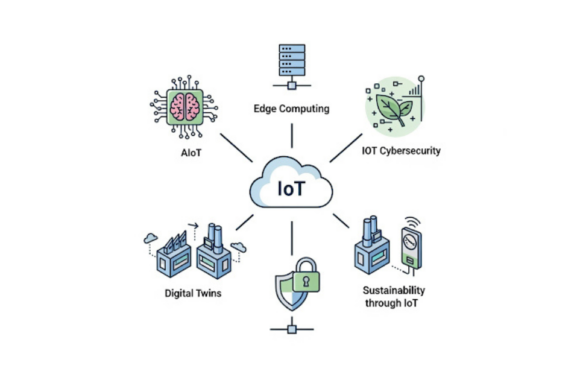
1. what does AIoT mean and why is it becoming the new standard?
Gartner classification: Slope of Enlightenment
AIoT stands for the intelligent further development of networked devices - machines, sensors or gateways that make decisions and learn independently. What used to be a buzzword is now a business reality.
What does that mean?
Instead of simply recording data, machines will in future analyze their operating data independently, detect irregularities and initiate measures before an error even occurs.
In practice:
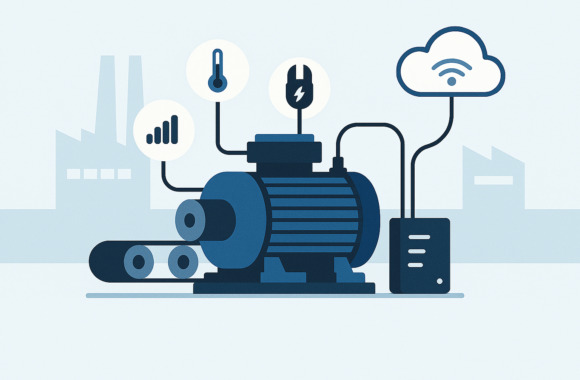
In a customer project with a southern German machine manufacturer, a sensor automatically detects minimal vibration deviations in a drive and automatically initiates maintenance long before a failure is imminent.
Core benefit:
- Proactively avoid failures
- More efficient processes
- Increase productivity without any manual intervention
2 Why is edge computing indispensable now?
Gartner classification: Early Mainstream / Plateau of Productivity
When real time counts, the classic cloud reaches its limits. Edge computing provides a remedy: data is evaluated directly where it is generated - on the machine, on the device.
This saves bandwidth, reduces delays and increases data protection, as sensitive information is not transmitted over long distances.
For decision-makers, this means that edge computing is no longer an option, but the basis for high-performance IoT solutions.
In practice:
At one medical technology customer, device data was initially transferred completely to the cloud - with high costs and delays. Through on-the-edge data parsing raw data could be filtered directly on the device and only condensed information forwarded. This noticeably reduced the load on the cloud, improved response times and lowered operating costs while simultaneously increasing data security.
Core benefit:
- Lower cloud operating costs
- More efficient data processing
3. cyber security: trust is the new currency
Gartner classification: Trough of Disillusionment → Slope of Enlightenment
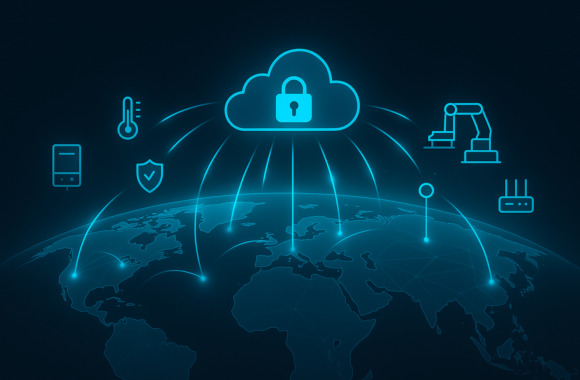
As connectivity increases, so does the risk, especially in sensitive areas such as medical technology, energy supply and industrial manufacturing. IoT cybersecurity is therefore not an IT issue, but a risk management issue.
Modern security architectures rely on:
- Certificates
- Encryption at device level
- AI-based attack detection in real time
If you want to create trust in digital business models, you have to think about security - right from the start.
In practice:
When setting up a remote access solution for a machine and plant manufacturer, we paid particular attention to secure certificate management with the integration of a PKI. This ensured both device authentication and the protection of sensitive production data - a key building block for trust in the digital solution.
Core benefit:
- High security
- Efficient maintenance
- Simple scalability
4 Digital twins: the key to transparency
Gartner classification: Slope of Enlightenment
What used to be a production line is now a digital shadow of itself. Digital twins make complex systems visible, simulatable and controllable - a huge advantage for planning, operation and optimization.
Whether production, logistics or energy management:
Digital twins allow processes to be simulated, standardized and better integrated.
In practice:
We consistently rely on digital twins in our customer projects. Especially when it comes to modelling and standardizing device properties or components. This not only facilitates operation, but also integration into 3rd party systems. Digital twins are also the ideal basis for a well thought-out monetization strategy.
Core benefit:
- Logical image of physical devices
- Simulation of virtual products
- Sustainable product development
5 How can IoT make sustainability measurable?
Gartner classification: Innovation Trigger → Peak of Inflated Expectations
IoT is increasingly becoming an enabler for sustainable business. Whether for intelligent energy management, precise irrigation in agriculture or the monitoring of environmental parameters - networked systems help to use resources efficiently and responsibly.
For companies, this means that IoT can be used to implement specific ESG goals in a measurable and transparent way - an important building block in any sustainability strategy.
An example from practice:
OneSolar networks around 45 solar parks with IoT SIM cards from Vodafone, saving 8-10 % of technician deployments, which saves around 0.9-1.1 tons of CO₂ annually1.
Conclusion: You should ask yourself these questions today
How does your IoT approach contribute to strategic goals?
Where can efficiency be increased, where can safety be improved, where can sustainability be promoted?
IoT is not an end in itself. True value is only created when technology contributes to strategic business goals, whether through increased efficiency, new services or sustainable transformation.
Take advantage of these five trends and make your company fit for the future. With the strategic use of IoT, you can secure competitive advantages, develop new business models and remain innovative.
And this is precisely where we at doubleSlash provide support with scalable solutions along the entire value chain.
Fancy more? Discover the IoT portfolio from doubleSlash. With practical use cases and real end-to-end expertise for your business.