- How do you win customers in an industry that is developing rapidly?
- How do I ensure that my existing customers remain loyal and increase sales at the same time?
- How can I promote new offers more effectively?
One possible answer to these and similar challenges is to create incentives - be it in the form of vouchers, discounts or other benefits. This article deals with the strategic and operational aspects of vouchers specifically in the context of electromobility. Vouchers are one of the most effective digital incentive systems that are actively shaping the future of electromobility.
Note: There are various terms, such as voucher, promotion, incentive and benefit. Depending on what kind of incentives are involved. In this article, we use the term "voucher" as a collective term.
Vouchers: A key to success in subscription management
Vouchers can fulfill a variety of strategic purposes. However, the introduction of digital incentive systems should be well thought out and have clear objectives. Here are some of the most important areas of application:
- Customer acquisition
Vouchers lower the inhibition threshold for potential customers to try out new offers and are therefore an effective means of attracting new customers and encouraging their first interaction with a company. - Customer loyalty
In a world where customer loyalty is crucial, well-placed vouchers can make the difference between a one-time customer and a loyal one. Through customized offers, such as discount vouchers on recurring base fees, companies can strengthen the bond with existing customers. - Increase activity rate
Customer interactions can be intensified with time-limited promotions and discounts. This not only leads to an increase in sales, but also increases customer satisfaction. - Cross-selling and up-selling
Targeted campaigns can be used to motivate customers to use additional services or book higher-value subscriptions.
Classification in the offer-to-cash process
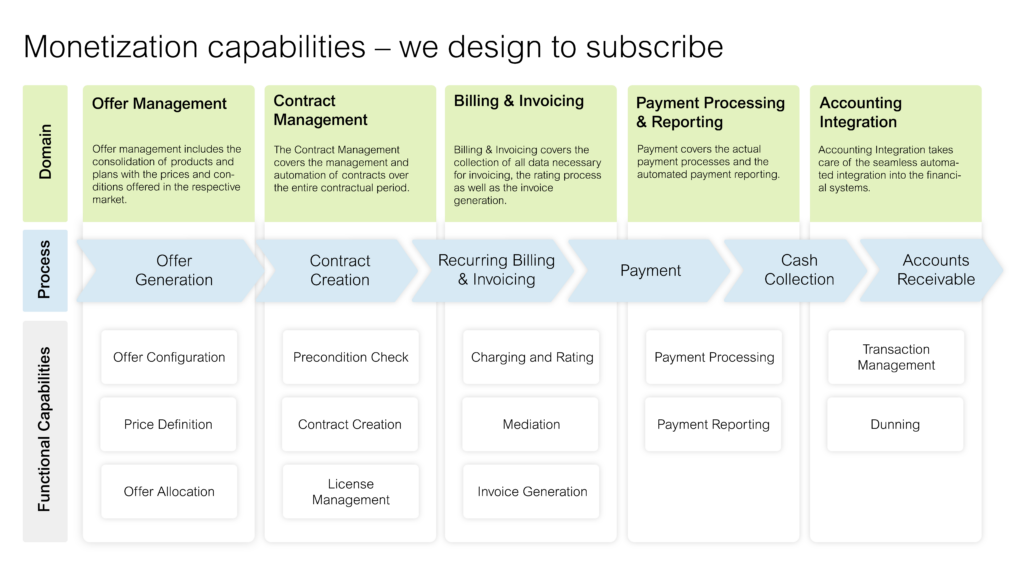
If you decide to offer vouchers, this must be taken into account throughout the entire offer-to-cash process. A well thought-out use of vouchers optimizes the customer journey and ensures lasting customer satisfaction.
For more details on the Offer-To-Cash process, please take a look at the following article:
Efficient scaling in the e-mobility sector
Offer management
Right at the beginning of the offer-to-cash process, the question of customer-specific offers arises in offer management. This is where the foundations for the use of vouchers are laid.
Key aspects
- Target definition: What should be achieved with the vouchers (e.g. new customer acquisition, customer loyalty, ...)
- Voucher types: The types of vouchers to be offered depend on the defined objective. Examples:
- Monetary or percentage discounts on charging sessions
- Waiver of an activation fee (one-off) for a charging service
- Waiver of a basic fee (recurring) for a charging service
- Free charging sessions for a specific period
- Combinability: Clear rules must be defined as to whether and how several vouchers (of the same or different types) can be combined on one contract.
- Configuration options: What restrictions apply to vouchers? Examples:
- Validity limited to a specific period, day, time of day, ...
- Only applicable to a specific CPO
- Only applicable in Germany or also outside
- Processes for voucher setup: It is crucial that clear processes are established to ensure a smooth implementation. These include:
- Applicant and recipient: Who initiates the voucher setup process and who is responsible for its implementation?
- Application information: What data is required for such an application? How is this information collected?
- Steps between application and setup: Commercial, legal and tax aspects must be taken into account
- Implementation: Who carries out the setup process?
- Error and change management: What steps need to be taken if subsequent changes or corrections are necessary?
- Test and presentation: Once the setup is complete, the voucher should be tested and then presented to the target group. Typical measures are
- Text changes on websites to clearly communicate the voucher and its conditions.
- Creation of marketing materials tailored to the target group.
Technical implementation
The decision as to whether voucher management is developed internally or implemented by a third-party tool is central to the effectiveness of a digital incentive system. Depending on how you decide, there are Advantages and disadvantages that need to be considered.
Contract management
Contract management determines how vouchers are applied to contracts and how changes are handled during the contract term.
Key aspects
- Redemption of vouchers: Redeeming vouchers influences how products or services are ordered.
- Customer-controlled: Customers redeem vouchers themselves, e.g. by entering a code → How does the customer receive the vouchers and how exactly can the customer redeem them?
- System-controlled: vouchers are applied automatically based on defined rules → How are vouchers redeemed and on the basis of which criteria?
- Contract amendments: It is important to define scenarios for dealing with vouchers in the event of contract changes
- Tariff change (if offered): What happens to remaining credit when I switch?
- Contract transfer: Can remaining credit be transferred to a new contract?
- Customer transparency: Customers should be informed at all times about redeemed vouchers and their current values, e.g. via a customer portal or by email. The impact of the voucher on the use/purchase of a product or service should also be communicated. Example: A customer has a voucher worth €100 for charging sessions. When displaying the current prices in an app, the voucher should be taken into account directly so that the customer knows what amount they actually have to pay.
- Dealing with customer support cases: A smooth handling of customer support cases is crucial to ensure customer satisfaction and avoid potential frustration. This should be clarified in advance:
- What information do support agents need to be able to help effectively? Examples are
- Redeemed and remaining vouchers of a customer.
- Validity periods and restrictions.
- Combination rules that apply to the contract.
- What rights and powers do support agents have? Possible scenarios are
- Extension of the validity of a voucher.
- Reissue of a voucher in the event of technical problems or redemption errors.
- Refunds or goodwill solutions in the event of incorrect calculations.
- What information do support agents need to be able to help effectively? Examples are
By defining these processes at an early stage and providing the necessary tools, support agents can work efficiently and in a customer-oriented manner.

Billing and invoicing
Billing and invoicing are key components to ensure that vouchers are correctly accounted for.
Key aspects
- Price calculation: Before the invoice can be issued to the customer, the price must be calculated. Depending on the type of voucher, it will be taken into account at an earlier or later date. Example:
- An eMobility service provider that has to carry out usage-based billing of charging processes can, for example, include the price calculation based on the tariff and potential discounts in its own added value or leave this to the billing system. Depending on the type of voucher selected, certain vouchers must also be taken into account during the billing run itself. A voucher that waives a basic tariff fee only affects the total bill, not individual items such as charging processes. A voucher that provides a discount on a charging process must be taken into account directly when calculating the price of the process.
- Invoice presentation: Consideration of vouchers when showing them on the invoice.
- Invoice corrections: For example, how are credit notes handled if a payment has been made (in part or in full) using a voucher? (Re-issue of a voucher, refund in cash, ...)
Reporting
Finally, the effectiveness of the voucher campaigns should also be continuously monitored in order to derive data-driven measures. Dashboards and detailed evaluations help to make data-based decisions.
Important KPIs are:
- Number of vouchers redeemed.
- Increased sales through vouchers.
- Costs of the campaign in relation to the sales generated.
Financial accounting
Vouchers also have an impact on financial accounting, particularly with regard to sales and income reductions, provisions and the different accounting treatment of voucher types. It must be taken into account whether the vouchers are single-purpose vouchers (subject to VAT when issued) or multi-purpose vouchers (subject to VAT when redeemed) and whether the voucher has already been redeemed or is still to be recognized as a liability in the balance sheet.
Conclusion: use vouchers strategically
Vouchers are not just a means to an end, but a crucial component in preparing companies for the future of electromobility. They offer the opportunity to sustainably strengthen customer relationships and exploit the full potential of modern technologies. However, successful implementation requires well thought-out integration into the overall offer-to-cash process and a clear strategic direction.
Our expertise: With many years of experience in electromobility and monetization, we are at your side to jointly develop an effective voucher strategy - from planning to successful implementation, both procedurally and technically. Let's achieve your company's goals together!