
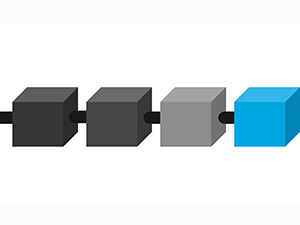
Blockchain was launched in August 2016 as disruptive technology in the Gartner Hype Cycle published - a Platform revolutionwhich creates completely new business models that companies have to adapt to. The principle of blockchain seems simple. Virginia Rometty, CEO IBM, summarizes the most important points in her quote:
"Blockchain offers a way to track items or transactions using a shared digital "ledger".
Blocks of new transactions are added at the end of the chain, and encryption ensures that it remains unbroken - tamper-proof and error-free."
1. Shared digital ledgerA distributed general ledger that makes transactions transparent and traceable.
2. Blocks: Blocks chained together that contain transactions.
3. New transactionsNew transactions that are added to the end of the chain in a block.
4. EncryptionEncryption technology that ensures that the chain is never broken - tamper-proof and error-free.
So how exactly does it work?
Introduction to the Bitcoin blockchain
The concept of Blockchain as a distributed database was first described by Satoshi Nakamoto in his white paper on Bitcoin in 2008. The following year, he published the first implementation of the Bitcoin software and thereby launched the first publicly distributed blockchain. Today - eight years later - more than 16 million Bitcoins worth over 15 billion dollars are in circulation.
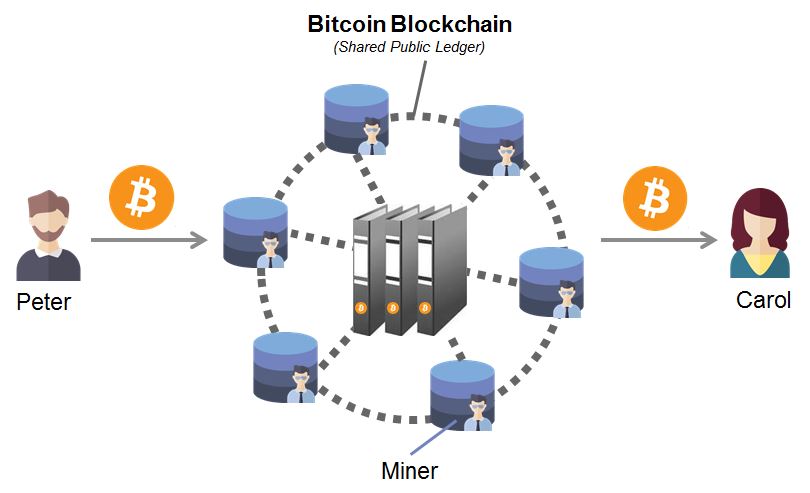
The Bitcoin payment system consists of a decentralized databasein which all transactions are recorded and the Bitcoin protocolwith which the participants manage the database.
Peter and Carol act as sender and receiver Bitcoin transactions. The Bitcoin blockchain is the public ledger that contains all transactions and is distributed across all network nodes. This means that all participants in the network have the same information and requirementsto participate in the system and add new information. The so-called Miner operate and secure the Bitcoin network by aggregating and validating multiple transactions. How exactly they do this is explained below.
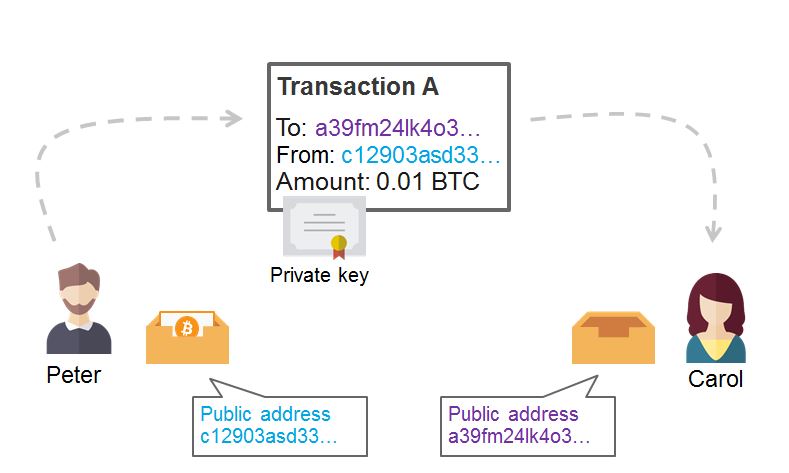
Bitcoin accounts are each addressed via a public address. A Bitcoin transaction requires:
- Public address of the sender account
- Private key to this public address to sign transactions from this account
- Transfer amount
- Public address of the recipient account
Information on such as card numbers, names or addresses must in this case be not disclosed become. Participants also process their transactions without an expensive intermediary.
Newly initiated transactions are entered into the Blockchain knitted in. To this end, the miners summarize transactions and attempt to create a to create a new blockwhich is appended to the end of the previous chain. In the case of the Bitcoin blockchain, the creation of the new block consists of solving a cryptographic task in which, among other things, the Hash function SHA256 is applied.
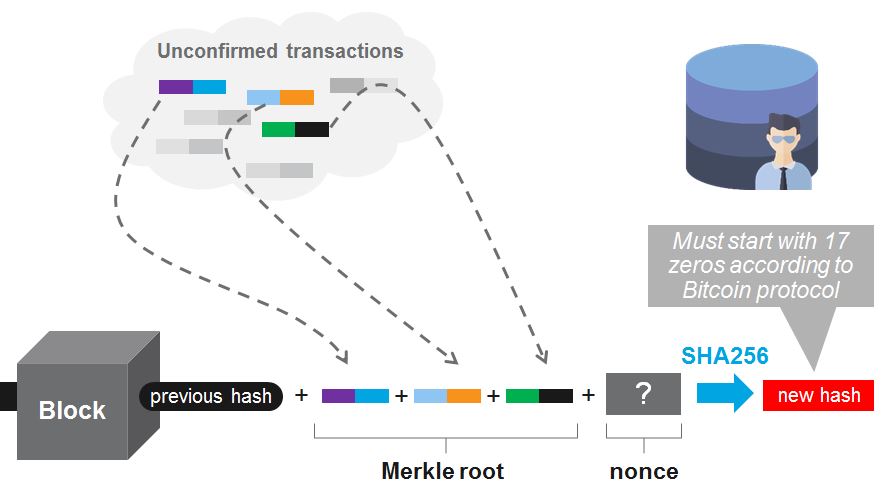
According to the Bitcoin protocol, the output of the function must be a new hash in which the first 17 bits are filled with zeros (see Figure 3). The following serve as input three sizes:
- Previous hash (256 bit): most recent block of the blockchain as a connection point.
- Merkle RootPairwise hashing of the transactions to be woven through a hash tree / Merkle tree. The last hash value is the root hash / Merkle root.
- Noncefreely selectable value to ensure that a solution can be found.
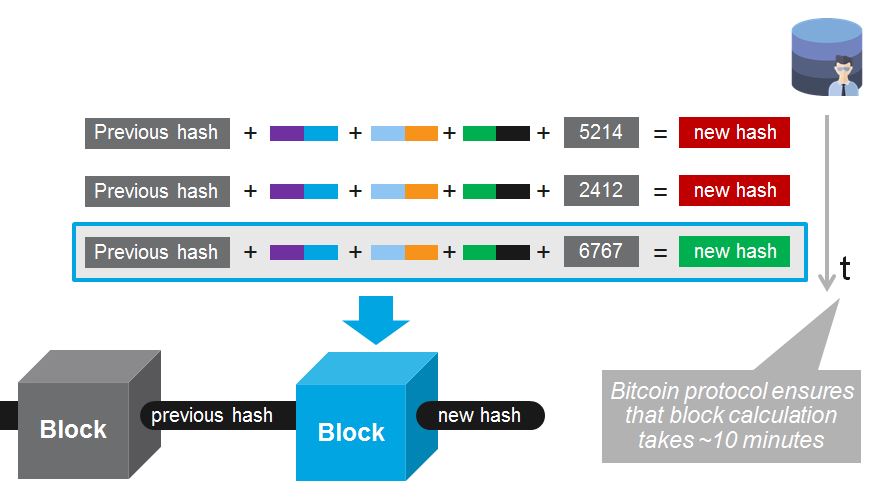
To find the new hash, which begins with 17 zeros, there is no way around doing a lot of work, trying it out again and again and exchanging the nonce. This The computationally intensive consensus procedure is therefore called "Proof-of-Work" (PoW). called.
The miner that generates the new hash first publishes the block to all other network participants. The block is verified by all computers and added to the chain. The "new hash" now serves as Starting point for creating the next block. The consecutive storage of data in a blockchain means that this data can be not subsequently changed without damaging the integrity of the overall system. This ensures the Data manipulation made considerably more difficult. The decentralized consensus mechanism replaces the need for a trustworthy third party to confirm the integrity of transactions. On average, an attacker would have to spend more computing time than all honest Bitcoin participants combined to falsify the proof-of-work.
Miners are rewarded for maintaining the network by providing computing power and creating new blocks. The miner who creates the next block first receives a protocol-defined reward of currently 12.5 Bitcoin.
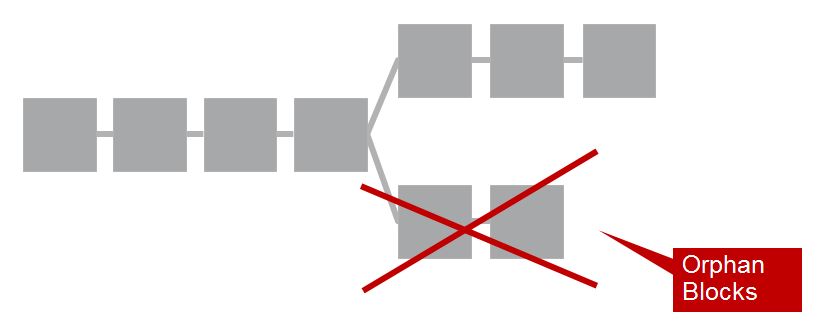
When creating a new block, it is not uncommon for the effect that several blocks found at the same time become. The blockchain branches out and then has several possible continuations that compete with each other - a so-called Fork is available. As there is no central authority to act as an arbitrator, the network decides by simple majority: The block with the most supporters finally prevails.
The longest chain is accepted because it has the majority of participants and the greatest computing effort (PoW).
After four to six confirmations, the transaction is part of the "eternal" blockchain
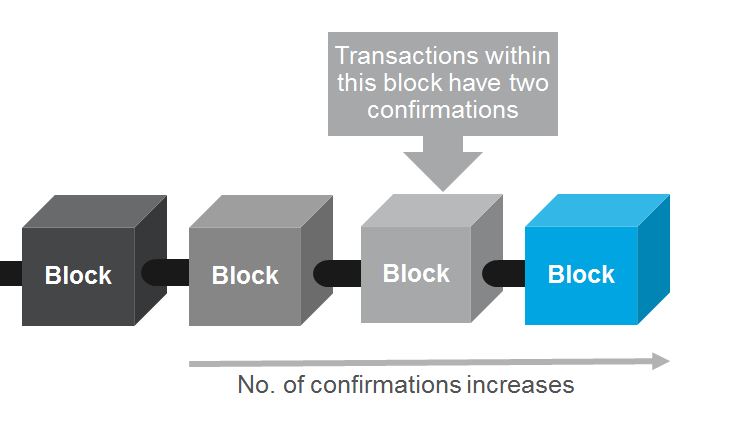
The Confirmation of a transaction takes as long as the creation of a new block - i.e. around 10 minutes according to the Bitcoin protocol. In practice, many users assume that the transaction is usually completed after four to six confirmations (the number of attached blocks is counted here), i.e. after approximately one hour. Part of the "eternal" blockchain has become. However, this is not certain in individual cases: if, for example, a Network-related disruption of data communication If there is no blockchain, the systems isolated to a network region continue the calculation and inevitably generate their own continuation of the blockchain until a new connection with the rest of the Bitcoin network is established. Something similar can happen when a Software update has only been imported on some of the computers. In both cases, a large number of blocks, including the transactions they contain, must be discarded.
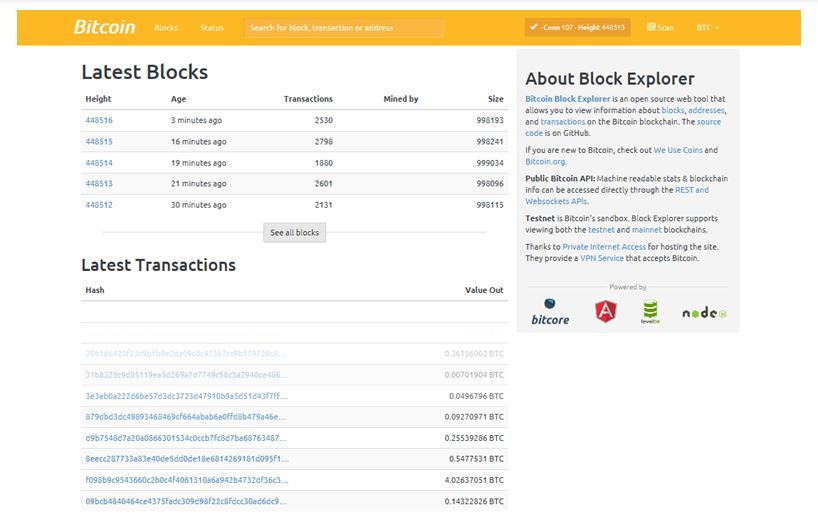
The complete Bitcoin chain can be accessed at https://blockexplorer.com/. The "Previous Hash" of the previous block, the "Merkle Tree" and the "Nonce" are also publicly available there, which can be used to determine the Hash value of the current block can be recalculated.
The blockchain embodies
- a distributed database with multiple nodes
- Chained blocks that contain transactions
- the creation of new blocks via a consensus procedure (e.g. PoW)
- the immutability of the data records
and thus pursues an approach that decentralized confidence building.
Is it now time to proclaim blockchain as the new database paradigm? Perhaps in certain use cases. The blockchain is a Basic technology and a Platform for innovationwhose value will crystallize in the future. You should invest primarily in the Understanding the technologyto be ready when several viable Blockchain ledger will emerge. Smart contracts that are based on the blockchain and ensure their own compliance could be just the start of something really big. More on this shortly.
Does blockchain suit my business? Learn more here
Sources:
- Avatar Icons made by Freepik published from Flaticon
- Database Icon made by Madebyoliver from Flaticon
- Diploma Icon made by Freepik published from Flaticon