

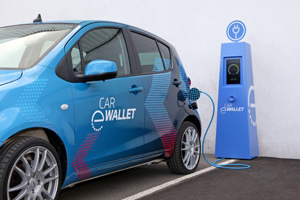
Autonomous driving itself is no longer a novelty, even if it has not yet been rolled out in practice in road traffic - the autonomous vehicle, on the other hand, goes a significant step further. With the help of digital assistants, the vehicle becomes truly autonomous completely independently of the driver - from parking to secure payment. With the Car eWallet, ZF shows how this can be achieved.
ZF has teamed up with technology partners IBM and UBS to shape the future of Development of autonomous vehicles to make a decisive impact. In today's digitally networked world, the trend is moving further and further away from individual players towards Networks and connected ecosystemssuch as car sharing, which are open and scalable.
The Car eWallet is a digital assistant that is firmly anchored in the car and ensures that bequem, secure and flexible payment processes for all aspects of vehicle use can be carried out without requiring the driver. In addition, use cases such as opening and locking doors or complete documentation of the vehicle history (e.g. mileage, owner) are also possible via the Car Pass.
Developed by IBM, the Blockchain technology - Hyperledger technology fabric - forms the technological basis here. In a fixed network, information from the participants (vehicles and service providers in this case) is stored in a trustworthy and unchangeable data set synchronized and updated as an unbroken chain. In contrast to classic blockchain technology, which is primarily known from Bitcoin, this technology uses a Rights and roles system ensures that each user can only see and use the information that belongs to them.
Secure transactions around the vehicle are thus possible virtually in real time - without the involvement of third parties. Behind this are so-called Smart contracts - they trigger actions such as payouts or digital services independently and automatically based on stored rules. There is no need for an intermediary to check the request or initiate the actions. The completed smart contracts contain logic (program code).
The Car eWallet creates a Open automotive transaction platform for mobility serviceswhich ultimately benefits everyone - manufacturers, suppliers, customers and service providers.
Also at this year's IAA topics such as electrification and personal awareness in the vehicle as well as many ideas relating to support services in the vehicle (accident avoidance, autonomous swerving or parking, etc.) are at the forefront. The autonomous vehicle is practically just around the corner.
Innovative services: Car eWallet in practical application
A wide range of scenarios are conceivable. The Car eWallet has initially focused on central and frequently used applications. Here is an overview:
- Parking: The car parks as desired in a suitable and permitted parking space and pays for this according to the parking time used. Principle: Micropayment = always pay according to usage and in small units, e.g. every minute / second, i.e. no overpayment and no risk of default
- Charging: The car refuels itself as required and then pays. Principle: Escrow-based procedure = top up escrow credit and use it until it reaches 0 and then pay again.
- Great: Pay toll or usage fee. Principle: Fixed price model = one-off payment of the amount and then use of the service, e.g. driving through a barrier.
- Further use cases: Car Pass = vehicle history recorded and documented unalterably and without gaps, e.g. mileage, accident, owner history
- Car opens and closes itself.
In a nutshell: No autonomous vehicle without blockchain.
This means that secure and convenient payment for vehicle use is one thing. Of course, this is currently also possible with Visa and comparable technologies.
But on the road to an autonomous vehicle, there will be no credit cards that a driver has to actively use. The vehicle needs a trained, expandable set of ruleswhich enables him to do so, operate autonomously and without a driver from paying to parking. In addition, there are clearly Lower costs for micro transactions and a Minimal risk of non-payment. Blockchain technology in conjunction with smart contracts ensures that the vehicle can act and consume independently. In conjunction with the smart contracts, it represents a Complete information chain in the transaction system that cannot be edited retrospectively in which manipulation is not easily possible.
The basis for this is also the M2M communicationwhich makes it possible to interpret the smart contract rules, as the digital assistant is integrated directly into the vehicle, enabling end-to-end communication all the way to the service provider. Hyperledger as a blockchain framework in particular ensures that More centralization contrary to the classic Bitcoin technology for more control back to the operators. Only through this oopen and scalable transaction platform makes it possible to connect additional service providers for all aspects of the vehicle in a meaningful and value-adding way.
The autonomous vehicle will be a key topic in the automotive future. It will only be successful if OEMs, service providers and end customers, i.e. car owners, can benefit equally from its added value.
Does blockchain suit my business? Learn more here
Image source: ZF Friedrichshafen