To this day, the aim of this initiative is to apply the advantages of distributed ledger and blockchain technologies, such as transparency and efficiency, to the corporate context. The Hyperledger Foundation acts as a non-profit organization. It brings together all the necessary resources and infrastructure to ensure flourishing and stable ecosystems around open source software blockchain projects.
Hyperledger officially launched in 2016 with a technical and organizational management structure and 30 founding members. These included companies such as Accenture, IBM, Intel, J.P. Morgan and Cisco. Today, the Hyperledger Foundation is a global collaboration with over 150 members, made up of leading companies and institutions in the fields of finance, banking, IoT, supply chain, industry and technology. This development is also reflected in the fact that Hyperledger is the fastest growing of the more than 70 open-source organizations established by the Linux Foundation.
Goals and features of Hyperledger
The Hyperledger Foundation pursues a wide variety of goals with its initiatives. A core aspect of Hyperledger is the strong focus on companies and the development of enterprise solutions using frameworks, tools and libraries to support transactions in the corporate environment. The development and adaptation of cross-industry platforms based on distributed ledger and blockchain technologies is to be explicitly promoted. Furthermore, the provision of a neutral, open and community-driven infrastructure supported by a technical and organizational steering committee is essential. This goes hand in hand with the self-imposed mission of informing and educating the public about the potential and opportunities of blockchain technology in the corporate context.
The design philosophies of the Hyperledger Foundation also result from the aforementioned objectives:
- Modularity
- Maximum security
- Interoperability
- Cryptocurrency agnostic
- API-centric
Hyperledger Project Lifecycle
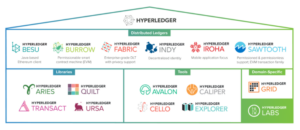
There are currently 15 Hyperledger projects being actively worked on, which can be divided into the categories "Distributed Legders", "Libraries", "Tools" and "Domain-Specific". They each have different focuses and objectives. The following graphic provides an overview of all current projects.
These projects are each in different phases of development. The following diagram provides an overview of the life cycle of a Hyperledger project:
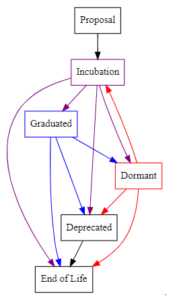
At the beginning there is a Proposalwhich must be submitted to the Technical Steering Committee in accordance with a template. As soon as a proposal has been approved, it enters the Incubation Phase. A repository is created for new components and modules in this phase. Reaching the incubation phase quite easily and the associated overlap in the content of some projects is intended to promote exploration and the exchange of ideas within the community. Once a project has reached a certain level of maturity, the project managers can vote on whether to submit an application for consideration in the Graduated (actively) by the Steering Committee. There are clearly defined exit criteria that must be met in order to move from the Incubation to the Graduated Phase. There is also the phase Dormant. It is reached when developments are suspended or slowed down for a period of time. Projects in this phase can be "reactivated", but must first return to the incubation phase, even if they were previously active. The phase Deprecated is achieved through an application from the community and subsequent review. After a further six months in this phase, the End of Life was reached, which meant the project was finally discontinued.
Overview of active Hyperledger projects
Of the 15 (current) Hyperledger projects mentioned above, there are currently:
- six in the active or Graduate Phase
- eight in the Incubation phase and
- one in the Phase Dormant
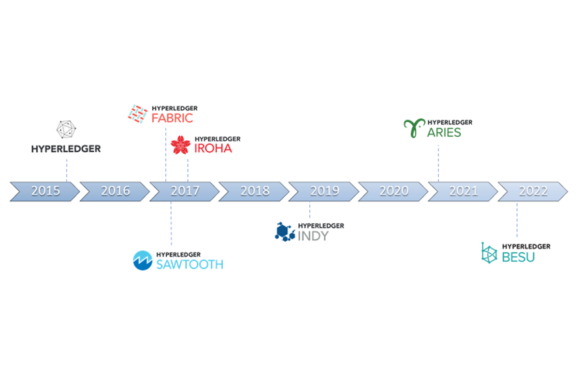
The following chart provides an overview of the currently active projects and their development over time:
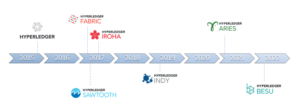
Hyperledger Aries (library)
Hyperledger Aries offers a toolkit that supports and simplifies the exchange of blockchain-based data, peer-to-peer communication and, in particular, interoperability between different blockchains and distributed ledgers. The focus of Aries is therefore primarily on solutions and initiatives for the creation, transmission and storage of digital identities.
Hyperledger visit
Besu stands out in the Hyperledger cosmos primarily because it is currently the only project with a concrete connection to the prominent Ethereum blockchain. More specifically, it is a Java-based Ethereum client that enables use cases for both public and private networks. Compatibility with the Ethereum Virtual Machine (EVM) also enables interoperability with other EVM-compatible blockchains.
Hyperledger Fabric
Probably the most popular project within the Hyperledger Foundation is Hyperledger Fabric. The core of this project is its strong modularity. Fabric offers a plug-and-play mechanism within its architecture, which makes it relatively easy to change the consensus algorithm or the network memberships, for example. Due to its modularity and versatility, Fabric continues to enjoy great popularity and is suitable for a wide range of different applications. In particular, the creation of private blockchain networks and the use of so-called channels, which enable private communication within the network between individual participants, predestine Fabric for use in the context of confidential business transactions.
Hyperledger Indy
With a significant focus on identity systems, Indy offers various tools, libraries and reusable components for the provision of digital identities based on blockchains or distributed ledgers. The aim is to enable transactions using digital identities as part of decentralized identifiers (DIDs) and thus ensure interoperability with all supported DLTs.
Hyperledger Iroha
Hyperledger Iroha is an uncomplicated and comparatively lean platform that is inspired by the Japanese Kaizen principle and enables the creation of permissioned blockchains/DLTs. Thanks to Iroha's simple structure and uncomplicated handling, it can be integrated relatively quickly and easily into infrastructure or IoT projects integrate. Iroha is characterized above all by a simple structure, a modular, domain-driven design and a focus on the development of client applications (e.g. iOS, Android).
Hyperledger Sawtooth
Sawtooth offers a highly flexible and modular architecture that separates the core of its own ledger from the application-specific execution environment of the business logic. At first glance, there are similarities to Hyperledger Fabric, but in contrast to Fabric, Sawtooth offers the option of setting up permissionless blockchains in addition to permissioned ones. In addition, this framework offers further freedom with regard to the integration and executability of Smart contracts.
The Hyperledger umbrella project offers a wide range of different tools, frameworks and libraries for the use of blockchain solutions in an enterprise context. This focus makes Hyperledger particularly attractive for companies and thus contributes significantly to its success story. The very active community is a central component in the (further) development of new and existing projects. The detailed and extensive documentation and the open-source nature of the individual projects also offer a good introduction to the topic of enterprise blockchain.
Learn more about blockchain applications
Sources:
https://www.hyperledger.org/
https://wiki.hyperledger.org/
Project Lifecycle | Hyperledger TOC
https://events19.linuxfoundation.org/events/hyperledger-global-forum-2020/