However, the effects of the pandemic are no longer limited to the healthcare systems of affected countries, but have had a noticeable and seemingly permanent impact on the economy, finance and public life. In addition to research efforts to combat the virus and its mutations by means of a vaccine and thus ensure a return to normality, digital and technological solutions are increasingly being used for this purpose. One of these solutions is the Blockchain technology whose well-known attributes such as decentralization, tamper-proofing, resilience and transparency can be of crucial importance in times of a pandemic. This article shows potential and already implemented fields of application for blockchain in the fight against corona.
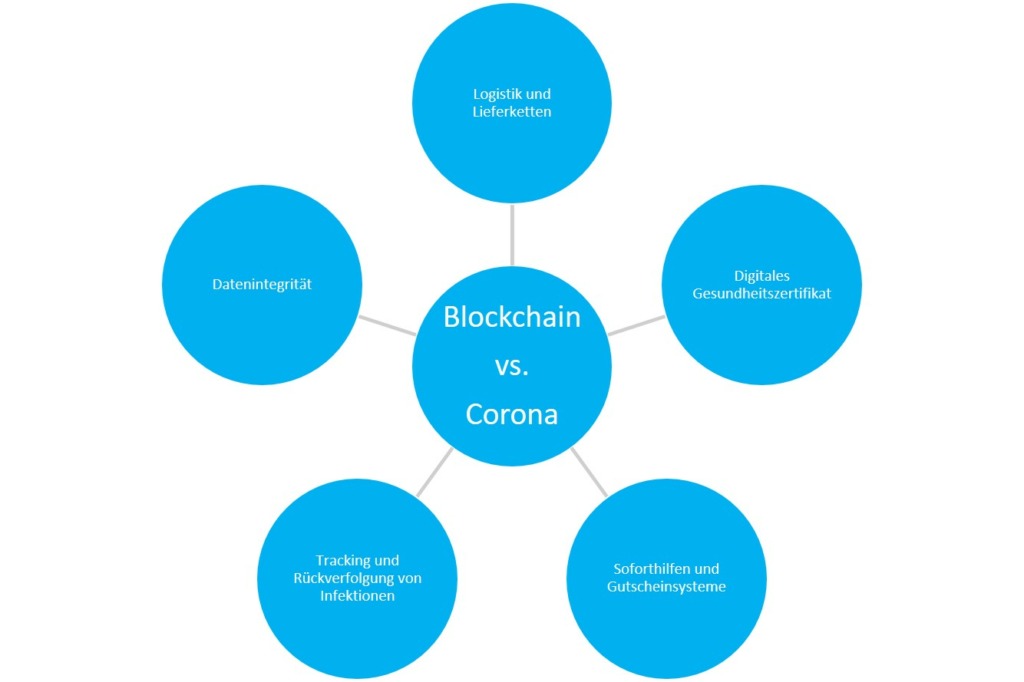
Logistics and supply chains: seamless tracking with the blockchain
One of the most obvious areas of application for blockchain is in logistics. Here, the technology offers potential solutions to current problems in the context of supply chains. The blockchain allows several parties to create a Decentralized database manage and share them. By means of a generic standardized protocol, a Single Source of Truth (SSoT) created.
Initial euphoric reports about the successful development of promising vaccines were quickly followed by disillusionment due to problems with their widespread distribution. The main reason for this is a logistical challenge: the Compliance with and monitoring of critical cold chains of the vaccine in complex supply chains. The vaccines developed to date have completely different storage and transportation requirements. The fact is, however, that it is crucial to store and distribute the vaccines properly to ensure their effectiveness. So how can recipients of the vaccine be sure that it has not been adversely affected by incorrect handling during transportation or that it is not counterfeit? Blockchain could offer a possible answer to this.
With the help of the distributed, decentralized data storage (distributed ledger) of the blockchain, it is possible to create transparency and thus Insights into the distribution and chain of custody of the vaccine in real time and thus eliminate "blind spots" in public and private facilities. In combination with other technologies such as IoT and AI can also support the preventive Detection and proactive reporting of interruptions in the supply chain, which would result in spoilage of the vaccine. In this context, the seamless and secure monitoring of transport and storage conditions as well as rapid traceability in the event of recalls creates confidence in this very sensitive and health-critical topic [2].
Digital health certificate: data protection thanks to blockchain
In the midst of the global distribution of the first effective vaccines, proof of a verifiable coronavirus test result and proof of vaccination are key to returning to a "normal" life. Especially for authorities, employers, clinics or in safety-critical locations, a Digital health certificate This ensures a certain degree of safety and reduces the risk of new infections.
The requirements for such a test certificate or proof of vaccination are an adequate Data protection, counterfeit protection and high cost efficiency. The blockchain offers a Robust and secure data management systemthat is easy to manage, cost-efficient and tamper-proof. Asymmetric encryption and digital signatures ensure that sensitive data is protected accordingly. The decentralized character of the blockchain also prevents a single point of failure and malicious attacks on the system from outside.
Starting with the anamnesis of suspected cases, through sampling and analysis in the laboratory, to the transmission of test results to the patient and/or institutions, all process steps in the issuing of a test certificate can be carried out in the laboratory. Fully documented on the blockchain be issued. The same applies to the issuing of vaccination certificates. One possible implementation, which is already finding its first applications, uses a patient's pseudonymous identity and links it to their health data. The pseudonymous identity is generated by an identity provider, either in the form of a self-sovereign identity (SSI) application or healthcare personnel. The respective samples or health data are anchored as a hash in the blockchain to ensure trustworthy and data protection-compliant storage. Each further step within the process chain or added information is hashed in the same way and added to the blockchain. The decisive factor here is that no sensitive data at any timebut only the corresponding hash is stored in the blockchain. The test results or proof of vaccination are then made available to the user, for example in the form of a QR code or in a mobile wallet. These digital certificates can in turn be used to verify vaccination status and/or immunity at the relevant points [3].
Tracking and tracing of infection chains
Monitoring and tracing chains of infection can make a significant contribution to combating Covid-19 and its spread. The Digital tracking of contactsfor example by means of Smartphone appwas one of the first and at the same time most popular technological initiatives in the fight against the pandemic. Despite initial successes, concerns quickly arose about the Data security and privacy on. The decentralized nature of blockchain makes it possible to bypass intermediaries and thus the central storage of sensitive data. Germany, for example, has opted for decentralized storage. Other countries such as France, however, store data centrally [4]. Another problem with current solutions is that the infection status must be kept up to date manually by the person concerned. In this case, the success of such an app therefore depends very much on the willingness of users to use it properly. Another option would be, for example, to automatically link the data from the aforementioned health certificate with the user's contact chain by means of a "digital fingerprint" and to store it in the app. Store blockchain.
Emergency aid and voucher systems: Blockchain as an unbureaucratic payment system
The effects of the coronavirus crisis and the measures taken to combat it are threatening the existence of many companies, self-employed individuals and freelancers. To counteract this and compensate somewhat for the massive liquidity bottlenecks of affected companies, many countries are relying on emergency coronavirus aid, usually in the form of one-off grants. Although it was announced in advance that a quick and uncomplicated solution would be found for the delivery of these grants, many problems arose during implementation. Several reports about Fraud in the context of emergency aid where funds were unlawfully applied for and granted. This contrasts with complaints and despair about urgently needed aid that has not yet been received elsewhere. This shows that despite the importance and urgency of such emergency aid, there are still some shortcomings in its implementation. The use of a blockchain can also be beneficial in this context.
Using a blockchain, it would be possible to set up a functioning blockchain in a relatively short time. Identity and payment network to be established. This could be implemented in the form of a smart and decentralized voucher system, for example, to ensure that the money is distributed promptly, accurately and for a specific purpose. Through the use of Smart contracts It would also be relatively easy to implement restrictions and conditions regarding the issue or use of blockchain-based vouchers, as well as expiry mechanisms. In this context, it would also be conceivable to manage funds or vouchers at regional and local level in a more targeted and dynamic way, thereby systematically supporting particularly affected areas and companies.
Ensuring data integrity - the blockchain as the basis of a data hub
The outbreak of Covid-19 has highlighted the need for a reliable, fast, secure and transparent system for the aggregation and distribution of relevant data and information. The integrity of corona-related data is particularly essential for tracking infections, predicting trends or for research work and results and the resulting decision-making processes. The blockchain enables the required data accuracy through its ability to verify and store unchangeable real-time data. The blockchain framework can serve as a foundation for current research while allowing organizations and associations to share their information and data with innovators, scientists and researchers in a trusted network. One successful implementation of this concept is MiPasa. The project, which was developed in collaboration with the WHO, technology companies and government authorities, is a scalable, verifiable, open data hub. It makes it very easy to process, analyze and share Covid-19-related information on a large scale. MiPasa is specifically designed to synthesize data sources, resolve inconsistencies, identify errors or false positives and integrate credible new feeds. Through provided APIs, data can be retrieved programmatically and even applications can be built on top of it using the blockchain-powered data feed [5][6].
The use cases described show how versatile and flexible the Blockchain in the fight against corona can be used. In combination with other technologies such as AI, big data or cloud computingg, the blockchain can make a significant contribution to dealing better with the challenges of a pandemic and paving the way back to normality. Furthermore, the successful realization and implementation of the possible applications presented can lead to a better positioning of blockchain as a technology in the future and thus also gain popularity outside of cryptocurrencies.
Learn more about blockchain applications
Sources
[1] [Online]. Available: https://covid19.who.int/
[2] [Online]. Available: https://www.ibm.com/de-de/blockchain/solutions/vaccine-distribution
[3] [Online]. Available: https://www.govdigital.de/govdigital/projekte
[4] [Online]. Available: https://www.infopoint-security.de/corona-tracking-apps-bewertung-eines-security-experten/a24186/
[5] [Online]. Available: https://www.ibm.com/blogs/blockchain/2020/03/mipasa-project-and-ibm-blockchain-team-on-open-data-platform-to-support-covid-19-response/
[6] [Online]. Available: https://app.mipasa.com/