Distributed database systems offer a solution here by distributing data across multiple nodes. In this blog post, we look at the basics, the different types, the advantages and challenges of distributed database systems and their possible applications.
What are distributed database systems?
A Distributed database system consists of several interconnected databases hosted on different physical locations (nodes). The data is either replicated (copied) or partitioned (split) so that the system can act as a single database management system (DBMS). Some of the main features of distributed databases are:
- Scalability: Systems can grow quickly by adding new nodes.
- High availabilityData is usually distributed across several nodes so that access to the data is still possible if one node fails.
- Fault toleranceIf a node fails, the system can continue to function.
Homogeneous vs. heterogeneous distributed database systems
There are two main types of distributed databases: homogeneous and heterogeneous Systems.
Homogeneous distributed databases:
All nodes in the network use the same database management system (DBMS), the same architecture and similar data models.
Advantages
- UniformitySame software on all nodes ensures uniform management and maintenance.
- Easier integrationSince all nodes use the same technology, integration and communication processes are simpler.
- ConsistencyEasier to ensure data consistency as all nodes are identical.
Disadvantages
- FlexibilityLimited flexibility in the selection of technologies, as all nodes must use the same software.
Heterogeneous distributed databases
The nodes in the network use different DBMS (e.g. MySQL and MongoDB), system architectures and possibly different data models.
Advantages
- FlexibilityAllows you to select the most suitable technologies for specific requirements at each node.
- OptimizationEach system can be optimized for specific tasks, improving efficiency and performance.
- AdaptabilityEasier integration of new technologies or systems without extensive changes to existing nodes.
Disadvantages
- ComplexityHigher complexity in administration and maintenance, as different systems have to interact with each other.
- Consistency problemsMore difficult to ensure data consistency across different systems, especially for write operations.
- IntegrationIntegration of data and systems can be more complex because different APIs and protocols are used.
Types of distributed database systems
There are various types of distributed database systems, which differ in terms of their structure and storage approach:
Distributed relational databases (DRDBs):
- Use the classic relational model (tables, SQL).
- Advantages: Proven ACID (Atomicity, Consistency, Isolation, Durability) properties, ideal for applications requiring strong consistency.
- Disadvantages: Limited horizontal scalability.
NoSQL databases:
- More flexible data models without a fixed schema (e.g. document or key-value storage).
- Advantages: High scalability, ideal for big data.
- Disadvantages: Eventual consistency (see CAP theorem), less suitable for complex queries.
Graph databases:
- Specially developed to model networks and relationships (nodes and edges).
- Advantages: Efficient queries in highly networked data models.
- Disadvantages: More difficult to scale, less suitable for tabular data.
Time series databases:
- Optimized for the storage and analysis of time series data (e.g. sensor, financial or log data).
- Advantages: High efficiency with time-stamped data.
- Disadvantages: Specialized area of application.
Cloud-based distributed databases:
- Fully managed, distributed databases in the cloud (e.g. Google Spanner, DynamoDB, Cosmos DB).
- Advantages: Seamless scaling, high availability.
- Disadvantages: Dependence on the cloud provider, potentially high costs.
Types of data storage in distributed databases
Distributed databases store data either by Replication, Partitioning (sharding) or a combination of both:
- ReplicationData is copied synchronously or asynchronously on several nodes to ensure reliability.
- PartitioningData is distributed to different nodes in order to distribute loads and increase scalability.
- CombinationSome systems combine replication and partitioning to maximize both availability and scalability.
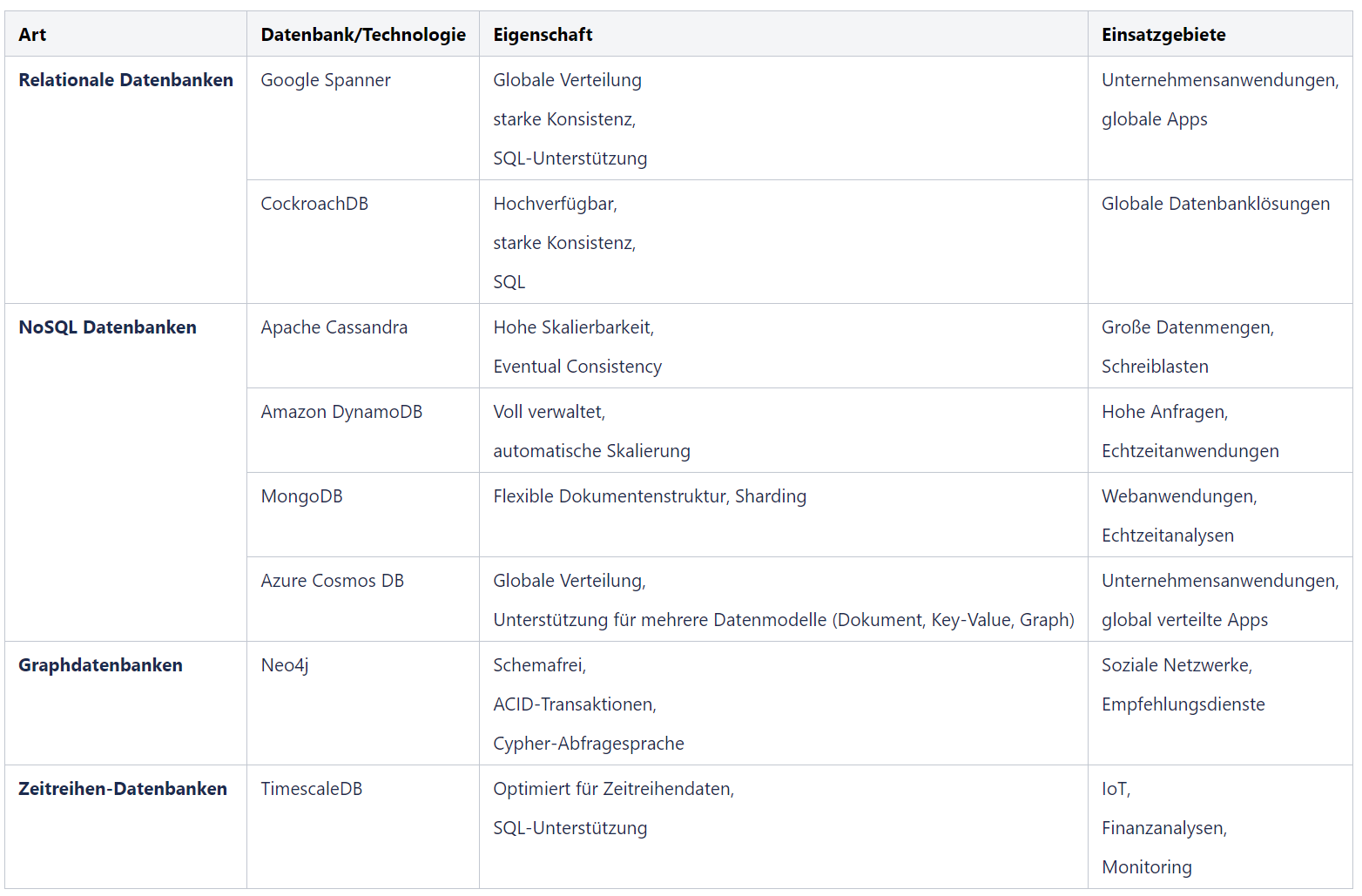
Known distributed databases
When is the use of distributed database systems worthwhile?
The use of distributed databases is worthwhile in scenarios where high availability and scalability are crucial, for example:
- Global applicationsSystems that are used worldwide and require low latency (e.g. social media, e-commerce).
- Big DataApplications with massive amounts of data, such as IoT, analytics or financial markets.
- ReliabilityCritical systems that must be continuously available, such as healthcare or financial applications.
Conclusion
Distributed database systems offer solutions to the challenges of modern data requirements, especially for large, geographically distributed systems. They enable high availability and scalability, but also pose challenges in terms of complexity and consistency. The choice between homogeneous and heterogeneous systems and between different types of storage depends heavily on the specific use cases and requirements.1