The variety of subscriptions is already present in our everyday lives: in my household alone, there are the monthly issues of "Tour" - a classic newspaper subscription in print form, plus an exclusive app with the latest news from the bike world. But also several Amazon savings subscriptions with automatic monthly delivery of products, the Zwift training program, annual Strava Premium memberships and, last but not least, streaming subscriptions for music and movies via SoundCloud Pro+ and Netflix.
I need a separate customer account for all these services - both analog and digital. I always have to enter new account information and payment plans and cancel each subscription individually if I no longer want to use the service.
Especially in the area of Subscription management of digital goods offers the Blockchain technology Smart contracts (i.e. the logic executed before something is written to a blockchain) offer interesting opportunities to simplify processes for service providers and consumers.
Success factors in subscription management
Digital services, such as music streaming, are often similar at their core and only additional services keep customers with one provider or another. These services can be payment modes, image or sharing functions for social media.
The success factors of subscription management include above all the fact that ...
- ... the service can be used permanently and is constantly updated (e.g. new songs from music streaming providers)
- ... is fun and easy to use (good usability)
- ... additional services can be booked as quickly as possible and contract modes can be changed easily (e.g. family subscription, change from Basic to Premium and back)
- ... the performance is available everywhere (e.g. broad device support or platform independence)
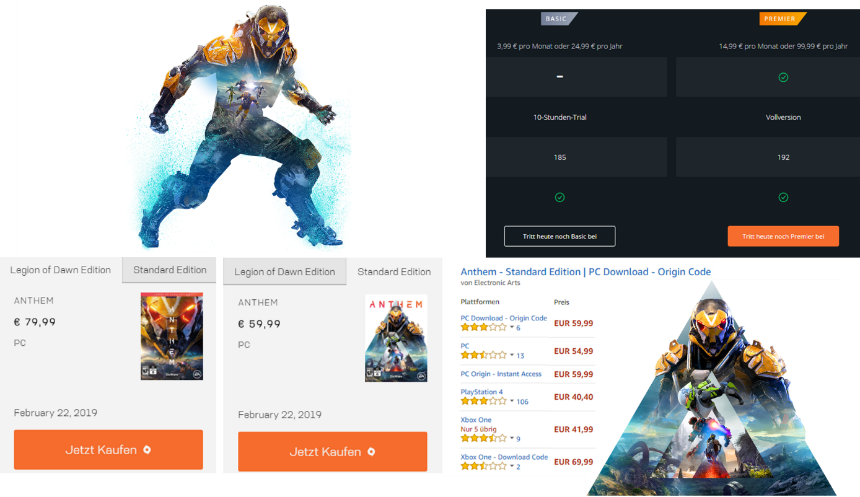
The video game "Anthem" from EA/BioWare, for example, shows how differentiated digital services can be offered:
- A wide range of platforms (PlayStation 4, Windows, Xbox) is supported.
- The product can be purchased physically or by activating the product code.
- Customers can book special editions with additional content.
- A subscription model, which is available in two versions (Basic & Premium), realizes the integration into the Origin Network .
Blockchain as a simplification tool in the subscription business
In order to be able to handle such a variety of payment and billing modes, a service provider must have modern Billing and payment systems that link customer data with contract data and billing modes: This is the only way to successfully create invoices, manage taxation and correctly post payments.
This is precisely where blockchain technology can provide support with smart contracts, particularly in the area of contract design - the core component of billing systems.
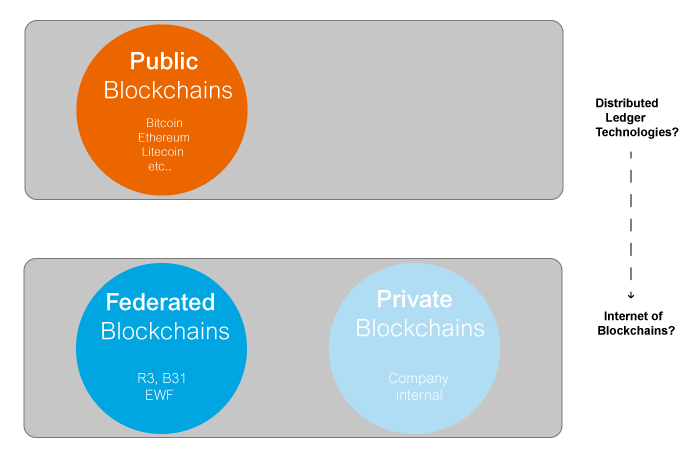
However, the blockchain used must never be a "private blockchain", but only a "public blockchain".
Defined in simple terms:
Private blockchain - A central location defines market participants and smart contracts, as in a separate fork of Ethereum or Hyperledger Fabric (HLF);
Public Blokchain - Anyone can do anything; there are no authorization structures and no central control, as with Ethereum or Bitcoin.
Since, as in reality, everything is rarely black or white with blockchains, a "consortial/federated blockchain", a hybrid form of public and private blockchain, is the right solution. In this form of blockchain, the operational process is regulated by an expandable committee, as is the case with Ripple or R3m HLF, for example.
Smart Contracts: Potential generators for service providers
The more service providers use the same blockchain, the greater the synergies, as one provider can benefit from the services of other service providers.
Service providers could create individual SmartContract "templates" (e.g. Music Streaming Free Subscription, Music Streaming Premium Subscription) for their various subscription models.
If a user wishes to take out a subscription, these samples can be used.
In terms of content, this does not represent a major change compared to a centralized billing system. However, it is precisely this decentralization that brings new advantages and options:
- instead of the actual service, the service provider could earn money with contract managementIf the subscription contract has proved successful, it could be offered to other service providers as a model for their services. The use of these sample contracts could be charged for.
- The service provider no longer necessarily has to know the service user:
As long as a specific contract from a provider has been selected, it is irrelevant which "real" user is hidden behind the cryptographically pseudonymous identity.
In this way, the service provider no longer has to store customer data and the user has their own data under control, which is advantageous for both sides, especially with regard to the GDPR. - The user also has the option of consume the services of different providers with one account/one identityThis could greatly reduce the number of digital identities required.
- The processes for authorized third parties can be accelerated:
One example of this is the payment of royalties to producers and songwriters. This would allow them to automatically receive a certain amount per stream in the case of music streaming services. Nowadays, this is extremely intransparent and time-consuming, as different rules apply depending on the country, subscription and platform and are collected by different rights administrators (e.g. GEMA or SACEM). This process could be anchored directly in the SmartContract and the corresponding shares could be transferred directly to third parties.
The solution: distribution via SmartContract instead of an intermediary
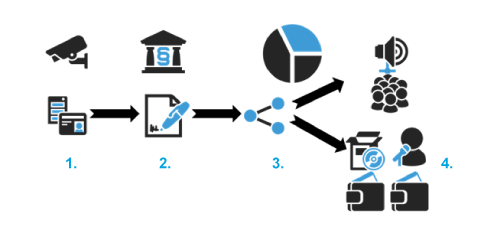
In simplified terms, the following process steps must be carried out:
- Check the identity of the user (user of the contract must identify themselves securely)
- Extract rules from the contract (selection of the SmartContract)
- provide the corresponding service (contractual conditions of the SmartContract)
- Transfer payment to others based on the rules of the smart contract (terms and conditions of the smart contract)
Conclusion: added value for all stakeholders involved
The use of blockchain technology for subscription models in the form of smart contracts delivers added value for customers, service providers and the stakeholders involved:
Customers and users benefit from the reduction in user accounts, greater control over their own data, greater flexibility thanks to barrier-free switching to other providers and lower costs thanks to the reduction in intermediaries.
Service providers can expand their portfolio and have the potential to monetize administrative processes as a service themselves (e.g. invoicing or creating a subscription contract).
Third parties involved could also participate more quickly and directly in the process via automated processes and rules.
You might also be interested in these blog posts:
Smart contracts - what's behind the smart contracts
What impact does subscription management have on the customer experience?