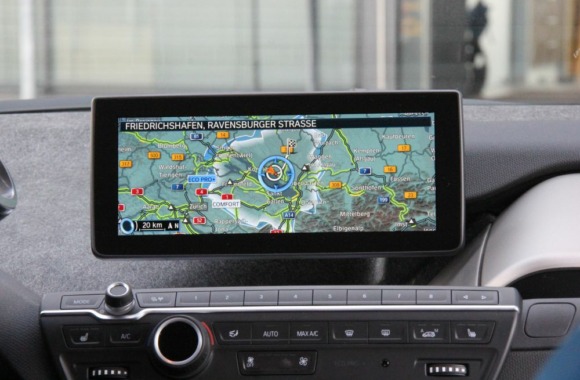
Anyone who has ever driven a BMW i3 will certainly have discovered a special feature in the navigation system that has never been seen before in the automotive world: The Dynamic range display or also Range spider called. Taking into account a wide range of parameters, such as driving modes or seat heating, it shows in real time how far the vehicle will get with the current charge level. doubleSlash developed the concept and process design of this innovative solution helped to shape. We are therefore all the more pleased that the solution was awarded the "Computer Bild" and "Auto Bild" awards at the end of last year. "Pioneer Award" was awarded.
Matthias Neher, Senior Business Consultant and Expert in the field of e-mobility at doubleSlash, worked with his team on the conception and implementation of the range display. In this interview, he talks about the challenges involved in developing this innovative service and about the The future of connected vehicles.
What exactly is the dynamic range indicator and why is it so innovative that it has even won an award?
Matthias Neher: The range of electric vehicles depends on many factors such as temperature, driving modes, environmental parameters, etc. For example, the vehicle consumes more energy in cold weather and therefore has less available for the route. When calculating the range, all Energy consumer - from the heating to the on-board electronics - so-called auxiliary consumers - are taken into account. The vehicle recognizes this information and transmits it to the IT backend. But there are other factors that influence the Influence range. This includes, for example, topology (elevation profile of the map), traffic information and road categories (highway or dirt road). These Environmental information the backend via external suppliers, so-called Content Provider. These providers, which specialize in certain content, enable the worldwide use of this information for the implementation of such services.
Many mathematical processes then run in the background and a dynamic range display is generated at the end. The innovation lies in the fact that no electric vehicle manufacturer has yet succeeded in implementing this service to be implemented and rolled out nationwide and across countries.
The BMW i3 is the world's first fully connected electric vehicle. The combination of technology and services creates high added value for the customer. What do other electric vehicles lack that BMW has combined in the i3 with ConnectedDrive?

Matthias Neher: The main difference is that with a BMW i3, the Connectivity is already integrated ex works. In every country in which it is sold, the vehicle is fully equipped with the Environment networked. For BMW, the i3 is the model car with which the consistent transformation to the integrated mobility provider is completed. All i3 services ultimately serve to support the driver holistically along the entire mobility chain to provide optimum support. For example, the "Intermodal Routing" service can be used to plan a route using different modes of transport. I have the route with me everywhere on the app - and if my plans change, it adapts. That's unique so far.
In order to provide drivers with optimal and up-to-date support for their mobility plans, all information must be available independently and at all times. What were the challenges in the conception and design of the solution?
Matthias Neher: The main challenge was to connect all the partners involved worldwide to the BMW system, especially from a data protection perspective - all in all, a lot has to be taken into account. The backend in particular has to be different levels of complexity avoid:
- On the one hand there is the Variance in the vehicle bodywork. Not every vehicle is the same, there are many different types of equipment.
- Then come Different country codes in addition. For example, information from certain countries may not be allowed to leave them. Attention must also be paid to the country- or market-specific requirements. Geodata for the Chinese area, for example, must first be converted because the coordinate system there is completely different.
- Another challenge is the Data transmission to the Car-to-X interface. The vehicle receives and transmits a range of data. However, this amount of data must be kept to a minimum for cost and performance reasons. It is therefore important to weigh up which data should actually be transmitted.
- Also Service Level Agreements (SLAs) are an important requirement. It must be ensured that the service offered is always available. This is achieved by setting up appropriate monitoring systems and designing the IT architecture and operating processes.
- And then there is the Connection of the various content providers. Standardized interfaces that enable the decoupling of IT components help here. This makes it easy to connect new providers. Standardization also makes these many connected services easier to maintain.
- In addition, the Scalability to pay attention. There are more vehicles on the road in the morning rush hour than at other times of the day or night. The technical infrastructure must be able to cope with these peaks. Naturally, parallelized server infrastructures are used here. The trend is clearly moving towards cloud technologies such as AWS (Amazon Web Services) and infrastructure technologies such as Docker. This allows additional instances of entire applications to be launched on demand so that the mass of requests can be processed with high performance.
- The topic of Data protection. All calls from the vehicle to the content provider must be assessed and anonymized wherever possible. It is also essential to ensure secure data transmission, because a vehicle must not be hacked under any circumstances.
What problems in the automotive sector can applications such as the range indicator solve in the future? Gartner predicts that there will be a quarter of a billion connected vehicles by 2020 [1]. At the same time, however, there is still a lack of established standards. In your opinion, what does the future of connected vehicles look like?
Matthias Neher: In my opinion, there will be no comprehensive and cross-brand car-to-car communication in the next five to six years. What will increase, however, is the Sensor-based detection of the environmentas is already the case today with the driver assistance systems "collision warning" or "lane departure warning". That is why the Computing power in the vehicle increase continuously. In addition Backend-supported services to optimize driver efficiency will gain in importance because no overarching standards have yet been established for how vehicles can talk to each other.
The successful model implemented with the range spider is therefore very promising. In principle, any number of content providers that provide valuable information can be connected to the vehicle to provide the driver with useful support. Thanks to the IoT technology the possibilities are far from exhausted.
Sources:
[1] http://www.gartner.com/newsroom/id/2970017