


In the first part of this blog series I explained the term big data and its origins and development history in the first part. In this second part, the connection between big data and the maturity level of IoT business processes will be explained.
At doubleSlash, we use a simple maturity model in consultations and workshops with customers. The model shows how far a company has already developed in terms of its IoT business processes.
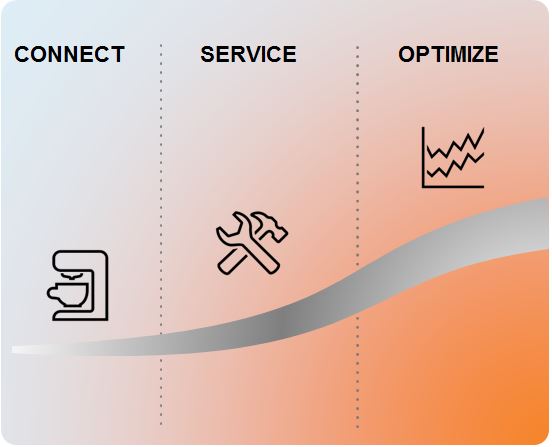
In the first phase CONNECT stands the Networking in the foreground. In many customer scenarios, the amount of data transmitted in relation to a single end device is relatively small. However, the Internet of Things usually involves a large number of endpoints. This very quickly results in very large amounts of data. large data volumes. In principle, larger volumes of data naturally also entail higher costs, e.g. for the network infrastructure, result. It is therefore important to "produce" as little data as possible and to transfer it as efficiently as possible. This is achieved, among other things, by using the leanest possible Data formats (e.g. JSON) and Protocols (e.g. MQTT or CoAP), but also by designing business processes tailored to IoT.
IoT service level with the right data processing
As soon as you start to integrate the newly acquired information into the company's internal business processes, you are in the second stage of the maturity model SERVICE. In this stage, the data should be made usable for a value-added service or business model. This requires a large number of individual large data pots be merged into one large pool. An example of this would be the Integration of an ERP system, one CMS system, various external content providers like Google or Yahoo and then just the respective IoT data. As this data usually needs to be available in the shortest possible time, it is essential to have a Efficient data processing to ensure that this is the case. One possibility (in addition to the use of very expensive mainframe systems) is the Use of distributed databases. The attempt is therefore to cope with the increasing additional hardware to be overwhelmed. Conventional relational database systems (RDBMS) quickly reach their limits here. RDBMs must guarantee the consistency of all data at all times. Due to the ACID principle (Atomicity, Consistency, Isolation, Durability), to which RDBMS are inferior. This means that as the number of nodes increases, more and more data has to be replicated and kept consistent. In short: the database becomes slower and slower and comes to its knees.
This is where NoSQL (Not Only SQL) databases, such as MongoDB, come in. They do not require a complete Data consistency on all connected nodes. Instead, they assume that it will be sufficient to establish the consistency of the data at some point in the future. As a result, these databases can be significantly faster with very large amounts of data. scaling better and still work with high performance at the same time. For the sake of completeness, it should be mentioned that it is not possible to guarantee system availability, data consistency and failure tolerance at the same time due to the CAP theorem. If you want to delve deeper into this topic, you can find more information in the collection of links at the end of this article.
Automation and optimization of IoT processes with the cloud
Once the integration of IoT data into your own business processes has been completed, they can be automated and optimized. This happens in the final phase OPTIMIZE and essentially requires three things: Powerful (scalable) computing power, a well-structured data basis and intelligent algorithms.
Computing power comes - how could it be otherwise - from the cloud: keyword "Cloud computing". This makes it possible to process even large volumes of raw data for further analysis. This is particularly necessary when dealing with unstructured data, for example, text data from a social media platform. Roughly speaking, the unstructured data is searched for relevant information and then organized in structured data. The data structured in this way can now be used to create a customized solution for specific business processes. optimized alternative solution to search. There are very different methods for this. Terms that are often used in this context include Data mining, evolutionary algorithms, MapReduce, fuzzy logic, decision support systems, machine learning and artificial intelligence. Each of these topics represents a separate field of research in itself, so it is unfortunately beyond the scope of this blog article to explain them all in any detail. The aforementioned list of links at the end of this blog post should at least provide a brief introduction.
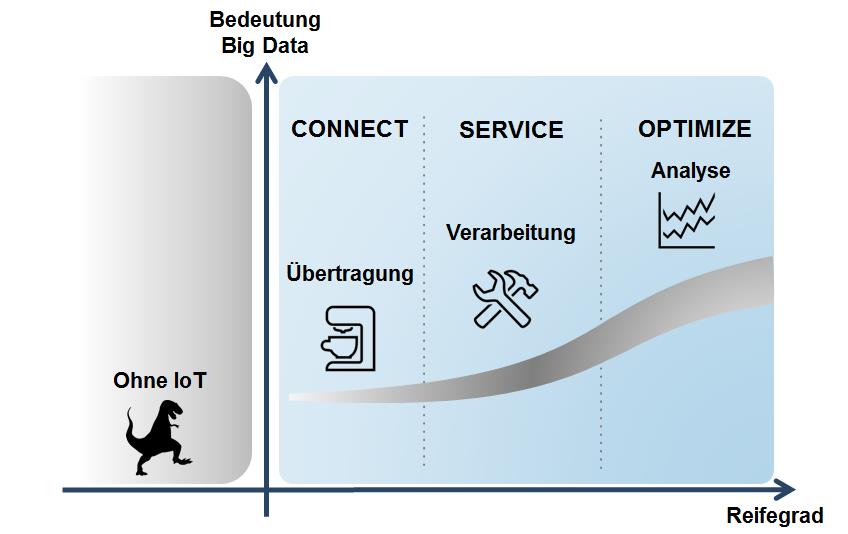
If you want to implement the steps described above on the way to an IoT business model, there are clearly also costs involved. One IT infrastructure must be built up, Business processes must be adapted and New tools and processes must be implemented. At the same time, however, each phase also offers the opportunity to monetize the data and information obtained. The more information you gain, the more money you can earn. This also means that the importance and also the share of value added by Big Data increases the further you progress in the maturity model.
In the third and final part of this blog series, a very specific use case - the failure of a machine tool - will be presented. This example will then be used to vividly describe the relationship between big data and the individual phases of the maturity model.
Sources and link list:
ACID, CAP and BASE:
http://www.norcom.de/de
https://de.wikipedia.org/wiki/ACID
http://db-engines.com/de/article/CAP+Theorem
https://de.wikipedia.org/wiki/CAP-Theorem
http://t3n.de/magazin/relationale-datenbanken-bekommen-konkurrenz-nosql-neues-224737/
Data Mining and Descision Support Systems:
https://www.th-nuernberg.de
http://dbs.uni-leipzig.de/file/dw-ss08-kap6.pdf
https://www.minet.uni-jena.de/fakultaet/schukat/ML/Scriptum/
http://www.gdrc.org/decision/dss-types.html
https://www.youtube.com/watch?v=o6-Ejw9vet8
https://www.youtube.com/watch?v=W44q6qszdqY
Machine learning and artificial intelligence:
https://www.youtube.com/watch?v=qDbpYUbf3e0
https://cloud.google.com/prediction/docs/
https://www.youtube.com/watch?v=-rMMTv7XLYw
https://www.youtube.com/watch?v=TnUYcTuZJpM
https://www.ibm.com/watson/
http://t3n.de/news/twentybn-startup-kuenstliche-intelligenz-deep-learning-709698/
https://de.wikipedia.org/wiki/K%C3%BCnstliche_Intelligenz
Evolutionary algorithms, MapReduce, fuzzy logic:
http://www.ra.cs.uni-tuebingen.de/mitarb/streiche/publications/Diplomarbeit.pdf
http://www.ki.informatik.uni-frankfurt.de/lehre/WS2012/KI/folien/06-suche-4.pdf
https://de.wikipedia.org/wiki/MapReduce
https://www.youtube.com/watch?v=bcjSe0xCHbE
http://www.urz.ovgu.de/
http://dbs.uni-leipzig.de/file/seminar_0910_findling_K%C3%B6nig.pdf
https://de.wikipedia.org/wiki/Apache_Hadoop
http://reinarz.org/dirk/fuzzykugel/fuzzy.html
http://www.spektrum.de/magazin/fuzzy-logic-am-praxisbeispiel/820701
https://www.youtube.com/watch?v=7FcMhTTG1Cs