

In our discussions with customers and partners often terms like Artificial intelligence (AI), data science or Machine Learning mentioned in the same breath. There are numerous buzzwords floating around, which are often not clearly distinguishable from one another or are used as synonyms. We would like to shed some light here and provide a brief and clear overview of the most important terms, explain them briefly and differentiate between them.
Artificial intelligence, machine learning, neural networks
AI refers to the automation of human behavior. A distinction is made here between strong and weak AI.
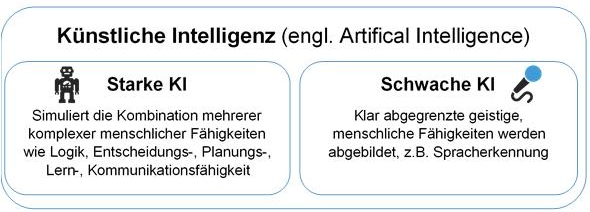
Comparison of strong and weak AI
From a strong AI Science is still miles away from having its own consciousness and empathy. When nowadays artificial intelligence, then this refers to use cases in the field of weak AI. These systems are able to solve individual, clearly defined tasks, such as image recognition, well. However, they do not gain a deeper understanding of the underlying problem and therefore only appear intelligent to the outside world.
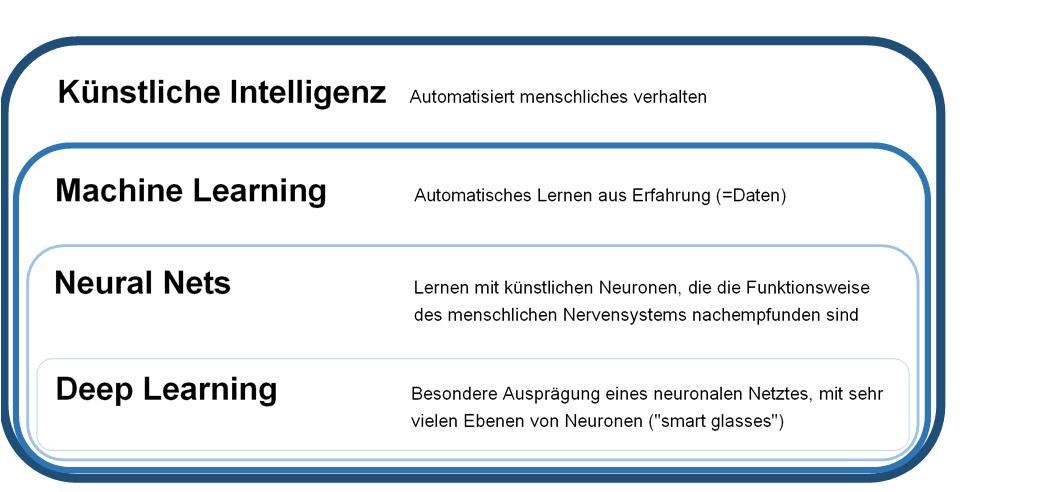
Artificial intelligence subsets
The weak AI based thereby on methods of mathematics and computer science. An important subset of methods in this area is referred to as Machine Learning summarized. Neural networks in turn are a method or tool within the "toolbox" of machine learning that can be used. Within this method, the Deep learning represents a very special form of a neural network.
Data analytics, data science, data mining
Under Data analytics is initially understood to mean everything that has to do with the targeted analysis of data. New conclusions and recommendations for action should be made possible based on the results of this analysis. Over time, other disciplines, such as data science, have developed under the term data analytics.
Data Science is the Generic term for a range of methods and algorithms that can be used to generate knowledge from data. can. Sophisticated methods from the fields of mathematics, statistics and computer science are used for this purpose. In order to be able to interpret the results of these methods correctly, it is necessary that a Data Scientist also has the relevant technical knowledge (e.g. about how a wind turbine works) or builds this up over the course of a project. With data science, you are able to both Structured data (e.g. a table with fixed attributes such as age, name, etc.), Unstructured data (e.g. a complex text in natural language) and Semi-structured data (a mix of structured and unstructured data).
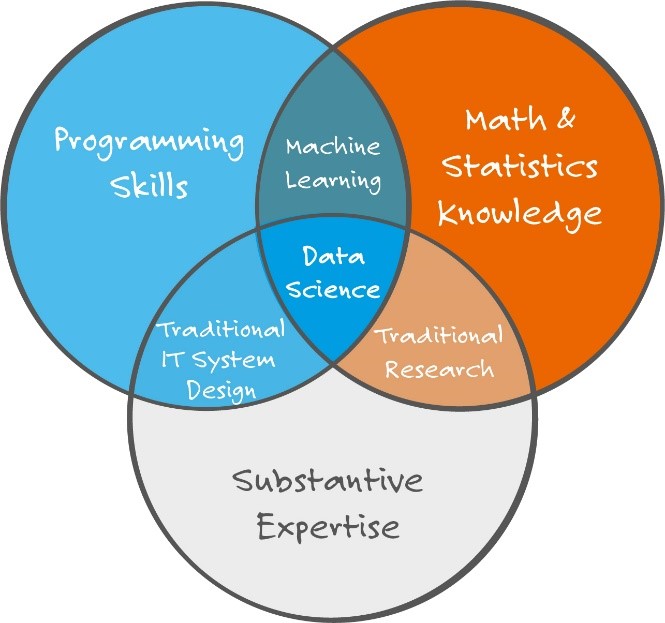
Data Mining is to be understood as a sub-area within data science. The aim is to find previously unknown cross-connections, trends or patterns in large amounts of data. Methods that are used in the field of machine learning (e.g. clustering) are also used. However, as these methods are applied to data "manually" by a person, data mining techniques (in contrast to machine learning) No self-learning mechanisms with. Figuratively speaking the human being learns, not the machine.
Roles in a data science project
Within Data analytics projects you need very different Skills and experts. The associated roles are very wide-ranging and often cannot be clearly distinguished from one another. For example, a data scientist can also take on tasks that would be assigned to a data engineer and vice versa. For example, a data scientist often has to prepare data, as this is an elementary component of many data analysis projects.
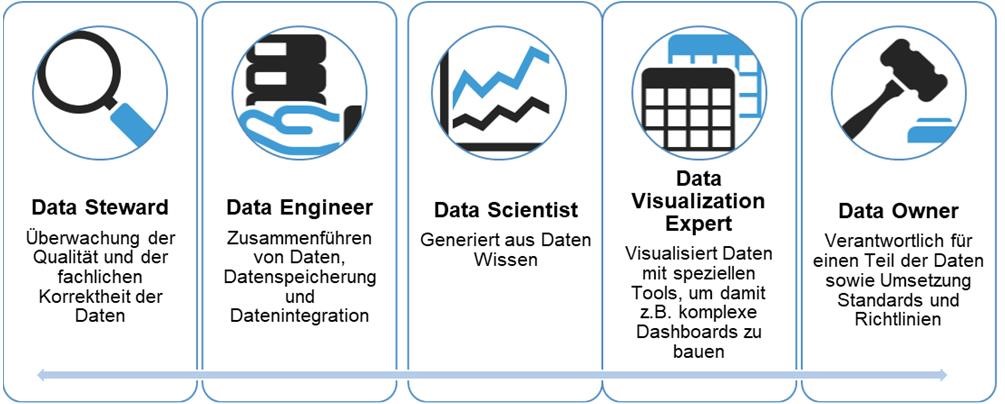
Data science project roles
In data analytics there are Four different levelsto analyze large amounts of data.
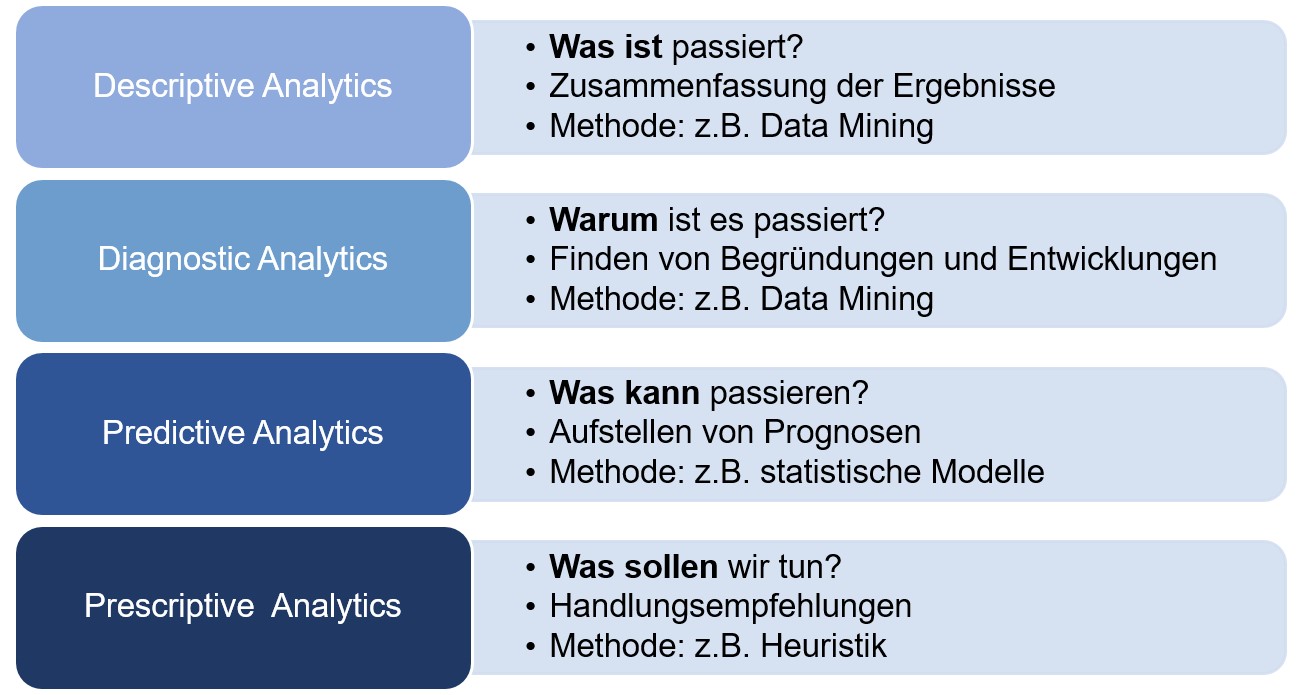
Analysis approaches in data analytics
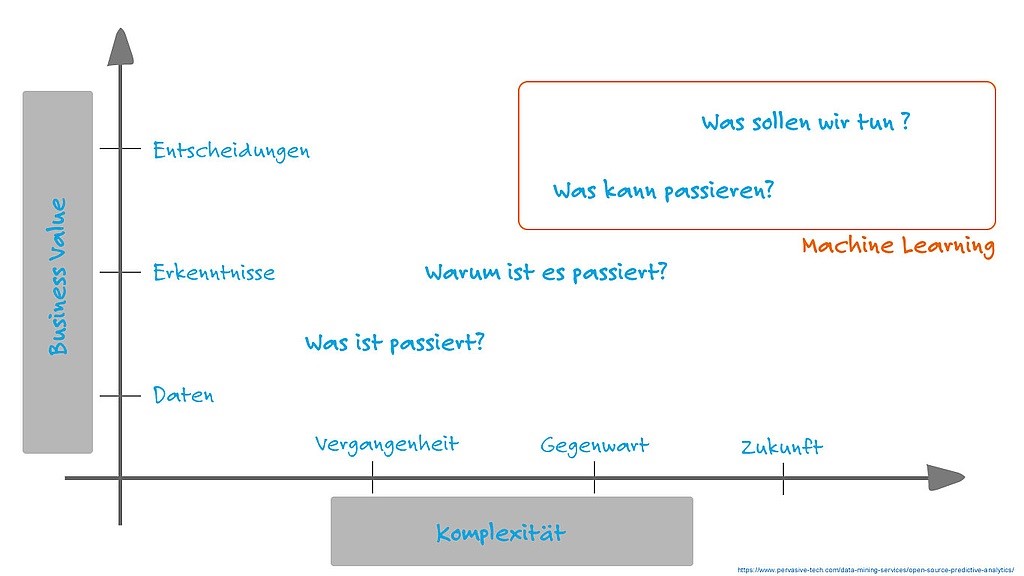
Each stage is linked to a specific question - which needs to be answered. The complexity increases in order to arrive at a targeted answer to the respective question. At the same time, however, the corresponding added value associated with this also increases.
Business Intelligence, Advanced Analytics
Both Business Intelligence as well as Advanced Analytics are frequently used terms that describe procedures and processes for analyzing data from your own company.
Business Intelligence is the Pioneer of advanced analyticswhere data analyses are used to examine past events. Business intelligence can be categorized as descriptive and diagnostic analytics, as questions such as "How many products have I sold at what price in which region?" can be answered.
In contrast to business intelligence Advanced Analytics methods are used to look specifically into the future¹. This allows forecasts to be made about future events. Questions such as "How many products should we produce?" or "When should maintenance be carried out?" can be answered. This is how Advanced analytics among the predictive and prescriptive analytics methods to be classified.
ETL, Big Data, Data Lake, Data Discovery, Data Exploration
ETL means Extract, Transform and Load and is the basis for filling data warehouses and a basic technology for data integration. First, the data is extracted from one or more sources, then transformed into a desired target format and finally stored in a target location.
Volume, Variety and Velocity are the three dimensions of Big Data. This means that this phenomenon results from rapidly (Velocity) increasing (Volume) data of different types (Variety). This results in challenges such as storage and management, as well as opportunities such as the ability to analyze this data.
In a Data Lakestructured and unstructured data from different data sources are merged with the aim of breaking down the various isolated data silos of a company and making the Consolidate data in one central location. Further, complex data analyses can then be carried out on the raw data stored there.
The discovery process in the Data Discovery covers the research and preparation of the data. The process can start with an initial quality check. A simple machine learning model can be used to obtain an initial assessment of the potential of the data. The discovery process serves to identify initial hypotheses, ideas or data potential.
As a continuation of Data Discovery Data Exploration The search is on for "deeper" discoveries that can lead to an initial prototype. The aim is to define the desired solution so that it does not deviate from the target.
CONCLUSION: Buzzword jungle AI - many paths lead to added value from data
In the course of time, a Variety of terms relating to AI which often overlap in parts and cannot always be clearly 100% delineated from one another. On closer inspection, one realizes that each buzzword hides its own, often very specialized domain of knowledgewhich is associated with corresponding technological and methodological expertise. What they all have in common, however, is that they try to generate new information and thus added value from data. In this article, we have tried to clarify the boundaries and also the overlaps.
Co-author Christina Reiter
¹https://www.alexanderthamm.com/de/
Do you want more insight into the AI jungle? This way ...