
At first glance, this classification is not so wrong. However, if you take a closer look at this topic, the problem of a clear definition quickly becomes apparent. Terms such as Business Analytics, Data Mining, Big Data Analytics or also Data Science also appear on the scene in the search for a clear definition - everything seems to blur into one another. So how can data analytics be differentiated?
From database systems to the cognitive processing of data
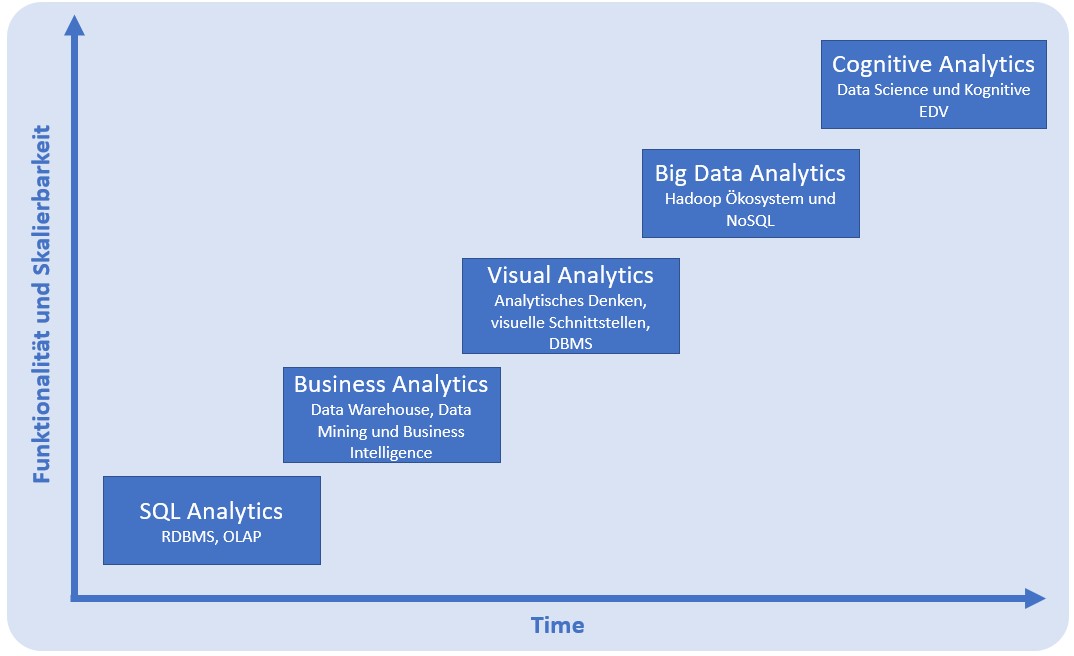
Data analytics has developed over the last few decades under various terms such as SQL Analytics, Data Mining or also Big Data Analytics developed from this. The origin lay in the classic database systems such as RDBMS (Relational Database System). With the rapidly growing Data volumes and their processing was a constant Customization unavoidable - right up to the cognitive processing of data. In principle, data analytics can therefore be seen as a kind of umbrella term under which the individual terms are summarized.
The following figure shows the development over the last 50 years:
Four analysis methods linked together
Data analytics has four Analysis methodwhich are strongly interlinked and overlap significantly. At different temporal levels, the processes attempt to combine different Questions to answer: Descriptive analytics (What happened?), Diagnostic Analytics (Why did it happen?), Predictive analytics (What will happen?) and Prescriptive analytics (What should happen?). While predictive analytics analyzes the probability of occurrence, prescriptive analytics provides the appropriate recommendation for action, e.g. how to influence a certain trend or prevent a predicted result, or how to react to a future result. It thus enables a Automated decision making.
Conclusion
After a closer look at the topic, it quickly becomes clear that there is no clear or even Uniform definition of the term Data analytics is far from the truth. A frequent Overlap of the main terms (SQL Analytics, Business Analytics, Visual Analytics, Big Data Analytics and Cognitive Analytics) not only leads to a fast-moving Further development of the subject matter; but also to a sudden Summary of topics, new descriptions or even completely new creations of terminology.
Still not enough? Read part 2 of the data analytics series here
1 Gudivada, Venkat N. (2017): DATA ANALYTICS: FUNDAMENTALS. In: Mashrur Chowdhury, Amy Apon and Kakan Dey (eds.): Data Analytics for Intelligent Transportation Systems. Netherlands, United Kingdom, USA: Elsevier, pp. 44-80.
Find out more about our Data Driven Services here