

Data integration is a central component of modern business processes. But what can be done when unstructured data, such as email signatures, needs to be quickly and efficiently converted into a standardized format?
The use case
The focus is on automating the creation of contacts in a CRM system. The aim is to convert email signatures into a JSON format that is compatible with the CRM API. An example of an email signature is:
---------
 Wettbewerbsfähigkeit sichern – datenbasiert entscheiden. Wir helfen dabei.
----------------------------------------------------------------------------------
Marc Mai
Senior Software Architect
Teamleiter Data Driven Solutions

doubleSlash Net-Business GmbH
Otto-Lilienthal-Str. 16
D-88046 Friedrichshafen

Fon: +49 7541 / 70078-XXX
Mob: +49 123 / 4567890
info@doubleSlash.de
http://doubleSlash.de
----------------------------------------------------------------------------------
doubleSlash Net-Business GmbH
Geschäftsführung: Konrad Krafft, Andreas Strobel, Patrick Schmerbach
Sitz, Registergericht: Friedrichshafen, Amtsgericht Ulm HRB 631718
----------------------------------------------------------------------------------
The implementation
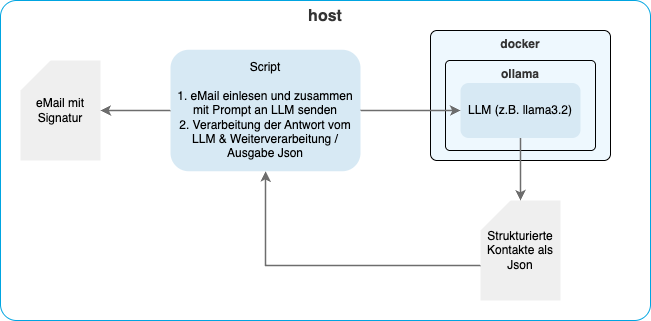
Infrastructure
The Ollama server is used as a local LLM service. This reduces the dependency on external APIs and enables flexible adaptation to different requirements. Specific details on this infrastructure are described in this Blog post described above. Alternatively, a cloud service such as ChatGpt can also be used.
Mapping script
The central element of the PoC is a Python script that includes the following steps:
- Input: E-mail signature as text.
- Prompt definition: A specially designed prompt instructs the LLM to extract relevant data and return it in JSON format.
- API integration: The LLM is addressed via a local REST API.
An example in pseudocode:
# E-Mail-Signatur und Zielformat einlesen

prompt = """
The following mail contains a signature:

{E-Mail-Signatur}

only reply with a json and no further content in the following format where you put in the right details extracted from the mail:

{Ziel-Datenformat}
"""

# Prompt an LLM senden, Antwort parsen und weiterverarbeiten
Results
Even with a basic configuration, the LLM delivers excellent results when extracting information such as name, position, company and contact details:
{
    "properties": {
        "firstName": "Marc",
        "lastName": "Mai",
        "title": "Senior Software Architect, Teamleiter Data Driven Solutions",
        "company": "doubleSlash Net-Business GmbH",
        "street": "Otto-Lilienthal-Str. 16",
        "city": "Friedrichshafen",
        "country": "Germany",
        "phone-mobile": "+49 123 / 4567890",
        "eMail": "info@doubleSlash.de",
        "website": "http://doubleSlash.de"
    }
}
To check the quality of the result, it is conceivable to subject the response to a Json schema validation.
Potential and outlook
The use of LLMs in data mapping impressively demonstrates how modern AI technologies can help companies to automate time-consuming processes.
To further increase accuracy, future iterations of the prompt could be extended with specific examples. If errors are detected during the schema check of the result, the LLM could be prompted again with the specific error and instructed to correct the data set. The use of more extensive LLMs (such as phi4) is conceivable in order to improve processing speed and the quality of data transformation.
In addition to the example shown here, the methodology can also be applied to many other use cases. Possible examples include the conversion of incoming documents (e.g. invoices or application documents) or the standardization of web search results.
The method reaches its limits when 100 % deterministic results have to be generated, as the outputs of LLMs do not follow any determinism.
Conclusion
Data-based mapping with LLMs offers a flexible solution for quickly and efficiently transforming unstructured data into usable formats.
We are already using them in our products, for example in our Data Factoryto realize data transformations quickly and efficiently.