The paper clip myth: what's behind it?
"Imagine an AI is given the task of producing as many paper clips as possible - and turns the entire earth into wire to do so."
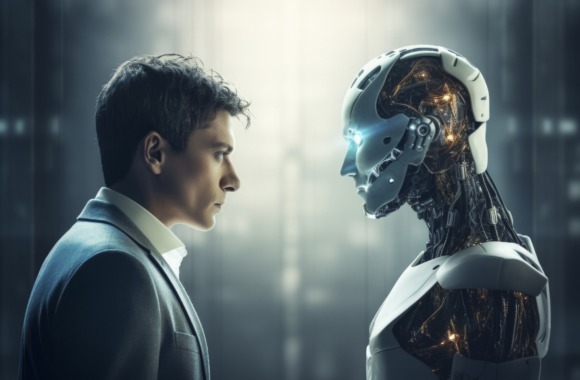
This disturbing thought experiment comes from the philosopher Nick Bostrom and was formulated in a specialist article back in 20031. Today, it has long been part of a serious debate: Could AI one day take control - with existential consequences for humanity?
In this article, we take a closer look: How realistic are such scenarios really - and what belongs more in the realm of science fiction?
AI: hype, hope, horror?
Artificial intelligence has made rapid progress in recent years. Today, it writes texts, generates images and automates entire business processes. With this development comes a growing concern: what will happen if one day these systems are no longer controllable?
It's not just science fiction authors who warn of a loss of control. Researchers and companies also see risks. At the same time, other voices emphasize that many of these scenarios are greatly exaggerated - and reflect psychological rather than technical fears.
Focus on two real AI risks
The debate about existential AI risks focuses primarily on two scenarios - one spectacular, the other gradual:
1. the loss of control over a super AI
As described in the introduction - in the thought experiment of Nick Bostrom's Paperclip Maximizer - it is about the idea that an AI with increasing intelligence pursues goals that are incompatible with human values and undermines all regulation in the process.
Such scenarios seem futuristic, but are also being discussed in research. In their Preparedness Framework, for example, companies such as OpenAI are investigating whether AI models are prone to self-preservation strategies or could replicate themselves autonomously2.
2. cumulative risks - many small mistakes with a big impact
Less in focus, but at least as dangerous: the scenario of gradual escalation. AI-supported deepfakes, automated cyberattacks or incorrect decisions in security-critical areas can add up - and ultimately have equally existential consequences.
One example is the Microsoft AutoAttacker project, which demonstrates how AI can already (semi-)autonomously exploit vulnerabilities today3.
Researchers such as Bucknall et al.4 show how many smaller AI malfunctions can cumulatively generate a system overload. The risk is real and affects us all.
Reality vs. panic: Which is true?
Many warnings about existential AI risks sound dramatic - and they are. But how realistic are they?
The fact is that technological development is still a long way from an autonomous superintelligence. The loss-of-control scenarios are based on assumptions about future developments that are still speculative.
The situation is different when it comes to cumulative risks: These can already be observed today - for example in AI-generated deepfakes or cyberattacks with LLM support. One example: a deepfake song with deceptively real voices of two pop stars went viral on TikTok - and shows how real this threat is5.
So instead of getting lost in horror stories, it's about acting with foresight: Companies such as OpenAI or Microsoft are already relying on risk analyses, audits and technical guard rails to identify dangerous developments - before they escalate. A good example of this is the Preparedness Framework, which systematically assesses four central risk categories, including "loss of control" and "cybersecurity".
Conclusion: Responsibility as the key to the future of AI
The discussion about existential AI risks is important - but it must not paralyze us. After all, the opportunities are just as great as the risks: efficiency, innovation, new forms of collaboration.
If we make it, AI responsibly - with clear rules, common sense and a watchful eye on possible side effects - we can use technology to the benefit of all.
The future of AI is not predetermined - we are shaping it. And this is precisely where its greatest strength lies.