LLMs are essential in many applications today. However, connecting to external systems is complex and often involves a great deal of development work. Anthropic's Model Context Protocol (MCP) was developed to simplify precisely this.
What is the Model Context Protocol (MCP)?
Anthropic describes MCP as "USB-C for AI applications" - a universal connection that can be used to seamlessly connect a wide variety of systems. The open standard offers a uniform interface that links large language models directly with tools and data sources - without individual adjustments for each integration.
Why was Model Context Protocol (MCP) introduced?
AI language models are now more powerful than ever. However, they reach their limits in corporate environments when it comes to making relevant information from different sources usable. Individual integrations used to be the rule - and quickly became a bottleneck for scalable solutions.
MCP solves this problem: as a standardized interface, it creates the basis for more relevant answers and more efficient workflows.
MCP saves companies considerable development effort. Individual integrations are a thing of the past. You can start AI agents faster and expand them flexibly - this saves time, reduces costs and increases the scalability of your AI applications.
The architecture of the Model Context Protocol (MCP) at a glance:
- MCP server: stand-alone programs that provide certain data sources or capabilities, e.g. access to the file system or a database.
- MCP client: connects to the server and mediates between the model and the data source.
- MCP host application: such as an IDE, a chatbot or a desktop client that uses an LLM.
- Data sources and tools: local files, APIs, web services, databases, etc.
- LLM: is used by the MCP host to
- understand what the MCP host needs
- Translate tasks into MCP-compliant commands
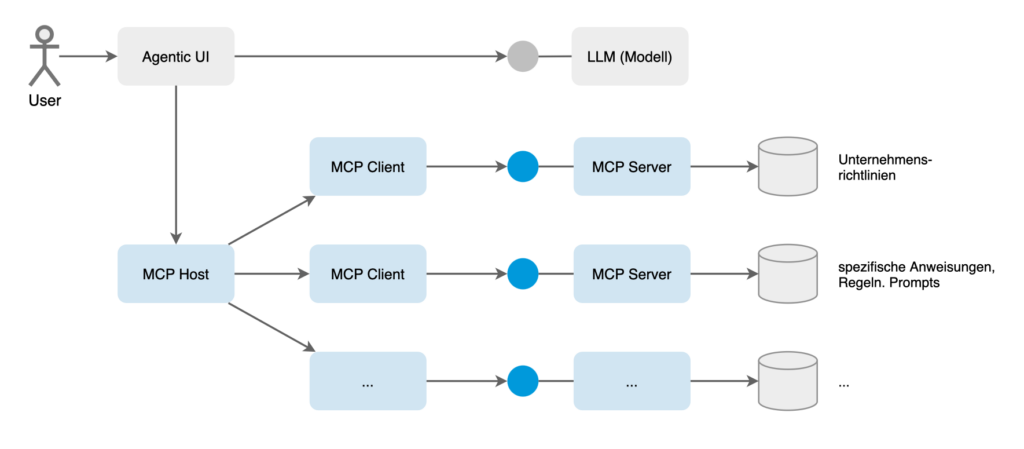
MCP creates a bidirectional and indirect channel between the model and the external world: models can both read data and perform actions - e.g. make changes in a repository or send a new Slack message.
The most important advantages of MCP
- Standardization
MCP solves the problem of fragmented integrations with a standardized protocol structure. Instead of developing numerous individual interfaces, developers can work with a single standard. - Flexibility
Thanks to MCP, it is comparatively easy to switch between different AI models and data sources without having to make major adjustments to the overall system. - Security and data protection
MCP ensures user control and protects sensitive data through secure communication channels (e.g. TLS-encrypted connections) and sandbox mechanisms. In this way, critical resources remain protected while AI agents still have access to relevant information. - Scalability
MCP speaks many communication channels such as HTTP, WebSockets, Server-Sent Events (SSE) and UNIX sockets, which enables a dynamic and scalable connection. Applications can thus be easily expanded without having to rebuild the entire system.
Typical application scenarios: From Git commits to Slack messages
Typical applications for MCP are
- Code assistance with Git integration
- Access to files or notes
- Communication with Slack, Google Drive, PostgreSQL
- Interaction with DevOps tools or knowledge databases
The great benefit for companies is that new data sources or tools can be integrated relatively easily - always according to the same principle.
What technologies are behind MCP?
According to the current specifications and references (e.g. docs.mcp.dev), the following standards and technologies are supported or recommended:
JSON-RPC 2.0 as a central message and method call schema
- Defines the format for requests, responses and error messages
- Enables a standardized structure for function calls and returns
Transportation routes:
- HTTP (incl. TLS encryption)
- WebSockets (for bidirectional communication in real time)
- Server-Sent Events (SSE) (for event-based data transmission)
- STDIO and UNIX sockets (especially in local or containerized environments)
- Authentication & Authorization:
- In principle, freely selectable (e.g. OAuth2, JSON Web Tokens), but the MCP specification recommends clearly defined Auth protocols for access control
- MAC or token-based mechanisms can be used as an option
Expandability:
- Own transport adapters can be added
- Community servers can provide specific "capabilities" such as Git or database access
- The modular structure makes it possible to integrate additional protocols (e.g. gRPC)
Security mechanisms:
- Encryption (TLS/SSL) for network connectivity
- Role-based access management to individual functions (e.g. getFile, writeFile, commitChanges)
- Sandbox approaches to allow actions only in the permitted context
As a result, MCP not only offers a standardized interface for AI agents, but also a wide range of options for selecting the right communication and security infrastructure depending on the use case.
How does MCP actually work?
Integration
Developers use official SDKs (Python, TypeScript, Java, C#) or build their own servers with JSON-RPC. The server provides "capabilities", e.g. getFile, search, writeFile.
An AI agent uses these capabilities via the MCP client. Typical procedure:
- Host app starts or connects an MCP client.
- The client connects to one or more MCP servers.
- The available functions (methods) are recognized automatically.
- If required, the model can address the server to obtain data or trigger actions.
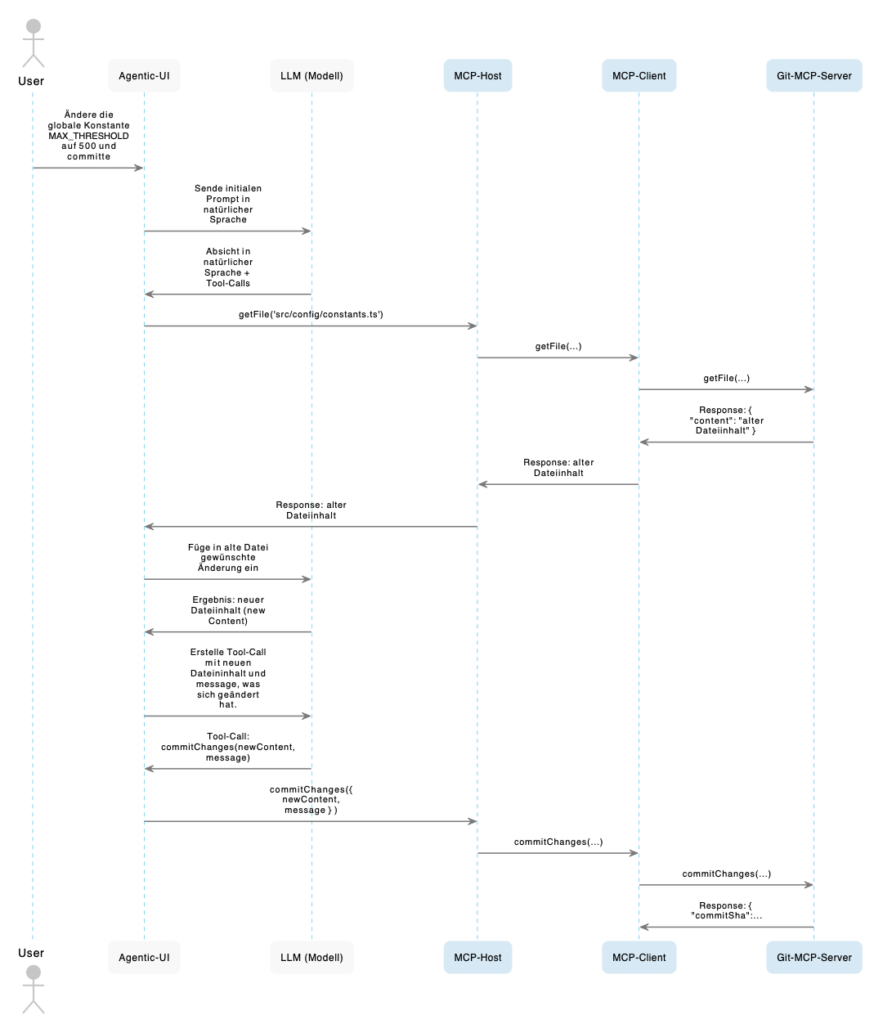
Example: Change & commit function via MCP
1st user prompt:
"Set the value of MAX_THRESHOLD in constants.ts to 500 and commit the change with the message: 'Increase threshold to 500'."
2 LLM recognizes the intention:
- File must be changed
- Customize code
- Trigger commit
3. host calls getFile via MCP to load the current status:
{
  "jsonrpc": "2.0",
  "id": 1,
  "method": "getFile",
  "params": {
    "path": "src/config/constants.ts"
  }
}
4. model generates new content
(based on old version + change request)
Example content after modification:
export const MAX_THRESHOLD = 500;
5. host calls commitChanges:
{
  "jsonrpc": "2.0",
  "id": 2,
  "method": "commitChanges",
  "params": {
    "changes": [
      {
        "path": "src/config/constants.ts",
        "newContent": "export const MAX_THRESHOLD = 500;"
      }
    ],
    "message": "Erhöhe Threshold auf 500"
  }
}
6 MCP server responds with commit success:
{
  "jsonrpc": "2.0",
  "id": 2,
  "result": {
    "commitSha": "a3b9cfe1",
    "status": "success"
  }
}
Result:
- The agent was able to understand, change and save code in a context-sensitive manner.
- The whole process runs via MCP in a structured and secure way, without the model having to speak "Git" directly.
Risks and challenges in dealing with MCP
Technical
- Incorrect integrations can provide incorrect data or trigger actions.
- Community-based servers may be insufficiently tested.
- Without stable interfaces, there is a risk of instability when API changes are made.
Security
- Models could trigger actions that are not authorized.
- Prompt injection can lead to dangerous behavior.
- Access rights to data and write functions must be configured precisely.
- A lack of authentication or encryption can lead to data leaks.
Ethical
- Who is liable for wrong decisions made by an AI agent?
- How do you prevent agents from making unwanted changes to systems?
- How can we understand what an agent has learned and used from a context?
Conclusion: MCP as the backbone of the agent future - with potential and manageable risk
MCP provides a clear answer to a central problem: How can an AI agent interact reliably with its environment without connecting each system individually? The vision: a modular, reusable slot for context and tools.
A concrete example from practice is the doubleSlash AI Assistantwhich is already successfully based on the MCP architecture and therefore interacts flexibly and efficiently with different company data sources.
Companies such as Replit, Sourcegraph, OpenAI and many more are already using MCP or are working on integration. In the long term, MCP could become a central standard for agent architecture - similar to REST for APIs or USB for hardware.
A conceivable future scenario: AI-agents with secure, structured access to an entire ecosystem of capabilities - from financial reporting and software testing to sales analysis. All via a uniform protocol standard.
The risks are real - but manageable. MCP could be the backbone of a new era of agents: secure, open and powerful.1
This article was written jointly by Konrad and Manuel.

About me
Manuel Bauer
Manuel Bauer has a Bachelor of Science in Business Informatics, is a Software Engineer at doubleSlash and has extensive experience from IT projects with customers such as BMW, Porsche and Vorwerk.
His focus is on complex IT systems, cloud infrastructures and the development of cloud-native software solutions. He is currently focusing in particular on the use of artificial intelligence in software development.
Well versed in requirements engineering, Java, Python, cloud-native application development, SQL/NoSQL, AI and DevOps, he combines technical expertise with an eye for holistic solutions.