

Would you trust an algorithm with your life?
In medicine, justice and road traffic, AI systems today make decisions that can have serious consequences. This makes it all the more important that we understand how these decisions are made.
Artificial intelligence is no longer a topic for the future. In industry, AI simplifies processes, in medicine it recognizes diseases, and even the judiciary and finance rely on automated decision-making. But the greater the influence, the greater the risk: discrimination, misuse of data or incorrect diagnoses can have serious consequences.
This is where two key concepts come into play: Responsible AI and Explainable AI. They help to make artificial intelligence not only efficient, but also transparent, fair and responsible.
What are Explainable and Responsible AI (XAI and RAI)?
Responsible AI means: AI must follow ethical standards. It should be transparent, fair, secure and data protection-compliant - especially in security-critical areas. There are no uniform rules, but there are numerous guidelines and principles.
Explainable AI (XAI) is the backbone of this responsibility. These principles can only be enforced if it is clear how a model makes decisions. Together, XAI and RAI form the basis for trustworthy AI.
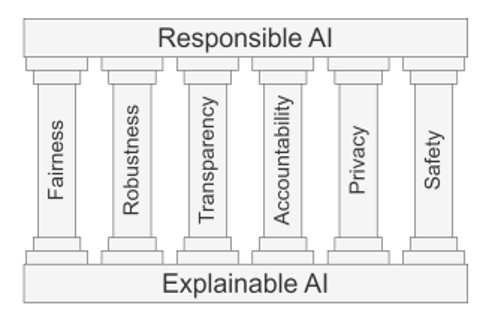
The 6 pillars of Responsible AI - and how XAI helps
- FairnessXAI makes it visible whether models discriminate against people on the basis of gender or origin. Tools such as SHAP or LIME show which characteristics influence decisions - a must for lending or criminal prosecution. Techniques such as SHAP (Shapley Additive Explanations) help to identify biases by showing how certain characteristics - such as gender or nationality - influence predictions. This enables developers to take targeted countermeasures and make fairer decisions. This is particularly essential in sensitive areas such as crime predictions or credit checks.
- RobustnessAI must function reliably - even with new data or attacks. XAI helps to analyze how stable a model reacts to disruptions.
- TransparencyHeatmaps or text-based explanations enable users to better understand - and trust - decisions.
- ResponsibilityIt is particularly important to justify decisions in medicine or finance. XAI makes it clear why a decision was made - e.g. for diagnoses or loan commitments.
- PrivacyTechniques such as federated learning or differential privacy ensure that personal data remains protected - and yet it is still possible to explain how the model works.
- SecurityXAI helps to identify sources of error at an early stage - and to better safeguard decisions in safety-critical areas such as autonomous driving.
Where is explainability particularly important?
- MedicineReliable diagnosis requires explainable models - especially when it comes to cancer or chronic diseases.
- DefenseMilitary decisions are also becoming increasingly automated - responsibility is essential here.
- FinanceBanks use AI to detect fraud. Without a comprehensible decision-making logic, there is a lack of trust. Everywhere in the EUAccording to the law, AI decisions must be explainable - transparency is a legal requirement.
Explainability creates trust - especially where human lives, safety or justice are at stake.
Conclusion and outlook for part 2
Responsible AI and Explainable AI together form the ethical basis of modern AI. Without explainability, responsibility remains an empty shell - with XAI, on the other hand, it becomes tangible and verifiable.
In Part 2 let's take a look at the concrete methods of XAI: Which models are inherently explainable? How can black box models be understood retrospectively? And what role do tools such as SHAP or LIME play?