

Where can artificial intelligence be used in maintenance?
Artificial intelligence can potentially be used whenever Machines collect datathat can be evaluated. Whether on the machine itself or through networking in a cloud. Two fundamental questions often lend themselves to the use of artificial intelligence:
Data basis for a predictive maintenance project
First of all, it must be clarified which Data are available. In our implementation of Predictive maintenance in the area Wind energy with our customer ZF machine properties, machine status data and service logs are available, for example.
Due to the many different sensors on the machines, we often have to deal with a multi-dimensional task. In addition, completely different Data types be evaluated.
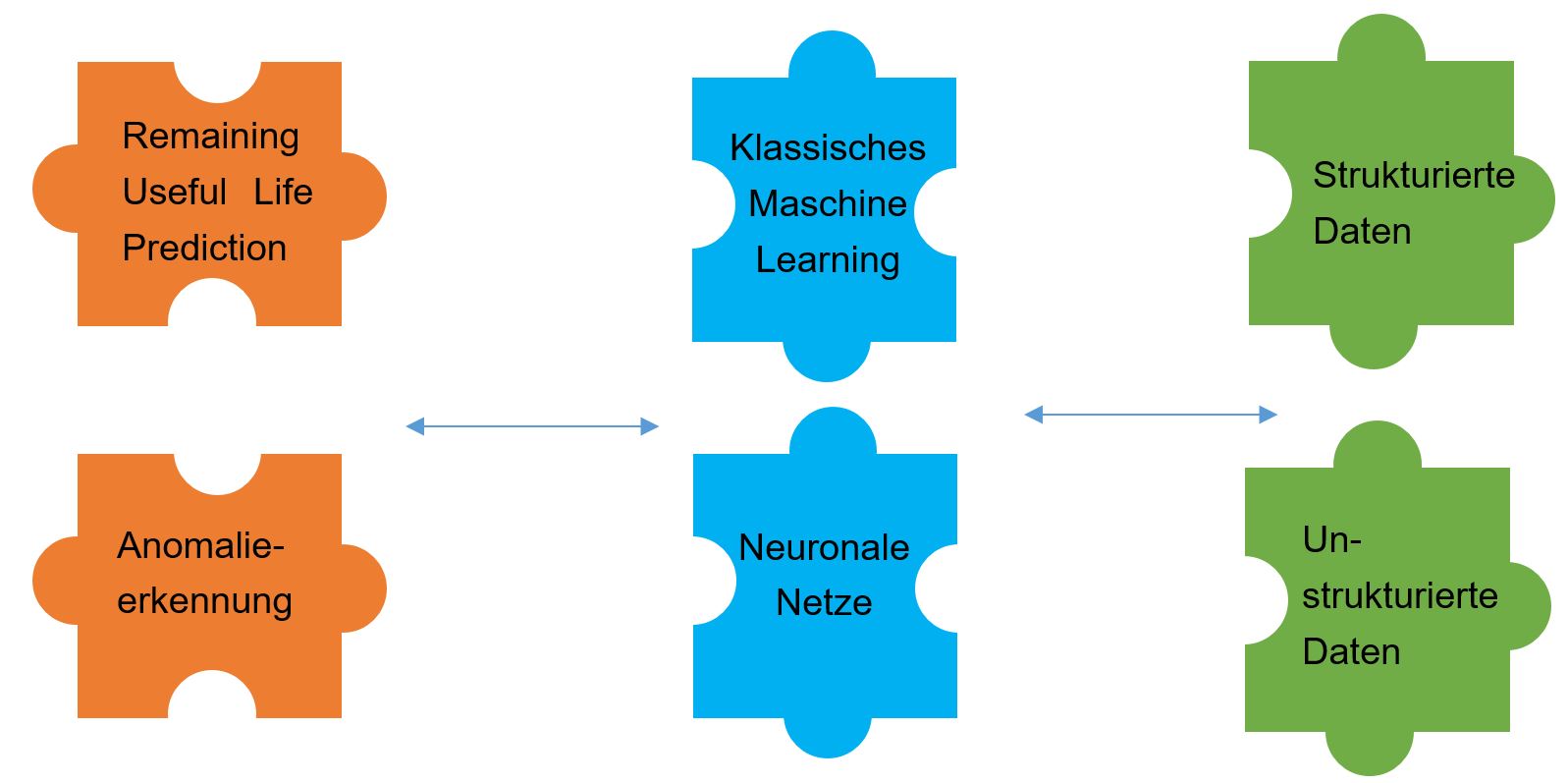
A rough distinction is made between two types: structured and unstructured data.
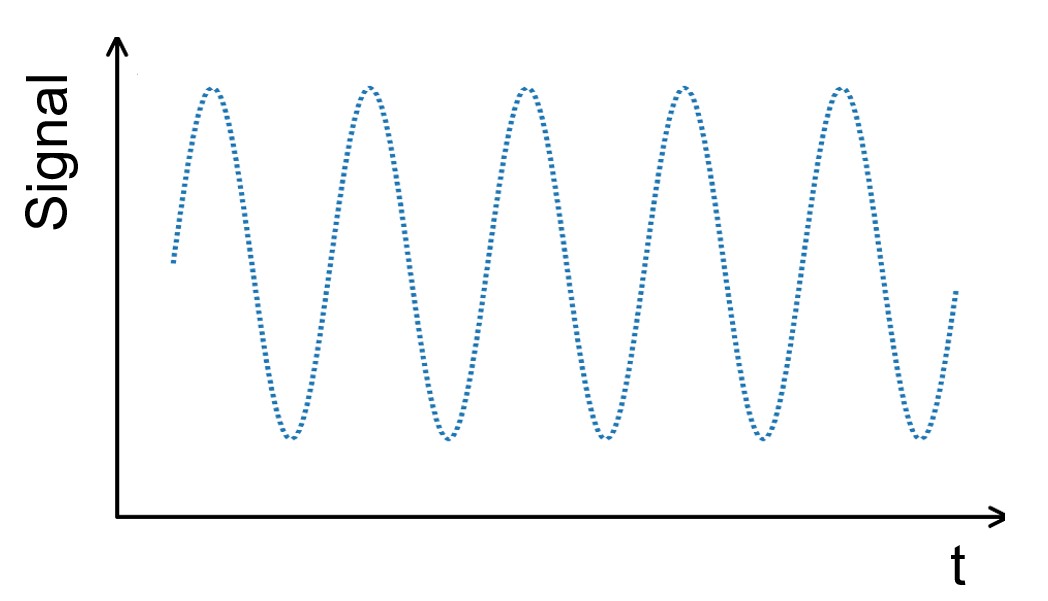
| Structured, sequential Data: This includes time series measured by a temperature sensor, for example. Time series have the important property that successive values are normally related and not random. |
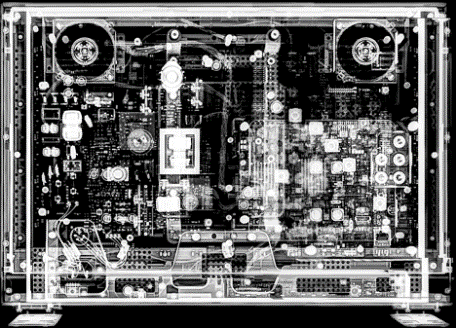
| Unstructured Data: Unstructured data includes, for example, images taken during the production process or audio signals from microphones installed on the machines. This data also allows conclusions to be drawn about the machine status. |
Frequently used machine learning methods in the predictive maintenance sector
Many different machine learning methods have already been used in the predictive maintenance environment. These can be roughly divided into:
- Classic machine learning: Examples of this are decision trees or support vector machines
- Neural networks: for example as an autoencoder.
The main difference between the two methods lies in the extent to which the data has to be prepared and processed manually. Ideally, neural networks require significantly less manual data preparation, provided that a sufficient amount of data is available.
Frequent use cases
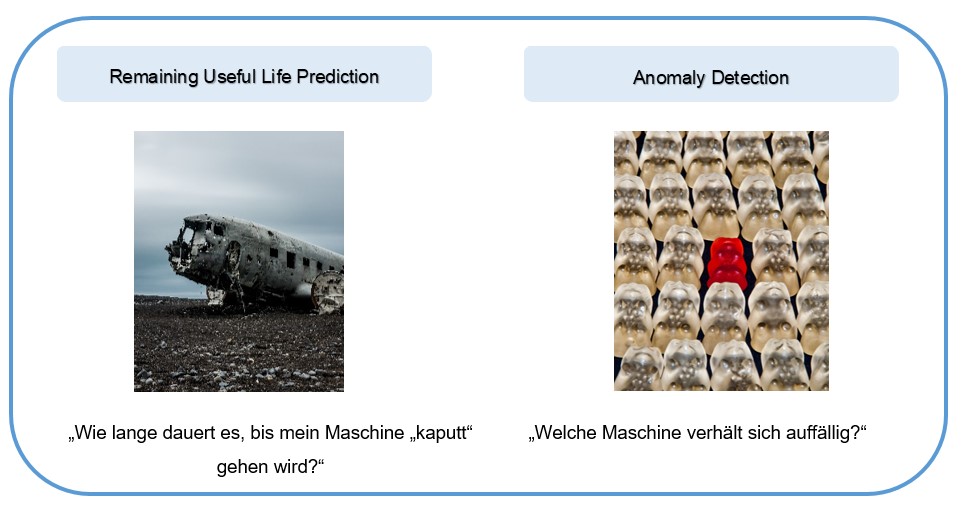
As described at the beginning, there are two common questions: how long can my machine still be used productively ("Remaining Useful Life") and does my machine already show signs of failure or breakdown ("Anomaly Detection").
Remaining Useful Life
To be able to answer, how long it takes for a machine to "break"labeled data is required. For this purpose, service data is compared with the machine data. From this history, it is always clear at a later date when the machine will historically break down. The label "broken" or "not broken" can therefore be attached to each historical machine condition.
The "Remaining Useful Life" of a machine can be defined in very different ways. For example as:
RegressionIn the regression, the remaining days until failure are predicted. For example: "The machine is expected to break down in 100 days."
ClassificationClassification attempts to predict a time interval in which the machine will break down. For example: "the machine will break down in the next 0-30 days."
In both cases, an attempt is made to model the broken state when recognizing the "Remaining Useful Life". Accordingly, data is required here that shows a machine that is gradually moving towards the defective state.
Anomaly detection
The second question concerns the Detection of unusual machine behavior. In contrast to the Remaining Useful Life application, anomaly detection models the normal Machine condition and sounds the alarm, when something unexpected happens. This is "predictive" in the sense that, ideally, signs of failure are detected that are an indication of future failure. In contrast to "retaining useful life" prediction, anomaly detection does not require data describing the broken state to create a model. Instead, the idea is to build a model for the normal behavior of a machine and report when the known behavior deviates from the model. Data on the defective machine state is then required for quality control. As a machine learning method, for example, a Autoencoder can be used.
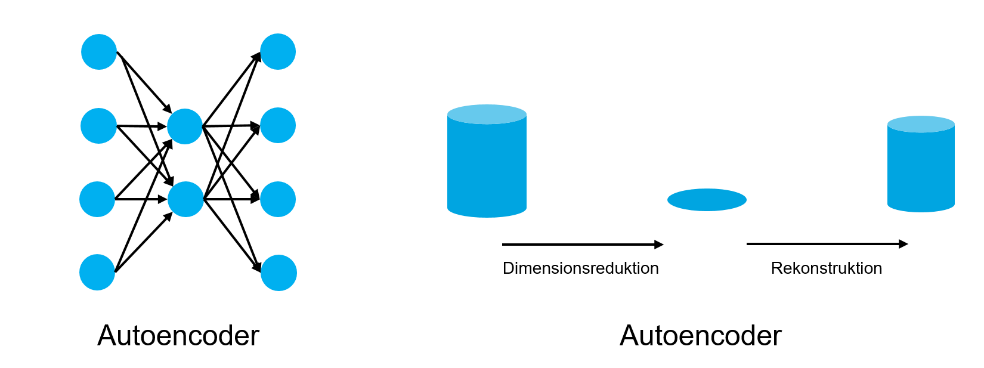
The autoencoder uses a tricky trick: it learns a rule from the machine's normal state data in order to compress the information it contains ("dimensional reduction"). For normal state data, the difference between compression and decompression is very small ("reconstruction error"). If, on the other hand, the measured data is unusual and therefore "not normal", the compression rule works significantly worse, so that the decompression error increases and the autoencoder classifies the data as "not normal".
Which machine learning method for which use case?
In our experience, the right combination of use case, data type and machine learning method must be found for predictive maintenance.
Conclusion
Predictive maintenance promises Great financial potential due to reduced downtime and optimized personnel deployment. Machine learning provides the necessary intelligence. However, the prerequisites for this must be right: the path to success can only be paved with well-considered planning. The absolute basis is a Thorough data inventory - it provides an overview of the possibilities; for example, to implement the Remaining Useful Life prediction or anomaly detection. Above all, it also depends on the Suitable combination of use case including data type and machine learning method to.

Sources:
[1] https://unsplash.com/photos/AoDlbGtfRh0
[2] https://www.pexels.com/photo/food-colorful-sweet-bear-54633/
[3] https://pixabay.com/de/photos/x-ray-xray-technologie-237402/
These other blog posts may also be of interest:
Digitalization as the basis for predictive maintenance
How does predictive maintenance differ from other maintenance methods?
Out of the downtime trap with predictive maintenance and monitoring