Monday morning, 8 o'clock. You're sipping your first coffee when an unexpected team call comes in. Your boss appears on the screen, serious and almost panicked. He urgently needs €10,000 to save a sensitive project abroad. You initiate the transfer. Finally, you recognize his voice, his face and even his facial expressions and gestures seem absolutely familiar.
But what if this call was never real?
Such cases are no longer fiction. In 2024, an employee in Hong Kong was also deceived with a deepfake. In a video conference with supposed colleagues and superiors, he was instructed to transfer 25 million US dollars. The money disappeared.1
Deepfakes - When the boundaries between truth and lies become blurred
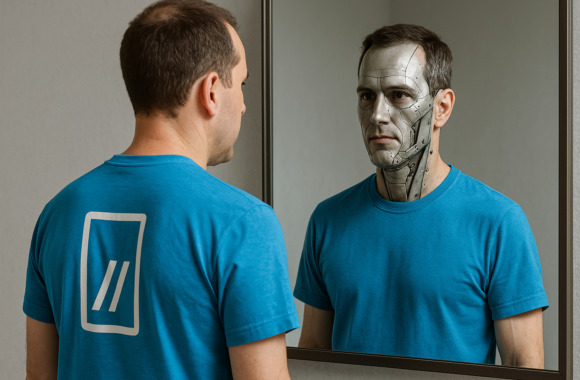
Deepfakes are created using Artificial intelligence (AI) generated deceptively real fakes of voices, images or videos. This is made possible by special generative AI (GenAI) models that have learned to imitate speech, facial expressions and movements, for example. This allows people to be copied almost perfectly across different media - even without their consent.
Current video example: Financial analyst imitated by deepfake on Facebook
An incident from 2024 illustrates the dangers of deepfakes: renowned financial analyst Michael Hewson fell victim to one such scam. A video circulated on Facebook in which Hewson appeared to be advertising a WhatsApp group promising quick investment profits. Both his image and his voice were manipulated using artificial intelligence to deceive potential victims.
Hewson makes it clear that he would never make such offers via WhatsApp. Meta, Facebook's parent company, has since removed the video and is working on identifying and deleting such fraudulent content more quickly.2
Deceptively real on the phone: the new danger of deepfake calls
It's not just videos that are affected, calls can also be deceptively faked these days. In so-called deepfake calls, fraudsters use AI-supported voice models to pretend to be relatives, colleagues or superiors. The voice sounds familiar, the content appears urgent and the fear for loved ones is shamelessly exploited. In Germany, there have recently been several cases in which supposed family members have called for help - in fact, AI fakes.
How do you recognize such deepfake calls in time?
A high level of urgency is typical: callers put pressure on the other person to act quickly, often with alleged emergencies. Although the voice sounds familiar, it sometimes sounds slightly unnatural - emotionless or monotone. Small delays or repeated evasion of specific questions can also be indicators. If you are unsure, you should end the call and call back using a known number or seek reassurance from colleagues or relatives.3
Dangerous deception: How AI disinformation deliberately manipulates opinion
Modern AI models such as LLMs or diffusion models are increasingly being used in disinformation campaigns. They generate deceptively real fake news, videos or social media posts. The aim is to create uncertainty, influence opinions or deliberately undermine democratic processes. The fact that almost any information about us is available on social media poses a particular danger, as AI models have been proven to be particularly convincing when they have access to personal data.
DeepSeek: Between censorship and disinformation
One current example is the Chinese AI model DeepSeek. It demonstrably censors sensitive topics and represents pro-Chinese positions. Even in the open-source version, these restrictions are difficult to remove. DeepSeek is therefore suspected of being used specifically for state propaganda and opinion management.4

Conclusion: Trust is good - control is essential for survival
Whether manipulated videos, calls or messages: Digital deception is becoming more sophisticated - and more dangerous. If you don't question content, you risk becoming a victim of modern scams.
Companies and private individuals alike have to deal with AI-risks. Technical protective measures are needed - and one thing above all: critical thinking, even if the voice sounds familiar.