Especially in the course of the Digitization and the age of Big Data machine learning models are playing an increasingly important role in the conquest of new business areas and thus the success of companies. One reason to devote more attention to this topic.
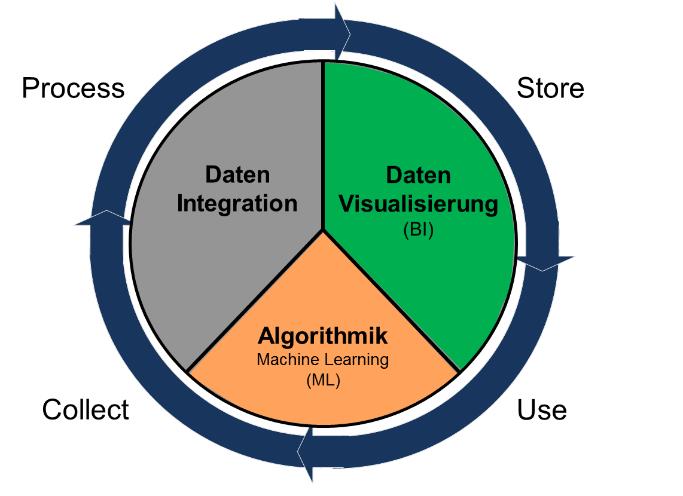
Our experience has shown that the following three topics can be found in most big data applications:
- Data integration / processing
- Data analysis/algorithms
- Data visualization/BI
Consequently, we at doubleSlash have organized our internal Big Data working group according to this structure.
Machine Learning
This article is intended to provide an insight into the topic of machine learning and answer the following questions:
- What is machine learning and what are its goals?
- Where does machine learning fit into the context of artificial intelligence?
- What are sub-areas and methods of machine learning?
Machine learning - goals and workflow
In its simplest interpretation, machine learning is the creation of intelligence in a system with the aim of simplifying and optimizing human decision-making.

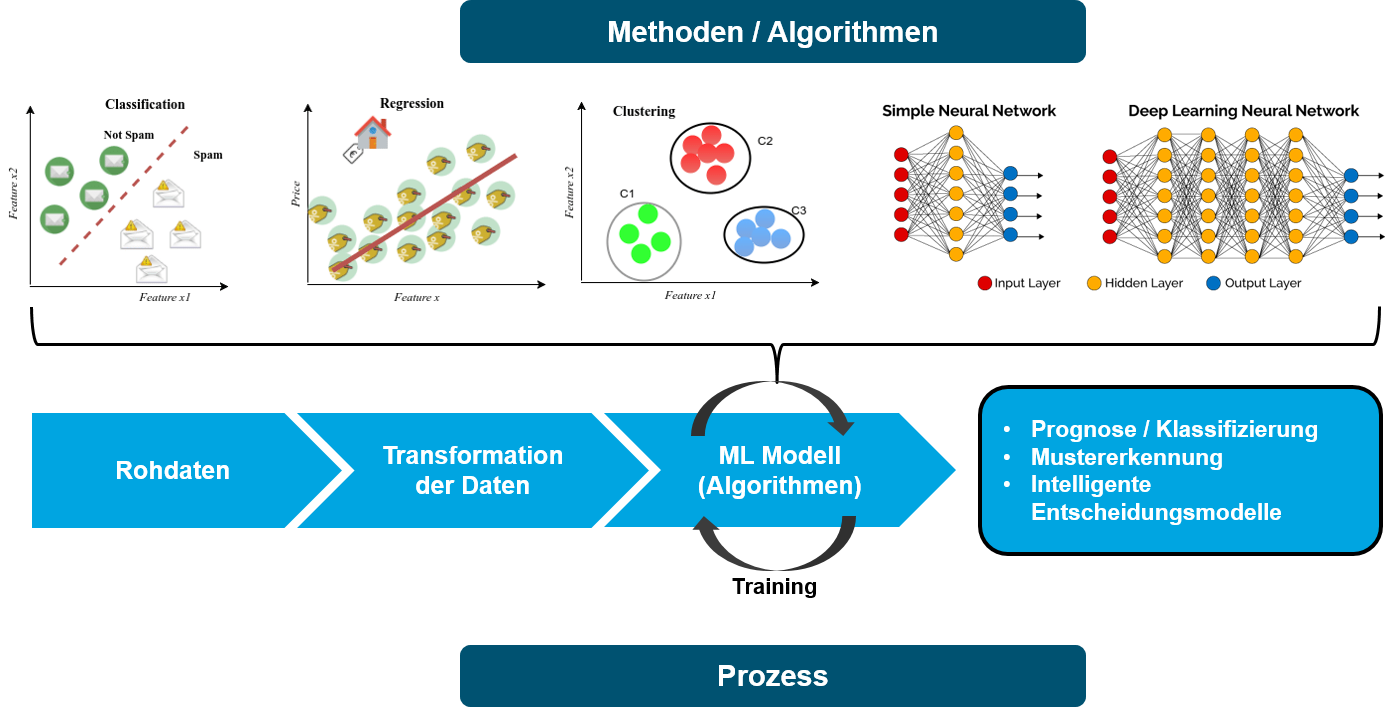
The aim of machine learning is for a system to independently "learn" the most appropriate prediction or classification model in relation to a specific target value or the identification of certain patterns in data.
Prediction or classification model by a system, in relation to a certain target value or the identification of certain patterns in data.
The methods of ML determine how suitable a model is with regard to reality and thus determine its informative value. We will take a closer look at this in the last section.
In addition, there is the specific ML process (workflow), which is used to learn and optimize the model.
Let's take a closer look at the machine learning workflow here. It is designed to train models, by validating the assumptions of the model with test data in numerous runs.
The ML workflow is divided into two phases:
- Training phase: Once the ML model (algorithm) has been selected, the model is trained in numerous runs using training and test data. The data first undergoes a transformation, also known as feature extraction. Here, the input data is "reduced" to certain target attributes.
After training runs with the model, these are evaluated and appropriate adjustments are made to the parameters of the model.
- Application phase: Once an ML model has proven itself in the training phase, the model is released onto real data. The feature extraction performed in the model is also carried out here. Forecasts, classification or structuring of the data is then used in business models.
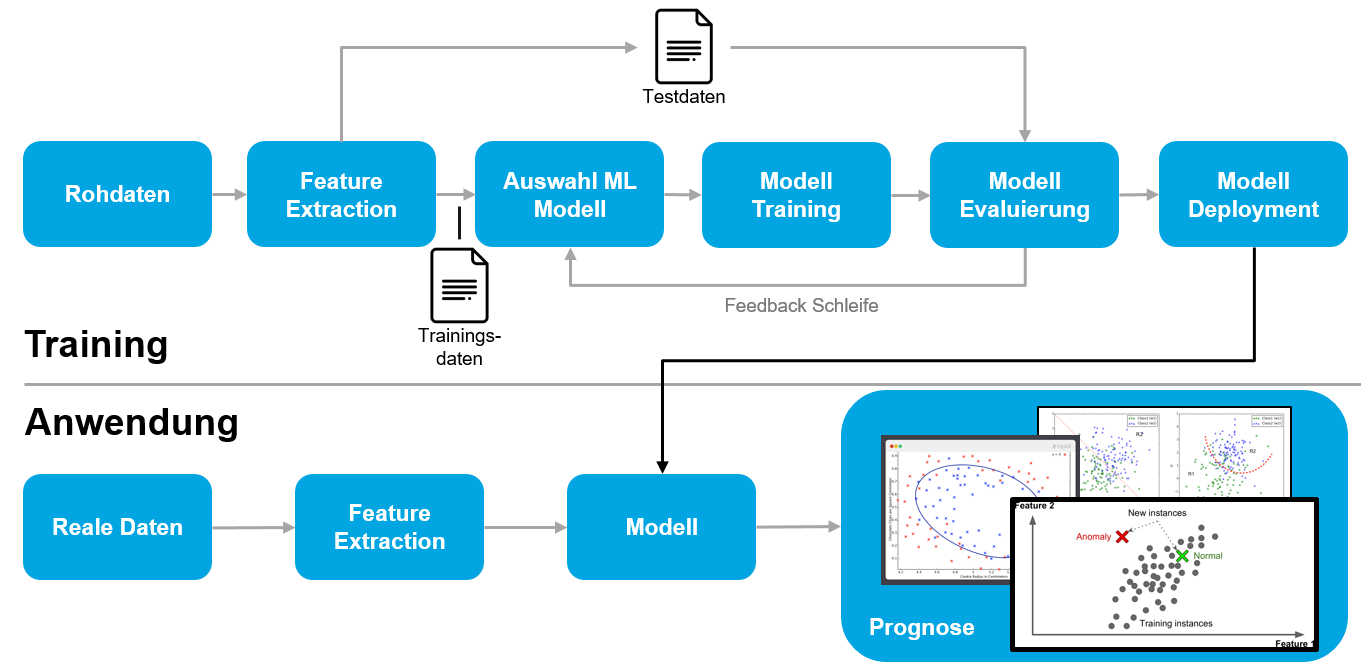
The feature extraction step is also often referred to as part of the overall dimension reduction. Here, the input data is reduced to a representative subset in order to reduce the complexity of the model. A common method of dimension reduction is the Main axis transformation.
Machine learning in the context of AI
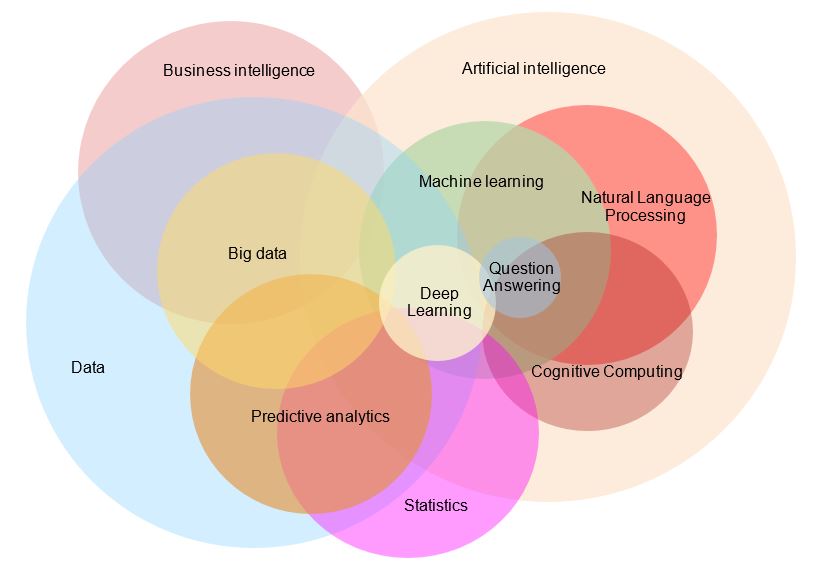
In the numerous discussions about artificial intelligence, machine learning or deep learning, these terms are often mixed up or used as synonyms. Let's break this down.
If we look at "Figure 4 - Machine learning context", we see the following connection: Deep learning is a sub-area of machine learning, which in turn is a part of artificial intelligence.
The sub-areas of artificial intelligence differ in terms of their field of application, but in some cases there is a large overlap in terms of the use of algorithms. Natural speech recognition, for example, is now largely based on machine learning models.
Deep learning is the most complex and powerful category of machine learning. Deep learning generally refers to the use and optimization of artificial neural networks (deep neural networks). The most popular example of a deep learning application is AlphaGo Zero.
Sub-areas and methods of machine learning
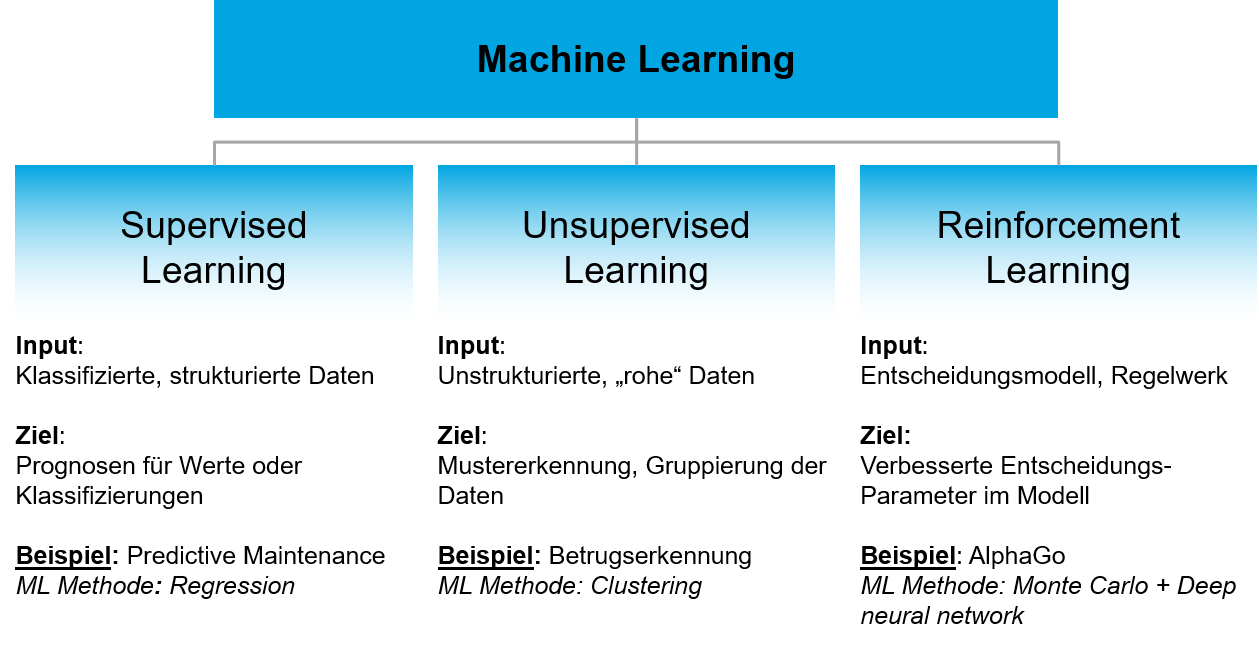
Machine learning is divided into three categories:
- Supervised Learning
- Unsupervised Leaning
- Reinforcement Learning
The three categories differ in terms of their input data, the type of learning process and their target statement.
Supervised Learning
In supervised learning, both input parameters (features) and target values (the correct answers) are already known. Training data is then used to create a model that is able to calculate a corresponding prediction for new, previously unknown input data. Put simply, the system learns to assign similar input data to similar target values. The system therefore knows how and what it has to learn. This is known as supervised learning.
Supervised Learning can be divided into two problem categories:
- Regression problems: I.e. the target value is a real value, e.g. revenue or rainfall
- Classification problems: The target value is the classification into a category, e.g. cancer cell vs. healthy cell
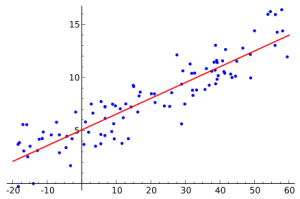
The following algorithms are most frequently used for these problems:
- Regression (linear, logistic, multivariate)
- Support vector machines
- Naive Bayesian estimators
- Simple neural networks
Unsupervised Learning
In contrast to supervised learning, unsupervised learning No specification regarding the target value made. The aim here is to, Structures and connections in the input data for recognize and thus learn more about the data itself. Learning is therefore not controlled with regard to a specific statement and is therefore referred to as Non-supervised learning ("Unsupervised Learning").
Unsupervised learning can also be divided into two categories:
- Clustering: The aim is to identify the inherent groups (clusters) in the data and to structure the data accordingly
- Association models: The aim is to identify logical relationships (rules) between data groups (e.g. customers who buy product A also choose product B)
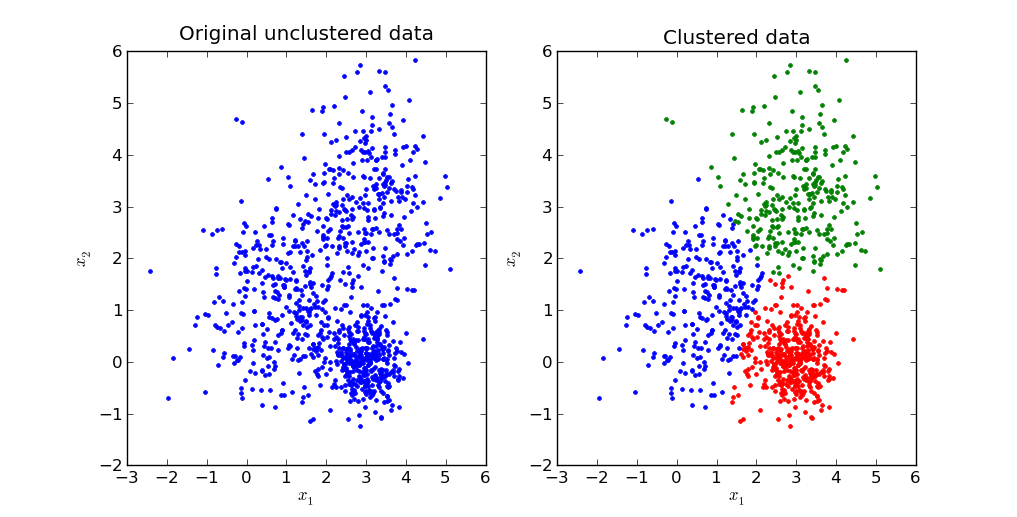
The following methods, among others, are used for unsupervised learning models:
- K-Means
- K-NN (k-nearest-neighbor clustering)
- Autonencoder (as an application of neural networks)
Reinfocement Learning
Reinforcement learning is a collection of techniques for the development of autonomous decision models in which it is necessary to react to changes in the environment. These scenarios are usually too complex, so that methods of supervised and unsupervised learning are no longer effective. The best-known example at present is the system developed by Alpha AlphaGo Zero.
The aim of reinforcement learning is to ensure that an agent of a decision model independently learns a strategy, with which the "reward" received is maximized. A reward can be, for example, winning or losing a game.
Agents are in models of reinforcement learning Executing units, from which the complex calculation steps are divided. The agent does not evaluate which action is optimal at each step, but receives a decision at a certain point in time. Reward, which can also be negative (e.g. profit / loss). Depending on the reward, the agents weight their decisions in the model.
Since the target function can no longer be calculated numerically in complex models with large action spaces, artificial neural networks (deep neural networks) are used to approximate the function.
To train the agents, the following are used Algorithms frequently Monte Carlo methods or the Temporal Difference Learning used.
Machine learning - an outlook
In the next part of our blog series we want to Machine Learning Framework from Apache introduce, Spark MLlib. Here we take a look at the Architecture from MLlib, go to Data structure and would like to introduce you to some of the methods MLlib has to offer using case studies.
elektroniknet.de describes what DFKI's "Fast&Slow" project on deep learning is all about.1