
Complexity in microservice architectures
Modern software architectures are increasingly relying on microservices to ensure scalability and modularity. However, these advantages come with a number of new challenges:
Do you know the problem when your service is suddenly unavailable - but nobody knows exactly why? Or when you have to spend hours debugging because another service is not responding?
How do you ensure secure communication between services? How do you deal with errors when individual services fail? And how do you maintain an overview when the number of services multiplies?
In traditional architectures, responsibility for many of these cross-cutting functions lay with the development team itself. But with the advent of Service Meshes - such as Istio - this approach is changing fundamentally. These technologies not only promise greater security and resilience, but also a considerable reduction in workload for development teams - and for you.
Service Mesh explained: what's really behind it
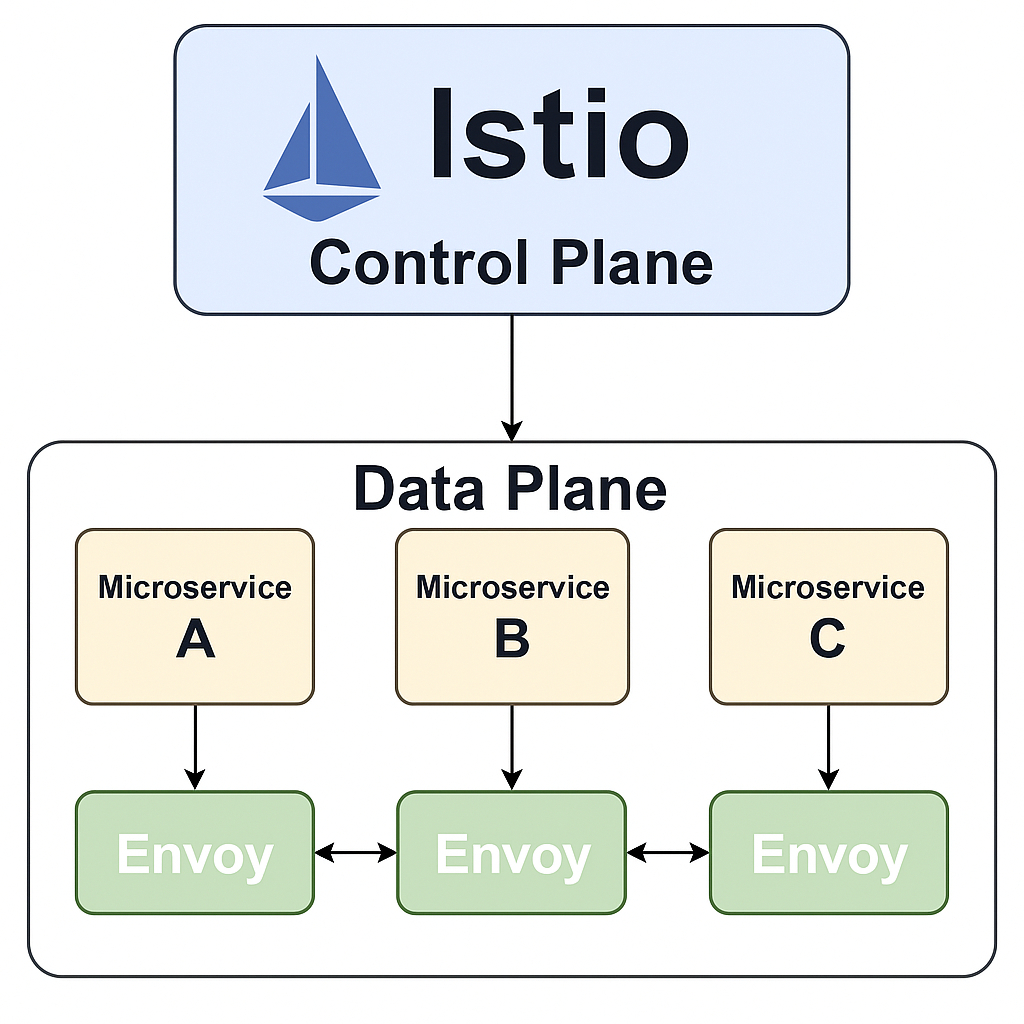
A service mesh is an additional infrastructure layer that controls and monitors the network traffic between microservices. It usually consists of two main components:
- Data PlaneConsisting of so-called sidecar proxies (e.g. Envoy), which run directly next to each microservice and handle incoming and outgoing traffic.
- Control PlaneA central instance (e.g. Istio) that controls the configuration and behavior of the sidecars.
This separation allows cross-sectional functions such as security, routing and resilience to be outsourced from the application code - and made centrally controllable.
Istio in focus: What it does for developers
Istio is one of the best known and most widely used service meshes. It offers a variety of features that directly contribute to reducing the workload of development teams:
- Automatic mTLS encryptionAny data traffic between services can be encrypted without you having to implement TLS manually.
- Failure resistance: Features such as automatic Retries, Timeouts and Circuit Breaker ensure that temporary errors do not lead to a system standstill.
- Traffic controlCanary releases or A/B tests can be implemented using simple configurations.
- Central security guidelinesAuthentication and authorization can be controlled via policies (e.g. based on JWTs).
Resilience without extra effort: best practices with Istio
Resilience is essential in distributed systems. But implementing retry mechanisms or timeouts in every single microservice is time-consuming and error-prone.
Have you ever experienced a single unstable dependency slowing down your entire application?
Istio allows these patterns to be implemented declaratively and consistently. For example, a service that accesses an unstable upstream service can be configured via Istio to automatically perform three retries with exponential backoff. All this without changing a single line of code in the microservice itself—just by using a YAML manifest like this: 1
apiVersion: networking.istio.io/v1
kind: VirtualService
metadata:
  name: ratings
spec:
  hosts:
  - ratings
  http:
  - route:
    - destination:
        host: ratings
        subset: v1
    retries:
      attempts: 3
      perTryTimeout: 2s
Zero trust and secure communication
In a service mesh, communication is based on the Zero Trust PrincipleNo service may trust another per se. Instead, authentication takes place mutually via mTLS (mutual TLS).
Istio automatically generates and manages certificates for each workload and ensures that all services only communicate with each other in encrypted and authenticated form. Policies can also be used to granularly control which services are allowed to talk to each other - without any security logic in the code.
What will change for developers
What would you do if you no longer had to deal with security protocols or load balancing in your code?
A service mesh like Istio allows you to focus more on the essentials: the business logic. Many infrastructure issues - such as security, routing or resilience - become the responsibility of the platform or the DevOps team. You can rely on declarative configurations that apply consistently throughout the entire system.
This creates a clear separation of responsibilities and higher quality in the overall system - without every team having to reinvent the wheel.
Limits and challenges
Despite all the advantages, a service mesh also entails a certain degree of complexity:
- The introduction requires initial effort and know-how.
- The sidecars cause overhead in terms of CPU and memory.
But don't worry: you don't have to implement everything at once. An iterative implementation concept - e.g. starting with individual namespaces or services - has proven itself in practice.
Conclusion: What does this mean for you as a developer?:in?
A service mesh is not a panacea, but it is a powerful lever for robust, secure and maintainable microservice landscapes. For you, this means a noticeable reduction in workload: less technical ballast, more focus on actual product development.
Especially in times when security and availability are key success factors, a service mesh like Istio can be exactly the missing piece of the puzzle that gives your architecture the support it needs.