

Anyone researching the topic of artificial intelligence or machine learning on the web will find many search results, and the trend is rising. The trend in Google search results for "machine learning" shown below clearly demonstrates this.
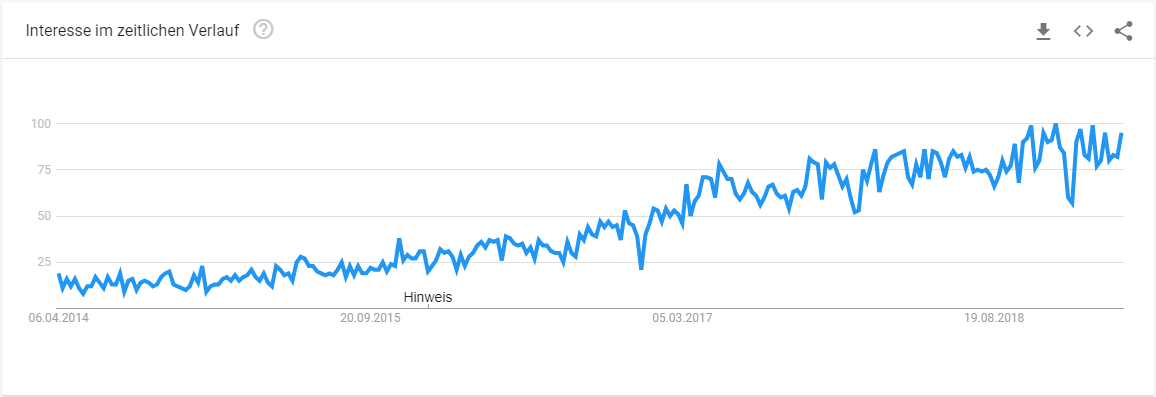
Google Trend - Machine learning Machine learning (ML) is not a brand new technology. In fact, research has been conducted in this area for several years, and frameworks such as Tensorflow and Keras have emerged from this research. Recently, the topic of also really takes off in practice. This is due to the following factors, among others:
- The rapid increase in computing power in recent years.
- There is now sufficient data available in many areas because companies are collecting more data - from interactions with customers and from their machines.
- AI (artificial intelligence) has already clearly proven itself in the consumer sector, and customers now expect the same convenient digital options from companies in every respect.
When we talk about the consumer sector, we are referring to applications that almost all of us have already come into contact with. Voice assistants on mobile phones, for example, or sound boxes at home such as Alexa or Siri. These systems are controlled by machine learning algorithms to support us in our everyday lives.
Machine learning - what is it actually?
If you look at the topic of machine learning in a very abstract way, you could say: It is about intelligent computers or servers independently recognizing situations and deriving or executing appropriate measures from them. The computer should be able to link data/events independently and intelligently, just like humans, and generate solutions for new, as yet unsolved problems.
But how is a computer supposed to do that?
The basis is software that works with self-learning algorithms is equipped and tries to use it, Patterns in data to recognize. The program uses these patterns for further decisions. At this point, however, we have to provide the software with the basis; it goes to school with us, so to speak. We use data to teach the software what patterns exist and what possible measures can be taken based on them. The self-learning algorithms build on this and develop new patterns.
This rather abstract description makes it very clear what the essential basis for machine learning is: data, data and more data. This is also one of the main differences to other projects in the IT sector. In ML projects, we have to start with a very clear focus on data and try to process it in the best possible way. The better we are at this, the better our results will be.
Very often, the effort that needs to be put into analyzing the data and selecting the appropriate algorithms is underestimated. For this reason, there are now also professions that deal exclusively with this topic. For example, the data engineer feels at home in the data environment and is competent in analyzing and preparing data accordingly. The data scientist, on the other hand, is responsible for selecting the right algorithms: They bring together data, use cases and frameworks and create an architecture that is then implemented by software developers.
The following diagram summarizes the two job profiles once again:
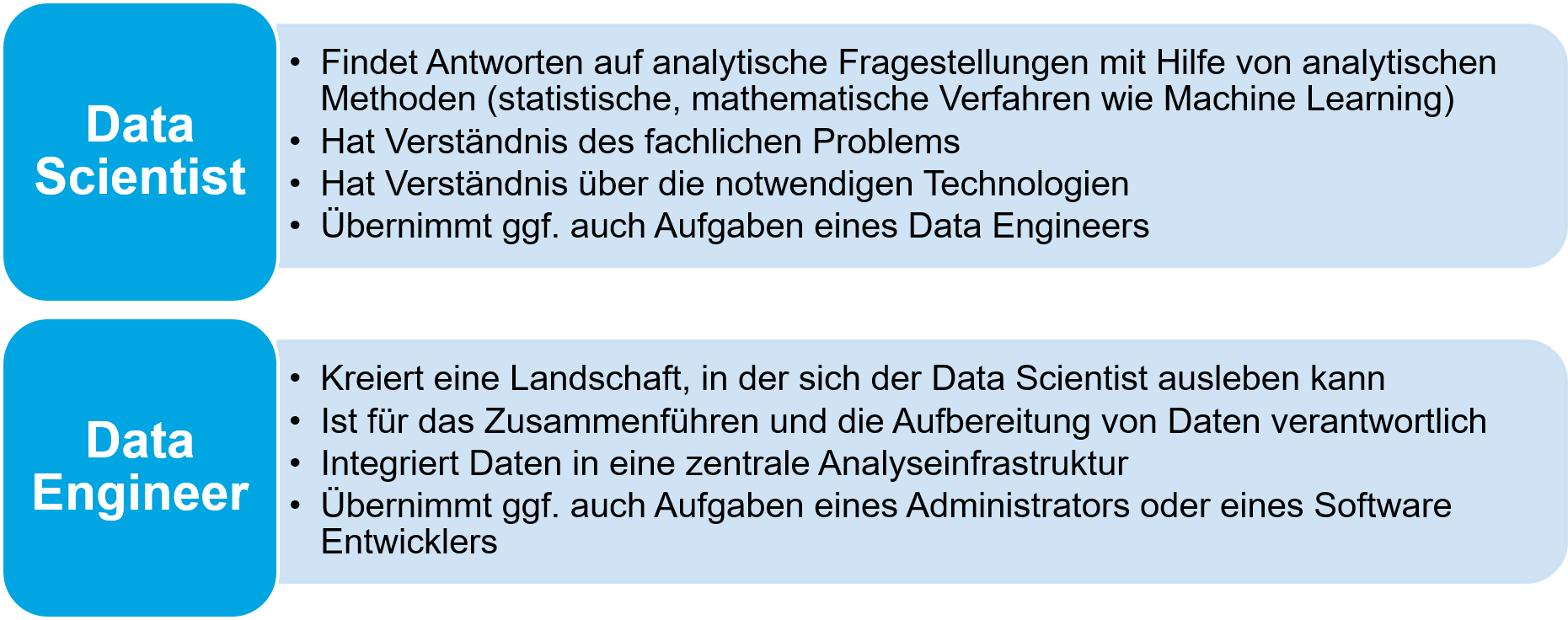
Figure: doubleSlash Net-Business - Profiles Data Scientist and Data Engineer
Where does machine learning belong and what else is there?
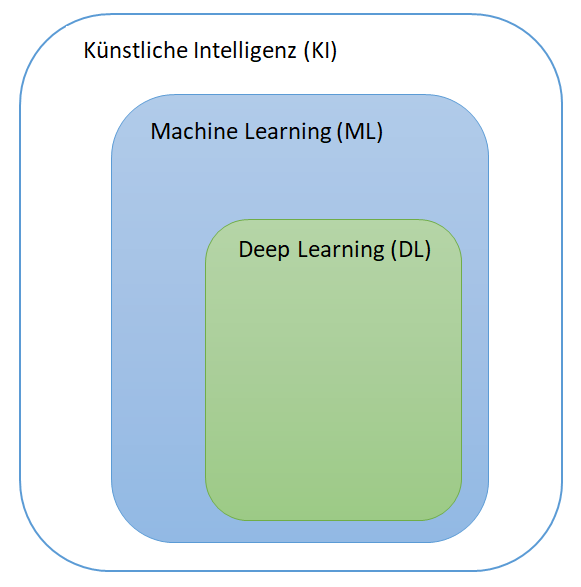
Artificial intelligence (AI):
The research field of artificial intelligence (AI) is generally concerned with the Transferring human skills to machines. Among other things, machines are expected to solve tasks that previously required certain cognitive abilities from humans. These include, for example, the recognition of language, text and image content. Artificial intelligence is often used as a generic term for sub-disciplines such as machine learning and deep learning.
Machine Learning (ML):
Here the provision of data enables a machine to learn new facts and an adequate response based on example cases. A distinction is made here between supervised machine learning and unsupervised machine learning. In supervised machine learning, the algorithm is told the meaning of the data provided during the learning phase, or more precisely: the answer to the specific question it has been asked. After the learning phase, the algorithm can then transfer what it has learned to new, unknown data. Unsupervised machine learning works without this assistance. The algorithm independently recognizes important patterns in the data and learns general rules independently of a specific question.
Deep Learning (DL):
Deep learning enables machines to do this, learn skills beyond the data provided to them. For example, the machine or software has to analyze and evaluate data in order to draw logical conclusions. This makes it possible to determine more efficient solutions and learn from mistakes. The quantity and quality of the data provided strongly influences the success of the learning process.
How does a machine learning project work at doubleSlash?
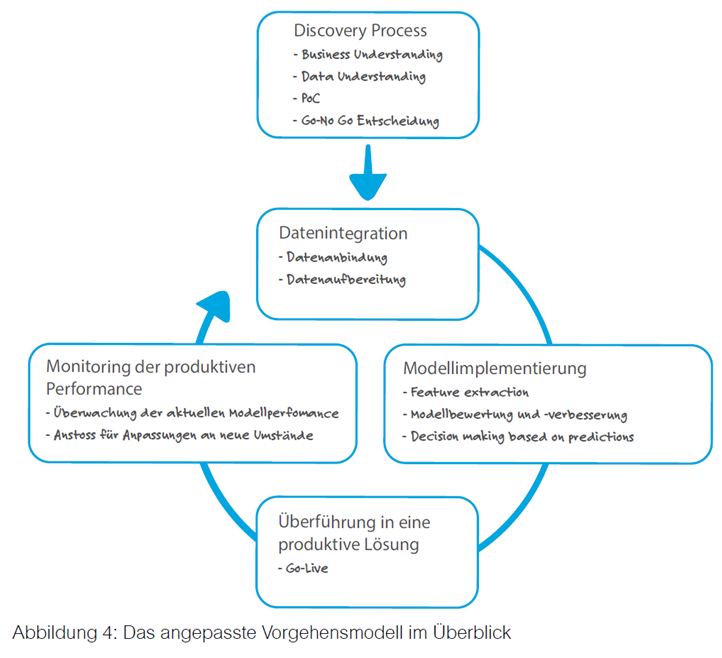
Machine learning projects at doubleSlash are carried out in a standardized process that continuous improvement of the developed machine learning model strives for.
In the initial discovery process the focus is on gaining an in-depth understanding of the problem at hand and the data provided. With machine learning, it is also essential to give sufficient thought to the problem and derive goals from it. In addition to the problem, it is also very important to understand the data to be processed. This understanding has a significant influence on the success or failure of a machine learning project. At doubleSlash, both are achieved through a Proof of Concept (PoC). The aim of the PoC is to make a well-founded decision on the continuation of the process based on this understanding.
Is the Feasibility proven by means of a PoC, the next step is the Data integration. The system is connected to one or more data sources such as databases or machines. Before the collected data can be processed, it usually has to undergo data preparation - for example through normalization, filtering, partitioning and transformation.
In order to reduce the complexity of the resulting machine learning model, the input data is analyzed as part of the Model implementation reduced to certain target attributes or representative subsets. The following trained model is then validatedby comparing predictions made by the model with existing data. Deviations between prediction and reality can be gradually minimized by adjusting different parameters and retraining.
If the quality of the model is satisfactory, its predictions serve as the basis for business decisions. The model can be converted into a solution that can be used in production.
Please note: The data provided, for example, can always change. Monitoring performance during productive operation is therefore essential in order to adapt the model to new conditions in good time if necessary. This is where the circle closes and a new iteration begins.
The following graphic visualizes this adapted process model.
Conclusion
Machine Learning offers a lot of potential for optimize existing processes and develop new processes. This potential is by no means limited to one business segment; rather, it can be integrated into all areas of a company. This results in a large number of use cases for machine learning. When planning machine learning projects, however, as described above, a Strong focus on the data The data must also be placed at the heart of the project, as it has a decisive influence on the success or failure of an ML project. In addition to the data, the Knowledge and skills of the project team. Both together are the key factors for the progress and therefore also the success of the project.
Would you like to find out more or use the customized process model for your machine learning project?