

Our approach: systematically recording quality requirements
High software quality is not achieved by chance, but through clear processes and cooperation between all those involved. Our new quality requirements process is based on the internationally recognized ISO 25010 standards and the Q42 model. It comprises two central elements:
- A clearly defined set of criteria
- A structured requirements process
The criteria catalog: Our quality standards
The quality requirements catalog forms the basis of our process. It comprises seven main categories: efficient, flexible, operable, reliable, safe, secure, suitable, usable. Each category contains specific requirements with measurable metrics.
Practical example: Digital Key Backend
A practical example of the application of our criteria catalog is our Digital Key Backend. The digital key is an electronic vehicle key that is stored on smartphones, smartwatches or other devices and replaces the physical key. It uses NFC, Bluetooth (BLE) or Ultra-Wideband (UWB) to securely unlock, start and share the vehicle.
As the Car Connectivity Consortium (CCC) standard enables interoperability between different vehicle and mobile manufacturers, we had to meet the highest quality requirements for this product - and at the same time ensure that it is intuitive to use.
To ensure the quality of the Digital Key clear objectives were defined on the basis of the quality catalog, such as
- EfficiencyThe system performance should be optimized so that the CPU load remains below 80 % even during high operation.
- ReliabilityThe availability of the service had to be at least 99.9 % to minimize downtime.
- UsabilityThe basic functions should be designed in such a way that new users can learn how to use them within 30 minutes.
The defined requirements are an integral part of the Definition of Done. Before each user story is completed, we check whether it has been fulfilled. This is how we ensure consistently high quality.
This example shows how the criteria catalog serves as a strategic tool to establish reliable and user-friendly products on the market. Through clearly defined requirements, measurable metrics and consistent implementation, a sustainable improvement in system quality and user experience can be achieved.
Our three-stage quality assurance process
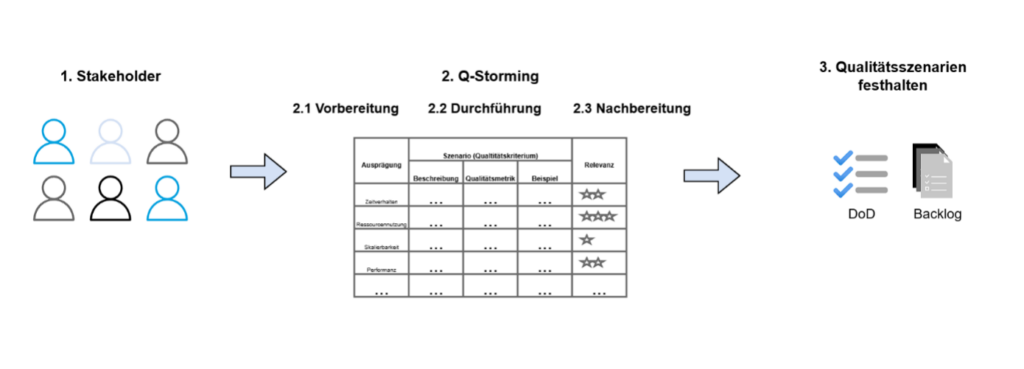
Our quality requirements process consists of three phases:
- Identify stakeholders: All relevant perspectives are taken into account.
- Conduct a workshop: Requirements are jointly defined and prioritized.
- Record quality scenarios: Requirements are precisely documented.
Workshop methodology: Q-Storming
The workshop follows a structured approach:
1. preparation: criteria catalog and stakeholder filtering
Good preparation is essential for a successful workshop. This includes
- Identification of relevant stakeholders (e.g. architect, product owner, developers)
- Initial filtering of a predefined catalog of criteria based on the specific project context
2. implementation: structured evaluation of quality requirements (Q-storming)
The Q-Storming workshop begins with an introduction to the main categories of quality requirements. The pre-filtered list of criteria is then evaluated and prioritized together with the stakeholders:
- Clarification of categories and definition of measured values (e.g. availability >98% per year)
- Evaluation of the requirements by the stakeholders (how important are they on a scale of 1 - 5)
- Prioritization and definition of concrete expectations
- Definition of realistic, measurable scenarios to ensure that requirements are met
3. follow-up: documentation and derivation of concrete requirements
After the workshop, the knowledge gained is systematically processed further:
- Definition of clear, measurable requirements based on the scenarios developed
- Use of standardized sentence templates for uniform formulation
- Documentation of requirements and provision to all stakeholders for review
- Allocation of requirements to specific system components
This process ensures that requirements such as:
"During business hours, the response time to a search query must be less than 2 seconds" are clearly defined, verifiable and integrated into development in the long term. This is ensured by record templates, clearly defined metrics and additions to the Definition of Done.
Ensuring quality for the future
Our quality requirements process ensures that our software remains stable, secure and user-friendly. In this way, we not only meet our customers' expectations - we exceed them.
This article was written jointly by Timo and Maren.

About me
Maren Tölke
Maren Tölke studied business informatics (M.Sc.) and has been working as an IT consultant at doubleSlash since 2022. She primarily supports companies in the automotive industry with her expertise in requirements management, analysis and IT design. As an IT Solution Architect, she is involved in the development of customized software solutions and accompanies the entire process through to technical implementation.