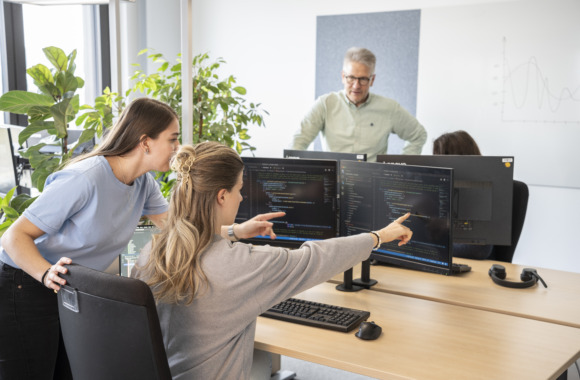
But how can this learning process be made more effective and accelerated? The answer lies in collaboration, the exchange of knowledge, different perspectives and expertise. People with different backgrounds and skills working together generates new ideas and solutions that lead to outstanding products.
Making knowledge explicit
In order to work together successfully, it is important that knowledge is shared. A good collaboration model systematically promotes the permanent exchange of information and the joint growth of knowledge.
Regular meetings and effective communication help to discuss successes, questions or problems. The product teams continuously exchange information across all levels and store relevant information in a knowledge database. Joint learning requires transparency, which is accessible to everyone involved via explicitly documented knowledge - employees, customers and suppliers.
At doubleSlash, cross-project findings and practically usable artifacts are collected in the so-called Software Creation Chain (SCC). These can be reusable software artifacts, best practices and checklists as well as document artifacts (e.g. templates). These building blocks are continuously developed with newly acquired knowledge and are available for all product developments and projects. They make it possible to enter any product phase in the shortest possible time. Learning success that is not just in people's heads, but is available in the system.
Collaboration improves software development
The software product is always viewed holistically across the three BIZ-DEV-OPS. This breaks down silos between the different areas and unites the teams into one product team with a common goal. Communication becomes more effective, collaboration and integration are improved and a platform for joint learning is created.
- The business level (BIS) creates a shared picture of the product vision. Exploration artifacts from the SCC are used here.
- Usable product increments are created at the development level (DEV). Continuous feedback loops ensure that the common goal is kept in view.
- The operations level (OPS) focuses on the stability of the software product. Software products do not stand still; the OPS level ensures that systems operate without errors and that problems are resolved together with the other levels.
An iterative approach across all levels, close cooperation between the product team and the customer and continuous learning ensure that the software product has its finger on the pulse and solves the "right" problems.
Together, we create the basis for a sustainable software product life cycle and create added value for everyone.