

According to the specification description, the object enables the language-dependent formatting of numbers and is therefore exactly the right tool to solve the problems mentioned above. Again, without adding another library. The constructor consists of two arguments. The first represents one or more locale strings and is based on the Best Current Practice 47. The second argument accepts a configuration object with the following options:
-
- "localeMatcher" - Specifies the algorithm to be used for area pubic matching.
-
- "style" - This option specifies the formatting style to be used. Possible values are "decimal", "currency", "percent" and "unit".
-
- "currency" - Is intended for currency formatting in accordance with ISO 4217. If the "currency" option has been configured in the "style" property.
-
- "unit" - Enables the exact specification of the "style" property. If "unit" is selected, the unit "kilometer-per-hour" can also be entered, for example.
-
- "minimumIntegerDigits" - Specifies the minimum number of integer digits to be used.
-
- "minimumFractionDigits" - Is the minimum number of fractional digits to be used.
-
- "minimumSignificantDigits" - Is the minimum number of significant digits to be used.
Incidentally, it is also possible to specify maximum values for the digits group. The object created by the constructor has a format method that accepts a number to be formatted. The following is an example:
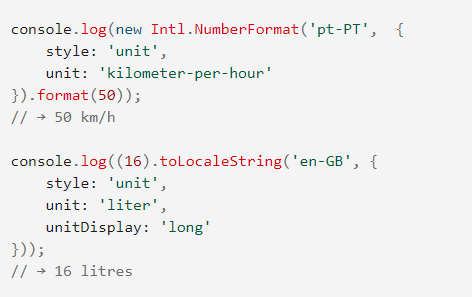
The times when you had to write your own formatter are over. Use the superpower of the browser! For those of you who are still struggling with IE support. Polyfills exist.
Learn more about Java programming
Sources:
W3C
gitconnected