
Good ideas rarely arise in a vacuum.
In digital product development, pure functionality is no longer enough. The decisive competitive advantage is created when systems take into account the expectations, habits and mental models of users.
At doubleSlash, this is exactly our claim. For many years, we have been supporting our customers with a clear focus on user experience (UX) and user-centered design (UCD). Because technical excellence alone is no longer enough. The decisive factor is whether a system meets the expectations, habits and mindsets of users and fits seamlessly into their everyday lives.
User feedback as a source of innovation
Many companies invest a lot of time in internal ideation sessions. But the reality shows: Most of the ideas have been around for a long time, they are in support tickets, feedback forms, comments in user forums or even in improvised workarounds from users.
The crucial thing is not that users always suggest the perfect solution. They often only describe symptoms: "The button is confusing", "It takes too long", "I can't find the function".
The trick is to translate this feedback:
- What is the real need behind this?
- What problem becomes apparent when you look deeper?
- Is it a usability issue, a missing process step or a trust problem?
Real innovation impulses arise from everyday comments. Users are the ones who directly experience points of friction in daily use and this is precisely where their value lies: they make visible where products are not yet running smoothly and where there is the greatest potential for improvement. This is why many of the best ideas ultimately come from the users themselves: They live with the applications, discover weak points in detail and thus provide the decisive clues for innovation.
Our proven UX process follows a clear, iterative procedure in four steps in accordance with the internationally recognized Human-Centered Design (HCD) from ISO 9241-210that the human-centered design process describes all phases of product development.
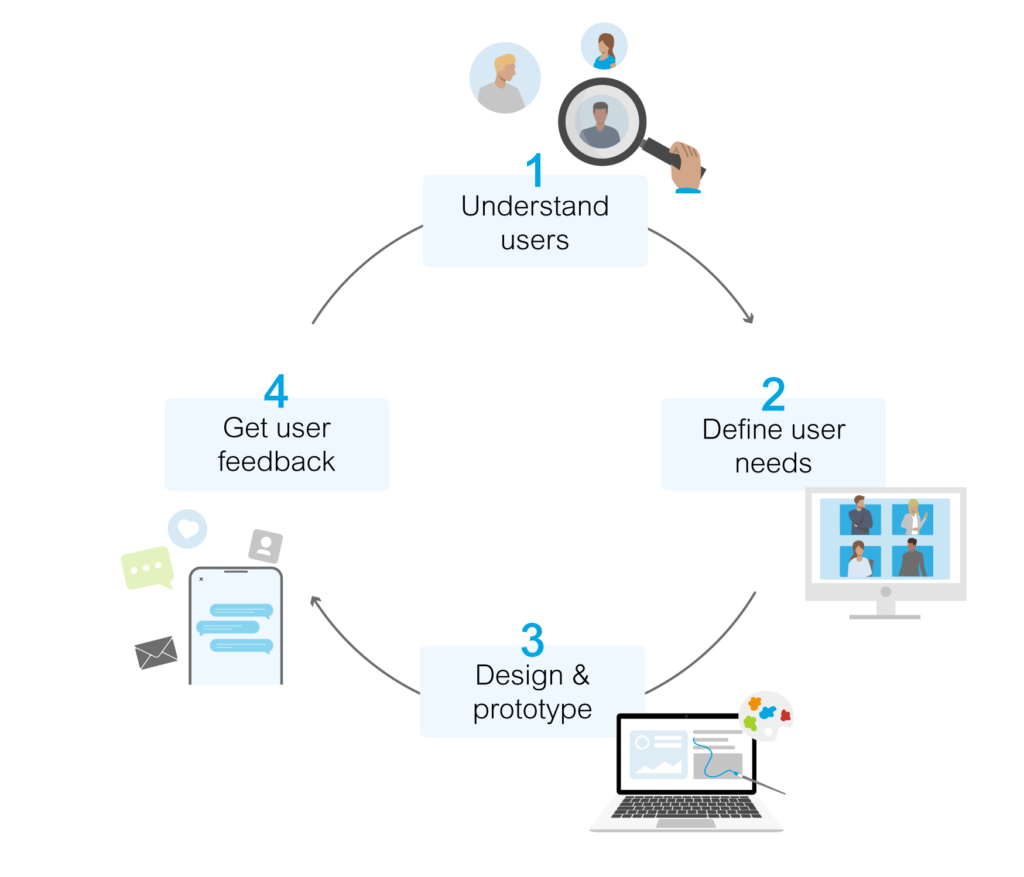
- Understand users: First, we analyze the target groups and usage contexts. Interviews, shadowing and data analyses help us to understand users' real needs and challenges.
- Define user needs: Based on these findings, we concretize requirements in functional, technical and emotional terms. Personas, use cases and empathy maps make needs tangible.
- Design & prototype: In the next step, we develop initial concepts, mock-ups and clickable prototypes, in some cases using AI-supported prototyping for greater efficiency. This allows ideas to be visualized quickly and tested with little effort.
- Get user feedback: We involve users early and regularly, for example in the form of usability tests, feedback sessions or through tools such as Sentry, which give us valuable insights into real user behavior.
This cycle can be repeated as often as required until a convincing solution is found.
User focus as a success factor
Good ideas often already lie dormant in existing data, you just have to recognize them and interpret them correctly. At doubleSlash, we use data from Sentry, among other things, to better understand real user behavior. This reveals recurring errors, unusual usage patterns or potential hurdles in the interaction flow.
Such information helps us to identify real problems, emotional barriers and creative workarounds. The insights gained flow directly into the further development of our applications - with a measurable effect: intuitive operation reduces support costs, consistent processes create trust and optimized processes increase conversion rates.
Especially in the B2B environment, such improvements make a noticeable difference, both technically and economically.
Conclusion: Listening pays off technically and economically
UX and development should always mesh like gears. This results in products that are geared towards people's needs, solve real problems and are technologically pioneering at the same time.
More about our understanding of technology in the field of user interfaces