Companies that use their existing data effectively can develop more precise, efficient and customer-oriented ways of working. They can also develop completely new hybrid or digital business models.
This not only helps to improve internal processes, but also strengthens long-term competitiveness.
The challenge: using data sensibly
But how exactly can companies make sensible use of the sheer endless amounts of data? Here comes the Data Factory approach from doubleSlash comes into play. We use building blocks to show you how our approach works and how your company can benefit from it.
Many companies have a wealth of data at their disposal, but this often remains unstructured and unused. The challenge is to process and analyze this data in such a way that it leads to valuable insights. Only then can it serve as a basis for well-founded decisions, whether in projects, processes or product development.
The doubleSlash approach: prepare data in a structured way and combine it into meaningful units
Imagine your company's data as a large set of building blocks. Each piece corresponds to a data set, and only when these pieces are put together correctly does a meaningful picture emerge. By integrating distributed data, the building blocks of well-founded, sustainable decisions are created.
At doubleSlash, we follow a zone-based data staging approach in order to carry out this integration and utilization of distributed data in the most targeted manner possible. In this approach, the value and quality of the data increases from zone to zone. The starting point is the Data Sources (Data Sources) that are not themselves part of the central solution.
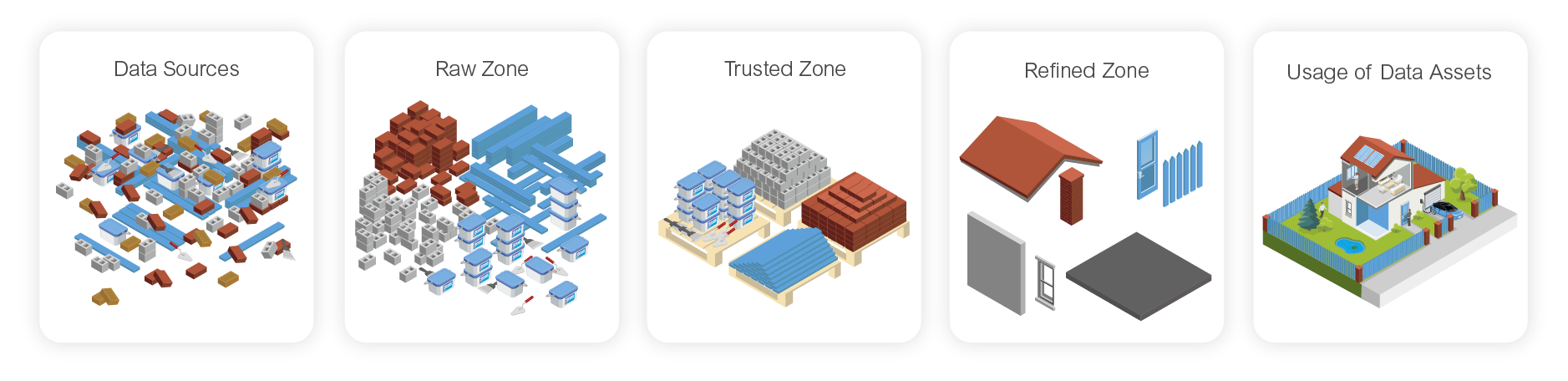
The data is scattered and disorganized in the data sources. They also do not have a standardized format. In this state, they cannot be used in an integrated manner. They usually only serve the primary purpose of the data source or the source system, but are otherwise of no further use.
A fitting image is a construction kit spread out on the floor containing the individual parts of various original models.
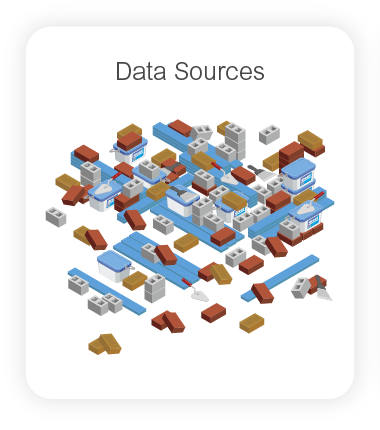
If you want to build a model from this "chaos", the first step is to pick out the bricks that you need. These are separated from the other bricks and collected in a "central" location. The counterpart to this central location in our data staging approach is the raw zone.
In the Raw Zone the data is centralized and sorted according to its source and type. Where possible, they are retained in their original form so that the original data is not corrupted by changes. This means that the raw state of the data can be accessed at any time. It is particularly interesting if new analysis or processing methods are to be used at a later date that require the granularity of the raw data.
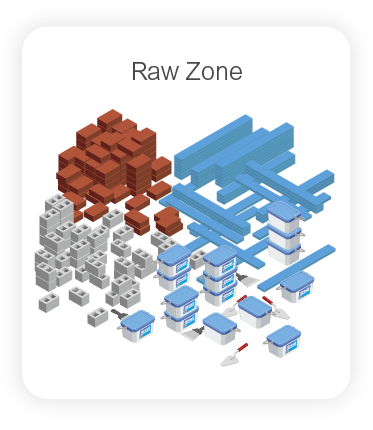
Have some bricks "crept in" when collecting the required building blocks for the planned model that don't quite fit? This can happen quickly if the color or shape seems to fit when first sorting, but the stone is not suitable for the model due to its "technical" characteristics. In this case, it is sorted out before starting to build the model. In this process, the bricks are also arranged in such a way that identical bricks are together in order to make the combination to the model as efficient as possible and to avoid a long search for the right brick. This is the analogy to the Trusted Zone of our zone-based approach.
In the Trusted Zone the data is converted into a generally usable format, validated and prepared in such a way that it can be used to create data assets. The same data from the trust zone can be prepared for different data assets and therefore different application purposes.
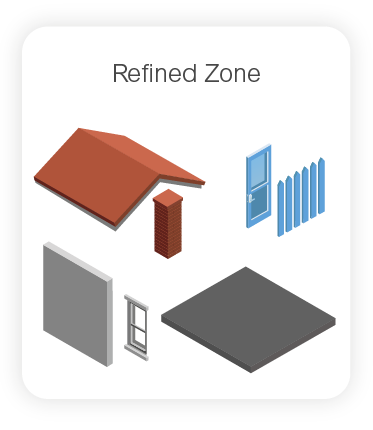
Back to the building blocks: Once all the blocks have been sorted and arranged appropriately, they can finally be used to build the planned model. The first step is to assemble them into sub-components of the model according to the building instructions. In the case shown here, in which a house is to be built, for example, a roof, a base plate, a wall as well as windows and doors are assembled.
If these equivalents are transferred to the use of data, the "construction manual" is the calculation formula for a KPI or data asset and the subcomponent is the data asset itself. The corresponding preparation step takes place between the trusted and refined zones.
In the Refined Zone is where the processed data assets are stored and versioned. Storage in this zone primarily enables quick access to aggregated key figures and the creation of a history of these.
The result is your added value: 360° data insights
This is where technical data preparation usually ends. Data assets are ready for use, e.g. in the form of BI or reporting applications. Depending on the technical question, a different combination or analysis of data assets is necessary.
Through the Utilization of the processed data, a comprehensive view of a real phenomenon can be created. The integrated use of data makes it possible to adopt different perspectives and to holistically capture the data-based representation of an object from the real world. This 360° view enables well-founded and sustainable decisions to be made.
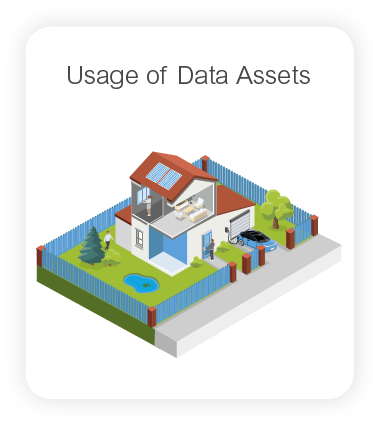
Applied to the building block example, this means that the modules can be combined in different ways to build the right house. It could be a multi-family or single-family house, a garage or a stable. Depending on which benefit is to be generated.
Building data assets is similar to building blocks: a structured integration approach increases the value and quality of data step by step, starting with scattered and disorganized data sources and ending with refined, ready-to-use data assets. Data is first centralized and organized (Raw Zone), then validated and converted into a generally usable format (Trusted Zone) and finally aggregated and versioned (Refined Zone). This process enables companies to make data-driven decisions by providing a comprehensive and integrated view of relevant data and real-world phenomena.

Would you like to find out more about how the doubleSlash Data Factory can revolutionize your data integration with the zone-based data staging approach? Discover how we transform distributed data into valuable insights and thus create the basis for well-founded, sustainable decisions.