A major added value that results from this is the collection and analysis of the recorded operating and machine data [2]. Using the data evaluations and the measures based on them, potential savings of up to 40% can be achieved in maintenance and servicing costs [3].
Lack of machine networking hinders data analysis and fault detection
However, if the machine does not have a connection to the Internet or to an intermediate component that is permanently connected to the data center, it can No data exchange take place. This makes availability and access to the operating and machine data used for evaluation or maintenance more difficult. There can be many reasons why the machine is not connected:
- Susceptibility to faults in important work processes (e.g. automatic updates)
- Security concerns - machines must not be networked (e.g. to protect against hacker attacks from a distance)
- Infrastructural reasons - machines cannot be networked (no Internet expansion or mobile phone reception in the area)
- Legacy systems - machines do not offer the technical capability for networking
However, these machines also require regular maintenance. For this Operating and machine data transferred and made available centrally so that a Analysis and resulting optimization measures how software updates can be installed or restored. The separation from the Internet creates a Gap between the machines and the cloud.
Closing the gap between offline machines and the cloud
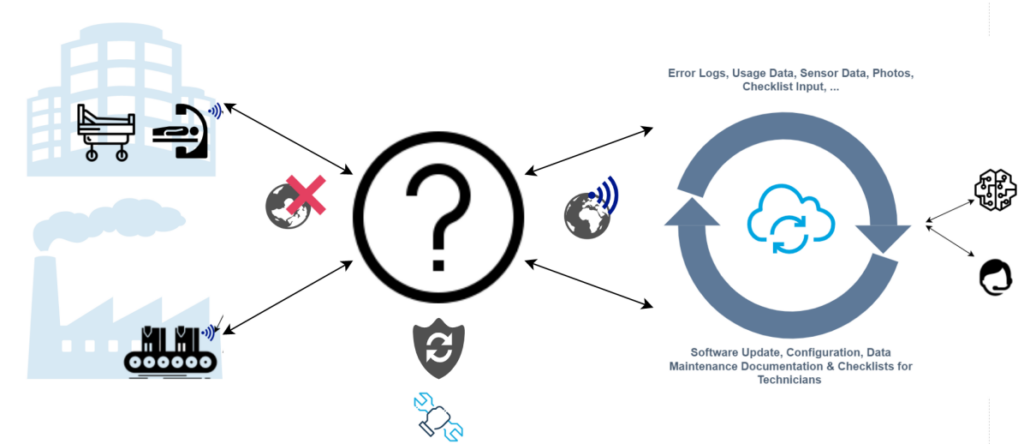
The "Offline Maintenance Lifecycle" is a process that digitizes maintenance and servicing and enables Communication bridge from the machines to the cloud.
The system was implemented as a prototype in the form of a thesis. Closing the gap can be divided into three challenges:
- Selection of a transmission medium
- Control on the transmission medium
- Security in communication
Selection of a transmission medium
To close this gap, a transmission medium that can be clearly separated from the Internet must be defined. Since an Internet connection is impossible at the machine location, a portable transmission medium is required that is carried to the machine by an assigned person. Several properties were considered for the selection. In principle, it is possible to develop a transmission medium that is intended exclusively for the purpose of data transmission. Another option is to select a category of transmission media that is already in use by the user group. These include Notebooks, tablets, smartphones and smartwatches. The devices are evaluated not only on technical aspects, but also on ease of use and portability.
The decision falls on the Smartphone. The physical properties of the smartphone offer a compromise between clear and convenient operation of applications and portability when carrying a service technician. Another reason for the decision is the possibility of using the smartphone already used by service technicians alongside telephony. [4] additional to be extended by an application to a maintenance toolso that no additional device needs to be used.
Control on the transmission medium
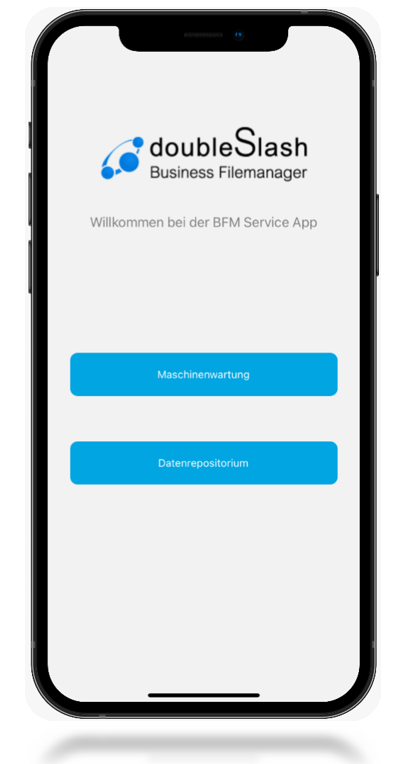
A controller is required on the transmission medium to perform various actions such as data exchange. The controller is an application that is called up on the transmission medium. With the smartphone, this means developing a mobile application.
The result of the development is an application that runs on over 90% smartphones on the market. It is compatible with the Android and iOS operating systems. This was made possible by using the Cross Platform Framework React native.
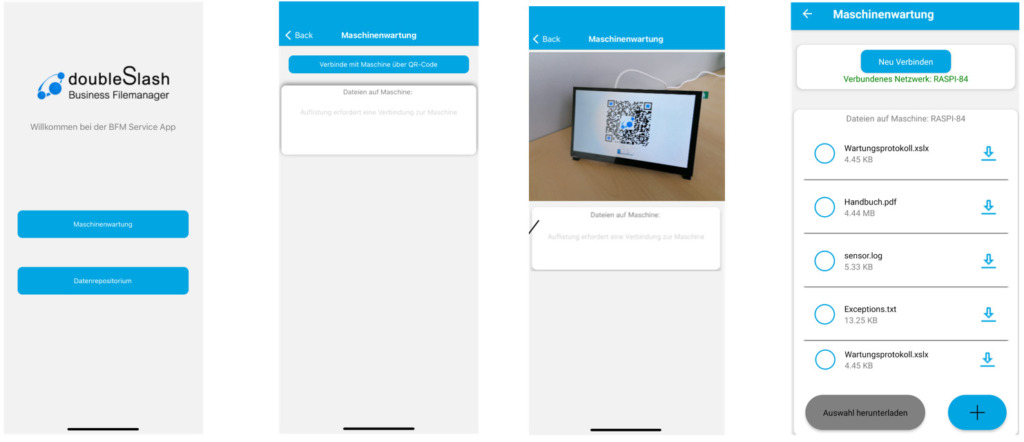
Various standards and protocols were considered and compared for communication with the machine. The maximum transmission speed was prioritized so that the radio transmission of large amounts of data, such as a software update, is carried out as quickly as possible. Communication with the machine proved to be WLAN as the most powerful radio transmission method. WLAN was used for the prototype implementation.
As a substitute for the machine, a Raspberry Pi single-board computer provided. The Raspberry Pi is used both in medical technology [5] as well as in industry and enables PC-based control and connectivity with other systems when used with machines [6]. A Wi-Fi connection to the smartphone can be established via a QR code reader in the smartphone. With the help of a server on the Raspberry Pi, files can be transferred via a REST interface be exchanged, without being connected to the Internet.
For data exchange with a data repository, doubleSlash developed the Business Filemanager (BFM) is used. The CMIS interface is addressed during Internet communication with the BFM data repository. The smartphone application and the data repository communicate via a Proxy serverwhich was developed with the "node.js" runtime environment. The proxy server processes CMIS requests separately from the smartphone. This leads to the outsourcing of the computing load. In addition, the memory size of the smartphone application is reduced.
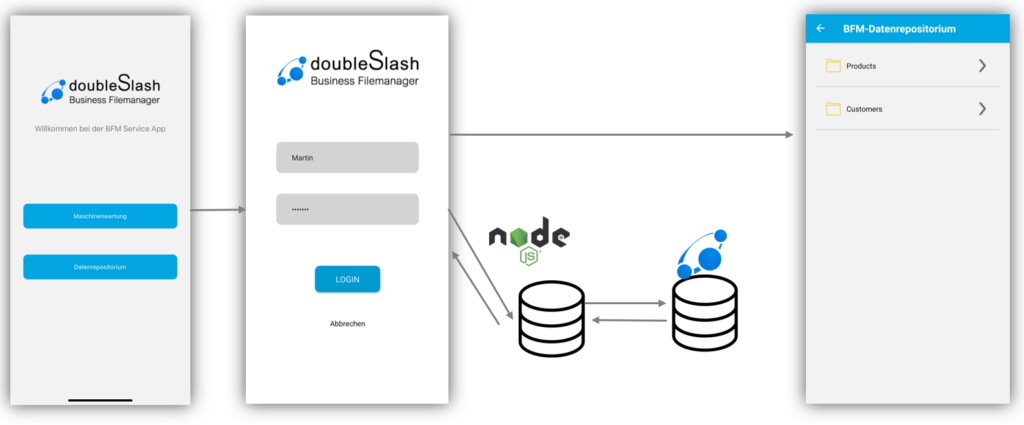
Isolation from the Internet is not enough to prevent unwanted access to a machine, as unwanted access can also occur in the vicinity of the machine in question. All communicating components within the system require a security concept to prevent unauthorized access. avoid access by unauthorized persons. The existing Identity Access Management (IAM) was used for authentication at the data repository. WLAN communication is secured by entering the password key. To access the functions of the BFM data repository, it is necessary to log in to a user account. This makes the Communication within the system only authorized possible.
The gap between the non-networked machines and the data center is closed with the following system:
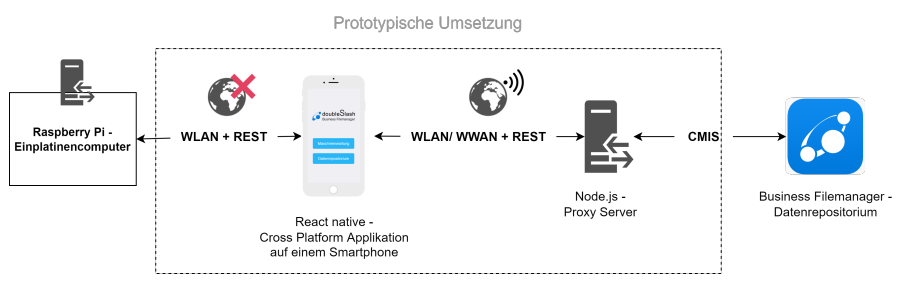
In addition to digitized maintenance and servicing, this system enables data integration of the disconnected machines. A suitable transmission medium was defined for this purpose. The control system on the transmission medium was developed in the form of a smartphone application that enables data exchange both on the machine side and on the data repository side. It was ensured that authentication of the transmission medium takes place at the machine and at the data repository.
The offline maintenance lifecycle enables the following use cases for offline machines:
- Digital maintenance and servicing
- Centralization of recorded operating and machine data
- Installing software updates, configurations, protocols, ...
- Evaluation and (error) analysis based on centralized data
- Data-driven decisions in the development of new software
- Optimized maintenance planning
This system can be used to apply measures from the IoT. One example of this is predictive maintenance. Planning is optimized by evaluating the recorded operating and machine data and the resulting knowledge about incoming events, such as the next maintenance requirement. This can significantly reduce maintenance and repair costs.
The added value of data integration should not be underestimated. Companies get to know their products better. In addition, measures for product and process optimization can be derived.
The reasons for disconnecting machines from the Internet are understandable. Offline operation does not have to mean a loss of potential. The Offline Maintenance Lifecycle proves this in the form of a solution.
Learn more about the Business Filemanager connect
Sources:
- [1]: https://www.mittelstand-heute.com/artikel/unternehmen-investieren-immer-mehr-in-iot
- [2]: https://www.sap.com/germany/insights/what-is-iot-internet-of-things.html
- [3]: https://ecbm.me/2020/04/08/kosten-sparen-durch-predictive-maintenance-vorausschauende-wartung-ihr-einfacher-einstieg/#:~:text=Predictive%20Maintenance%2C%%2020oder%20Vorausschauende%20Wartung,Kosteneinsparung%20durch%%2020Optimierung%20der%20Wartungsintervalle
- [4]: https://www.ecom-ex.com/de/blog/post/digitalisierung-in-service-und-wartung-industrie-4/
- [5]: https://www.all-electronics.de/elektronik-entwicklung/wie-sich-mit-dem-raspberry-pi-medizintechnik-entwickeln-laesst-260.html
- [6]: https://wiki.induux.de/Raspberry_Pi