KaaS - a digital key: can it work?
The digitalization of the vehicle key raised questions about security, but was received enthusiastically and raised the hope of finally no longer having to search for a key.
In 2020, the time had finally come: BMW and Apple jointly presented the Reference implementation of a new standard for digital vehicle keys at Apple's own developer conference, WWDC 2020.
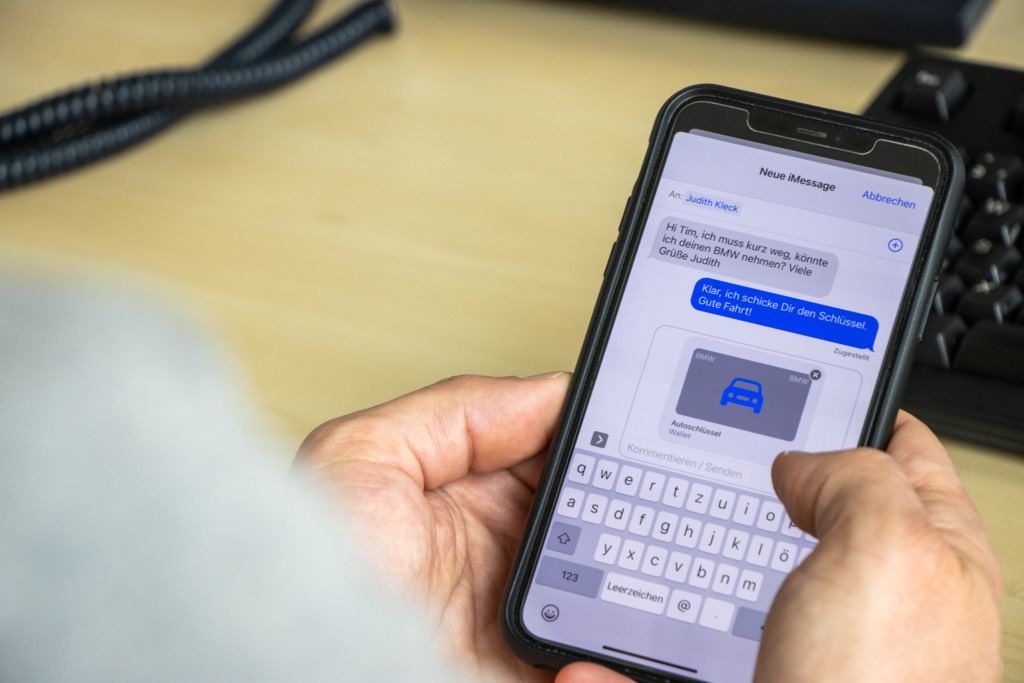
iMessage communication between two colleagues. Key exchange via KaaS
The standard itself was developed by the "Car Connectivity Consortium" (CCC), which includes Apple and BMW as well as other well-known manufacturers such as Mercedes Benz, Volkswagen, GM and Samsung.
There are countless reports and tests on the functions of the BMW Digital Car Key. We are not a car magazine, we are doubleSlasher, we have fun with IT and we are driven by the Creating IT experiences on. Since we wanted to know what KaaS feels like, we got ourselves a BMW with the appropriate special equipment (SA322) and one or two compatible Apple devices. Behind us are countless processes for creating the master key, sharing, revoking and deleting keys. We have compared these processes with the Documents from the CCC website, the Developer presentation of the Apple Car Key at WWDC20, as well as the information provided by BMW.
User conclusion First of all: it works, it's secure, data protection is taken seriously and it's easy to use. Funto experience the processes and technology live. What this IT experience feels like and what's behind it, we want to find out now in the Detail view.
The path to the digital key: linking smartphone and vehicle
The BMW Digital Key can only be created once the vehicle and BMW user account have been successfully linked. This is therefore unproblematic, as the Connected Drive services are linked via the user account.
There are several ways to establish the link. As I am interested in the general interaction between smartphone and vehicle, I started the process directly from the car. A QR code is displayed in the vehicle, which I scanned with the MyBMW app. A short time later, the vehicle was linked to my account.

Now it's time to create the master key
We continue with the master key creation, Apple calls this Owner Pairing. The master key is reserved for the main user of the vehicle and enables the management of additional keys at a later stage. Only one master key can exist. The key can be created either via the MyBMW app or natively directly in the vehicle. Both methods work, but creating the key with the app is more user-friendly. But more on this later, as we want to see and experience the IT, we must first deal with the necessary basics.
Key as a Service is nothing new from a technological point of view and is simply a clever combination of existing standard technologies. The choice of technologies allows the owner of a digital key to use their vehicle without having to be online - even in underground garages or in a dead zone. However, the smartphone and vehicle must be online to create the master key. To share the key, however, it is sufficient to have received the message beforehand.
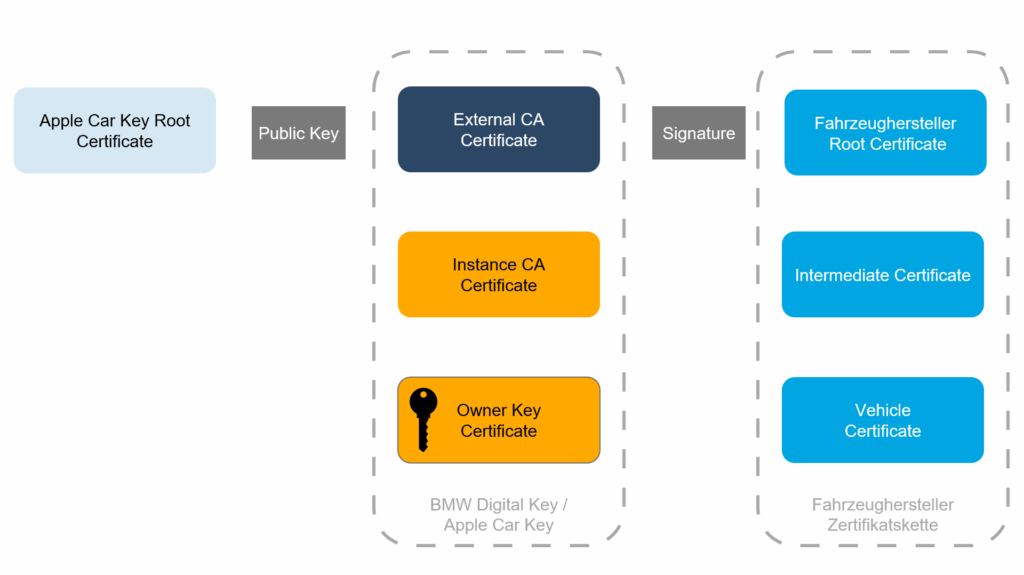
The creation of digital vehicle key certificates is based on Cross Certificates (RFC4158). In our illustration, this cross certificate is the External CA Certificate. The certificate was created by BMW, but also contains the Apple certification authority and was subsequently signed by BMW. In short, it is a new and separate "KaaS" certificate (External CA Certificate) that both Apple and BMW trust. The master key and then the keys of friends can be generated on this basis.
One key, two keys and tutoring in security and KaaS
It's a little abstract, but it's well thought out. Unfortunately for me personally, you don't notice much of it in the vehicle. So let's take a look at the part that you can actually experience. I got into the car highly motivated, started the MyBMW app and tried to connect. This made me smile a little and had a "Wow, that's clever" effect: on the one hand, I was reminded that you can just take a look inside the real car beforehand. well-prepared video in the app and on the other hand I was allowed to go straight back up to my colleagues in fleet management to have a look at the second key from the vehicle to get. BMW thinks along with you and generally only allows a master key to be linked if both keys are provided ex works. physical key are in the vehicle. I have tried everything, next to it, on the roof or under the car. No, the keys really have to be inside the vehicle. I personally think that's a great idea, because it's not usually that easy to get both keys. I've tried out enough nonsense and turned around the car, now it's time to connect the master key.
What components are needed to create a master key?
The process is characterized by the technologies used and the resulting system architecture. The KaaS system architecture consists of the vehicle, iPhone or Apple Watch including the built-in secure element and the backends from BMW and Apple.
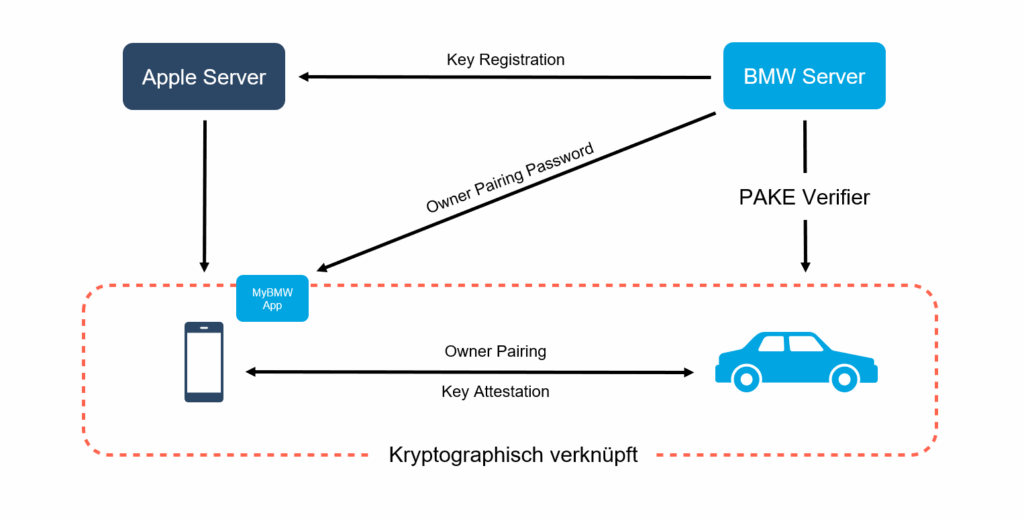
Password security through verifier generation
According to Apple, the process for linking the master key is based on PAKE (password-authenticated key agreement) RFC8125), to be precise "elliptic-curve based PAKE protocol with augmented security". Since I personally only deal with cryptography topics to a limited extent, I have the exchange with my colleague Benjamin Pomrenke searched for. He was then able to explain to me, using the Apple graphics, that in our use case the BMW backend generates a password and a verifier. This generated password is only made available to the client, in our case the iPhone. Only the verifier, which can check the password entered, is transmitted to the vehicle. Only the user receives the password itself.
In general, the PAKE protocol makes it difficult to guess this password. Even in a "man-in-the-middle" scenario, i.e. if the data flow were to be intercepted, the attacker would receive very little information about a possible password. This is made all the more difficult as elliptic curves are used to generate the password. This makes even otherwise simple passwords much more difficult to determine.
Link to the vehicle
Can I finally experience the second factor for myself when connecting the two devices? The correct answer in this case is a very clear "no".
If I start the link from the vehicle, a brief instruction is sent to my BMW Connected Drive e-mail address, as well as a link and an 8-digit password. The link should lead to the iOS Wallet and the password is passed as a parameter.
It's all easier and more intuitive with the MyBMW app. As long as I am in my Connected Drive Account Once I am logged in, I can click on the relevant menu items. The assistant explains that I have to place the phone in the appropriate compartment in the center console and 30 seconds later everything is complete. In some cases, however, the entire process took about 2 minutes. I was rather confused by the description and the pictures, as they are not adapted to the car. Otherwise, it was intuitive. Regardless of the route I chose, I always had an additional second factor during generation. Either I have to log into my E-mail inbox or in the BMW Connected Drive Account log in.
When researching the topic Digital vehicle key I came across an article by Allianz Versicherung. Allianz Versicherung had already published an article on the introduction of the digital key in 2018. corresponding guideline proposed. In the article on its website, it demands that if the vehicle is lost, a "clear, transparent and comprehensive" list of all authorized keys should be made available. This is logical, as the newly created digital vehicle key enables both access and driving authorization. If the vehicle is stolen, the keys must usually be presented or a credible explanation must be given as to why they cannot be presented.
The procedure also matches Apple's description from WWDC20, as a "confirmation attestation" is mentioned in the explanation. This is transmitted to the vehicle by the backend from the vehicle manufacturer. Unfortunately, the technical details are not disclosed, but according to Apple, this is the final step in opening our vehicle with the iPhone and being able to drive off.
Technically, it all seems well thought out and not like "security-through-obscurity". In other words, no deceptive security that is only presented as secure because the technological background and implementation are kept secret.
The digital key and the question of suitability for everyday use
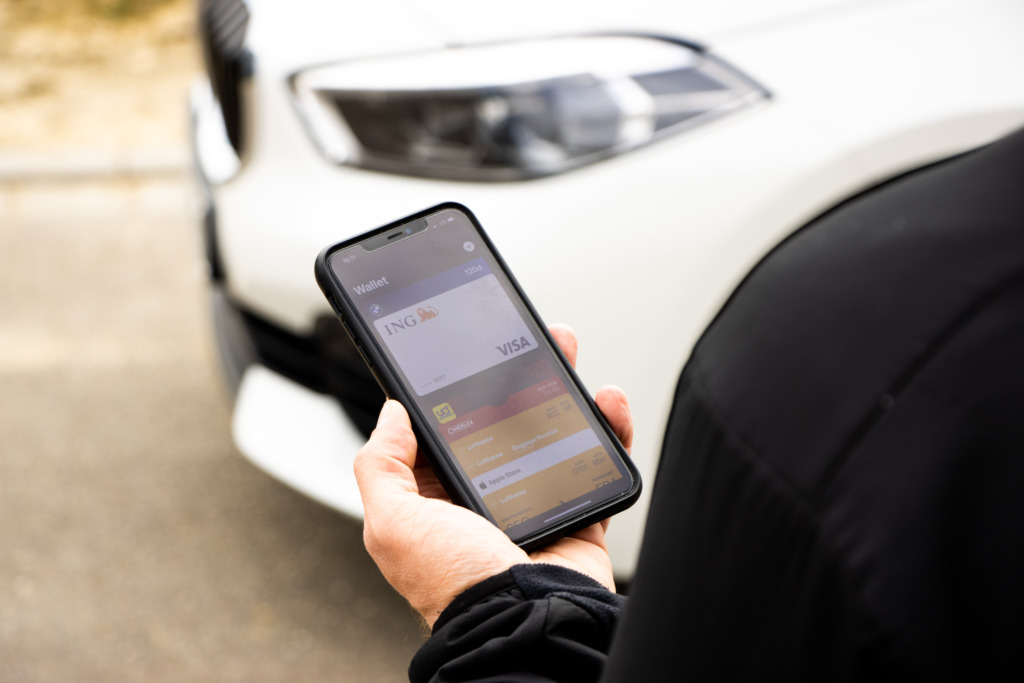
But how does the Everyday life with a purely digital vehicle key? It was a bit strange at first, but it didn't take long to get used to it and since then I wouldn't want to be without the digital key. I use KaaS almost exclusively and it doesn't get stuck or feel strange anywhere.
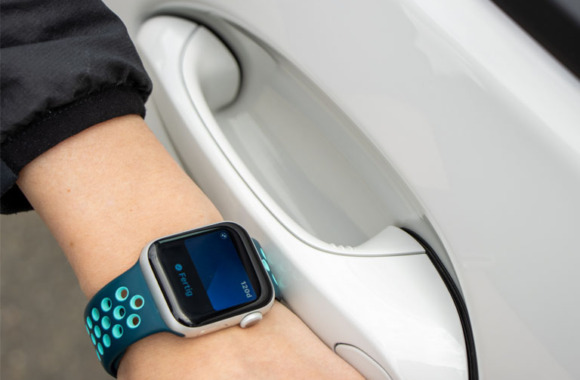
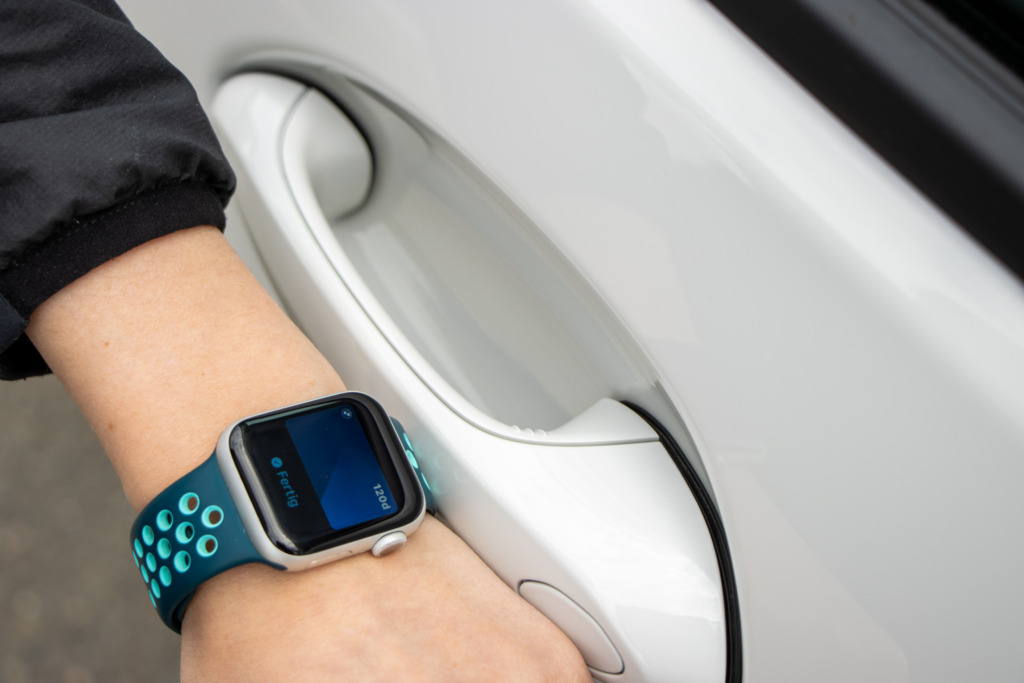
The current digital vehicle key is based on NFC (Near Field Communication). Only in the near future of the digital key will this be additionally UWB (Ultra Wide Band) which is used in Apple airtags, for example. Contactless payment when shopping or at the petrol station is also based on NFC and offers a similar level of convenience. The feedback from the iPhone takes a little longer to open the door than paying via Apple Pay at the till. It took me a little while to get used to it before I found the perfect point on the door handle. It all works quite well and I don't have to unlock the iPhone or confirm an action separately in express mode. This means I have to reach into my trouser pocket again and take out my digital car key. This step had actually been done away with, as almost all newer cars allow access without having to take the key out of your pocket. For technical reasons, the digital car key can only be given this functionality with the update to UWB.
The use of KaaS: it's all a question of habit
The digital key is fun and the fact that I can only open the driver's door with my smartphone doesn't usually bother me in these situations. However, there are a few situations where I specifically want to use the insert physical keylike when I'm shopping for groceries or picking up the kids from kindergarten. It's simply impractical to hold the phone up to the driver's door first instead of using the "Keyless Access" of the physical key to open the trunk or one of the rear doors directly.
The express mode preset by Apple in the iPhone can be deactivated in the Wallet. If express mode is deactivated, it is necessary to open and close the doors and also to start the vehicle, every action via FaceID or PIN to confirm.
This means that if the iPhone is stolen, the vehicle would still be safe, provided of course that the PIN has not been spied on. In principle, this makes sense, but it is somewhat cumbersome in everyday life. A great combination is therefore the Apple Watch for opening and closing the doors and the iPhone for starting the engine. As I usually have my phone in my trouser pocket, it gets in the way when I'm driving and I take it out of my pocket anyway.
What happens when the battery is empty?
What I have not tested, but according to Apple is not a problem, is the issue with the phone's empty battery. If the phone or watch switches off due to the battery level, the key can still be used for a limited time. However, as the storage area of the digital key cannot charge the phone, I always have an extra cable in the glove compartment.
Key card in credit card format
The BMW is also equipped with a Key card the size of an EC card. To activate it, I simply placed it in the same tray as the phone and then had to confirm the activation on the display. For workshop appointments, such as Inspection appointments or tire changesthis is super practical. Deactivation then takes place later in the vehicle and is self-explanatory.
What I didn't like was the general risk of Resetting the phone delete the key. Because with all the options offered to me when resetting the phone, my Wallet entry of the digital vehicle key completely deleted. The warning when resetting only refers to all Wallet entries in general and does not specifically mention the digital vehicle key. You should therefore be aware that the vehicle key is nothing more for Apple than another Apple Pay entry in the Wallet. Cinema tickets or flight tickets are apparently something else internally, as these remain in place. It is therefore advisable not to reset your phone when on vacation, otherwise it could be an exciting return journey. Shared keys are also retained after a smartphone reset.1
Conclusion on KaaS
The Digital Key is definitely my Favorite of the new features in the new BMWs. However, I think that KaaS will only really catch on with the introduction of Ultra Wide Band support. The reason for me is clearly the handling on the door lock with the phone and the Apple Watch usage. It works great, but I'm very close to the door handle with my phone and I'm a little worried about scratching the paint on the door handle. So far, the digital vehicle key has therefore only shown its true potential in the Sharing the key with other supported Apple devices.
The Key Sharingas Apple calls it, but we'll take a closer look in the next part of this blog series on the Key as a Service on. Until then, all I can really say is "Awesome, great job!".
Update: The digital key now works at BMW with Google and Samsung phones