
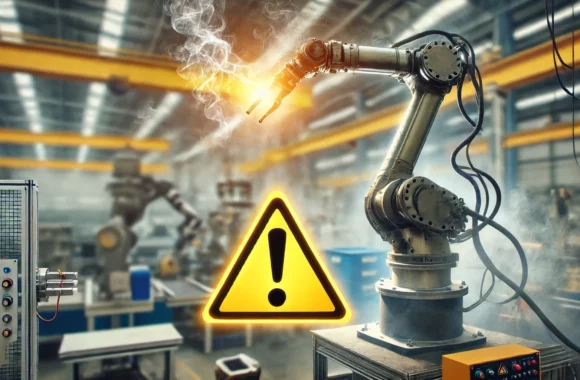
Reason enough for us to take a look at the topic from the perspective of companies that use or develop IoT applications. In our three-part AIoT blog series, we look at the various use cases.
What actually is AIoT?
AIoT stands for Artificial Intelligence of Things. It is a combination of Artificial Intelligence (AI) and the Internet of Things (IoT). AIoT refers to the integration of AI technologies into IoT systems to better analyze the collected data and make smarter decisions based on it. This combination enables IoT devices not only to collect and communicate data, but also to learn and act autonomously, resulting in more efficient and intelligent systems.
Part 1: The Intelligent Field Assistant
Machines and systems generate valuable data over the course of their lives, which can provide exciting insights and profitable findings.
One specific example here is the evaluation of vibration data, which can occur in a variety of scenarios - e.g. in motors, pumps, lathes or ball bearings. In combination with machine learning algorithms, intelligent and predictive maintenance schedules can be predicted and planned.
The following practical example will show how the maintenance process can be optimized using an AI-supported field service assistant.

How a pump manufacturer can intelligently optimize its maintenance processes with a Field Service Assistant
A pump manufacturer has installed several sensors that are able to record vibrations, speed, pressure information and temperature conditions. The manufacturer's associated research department has corresponding sample data for these measured variables, which describe the wear of the pump.
Based on this data, a machine learning model (e.g. a decision tree) can be trained, which is able to predict how long the pump can run without failure.
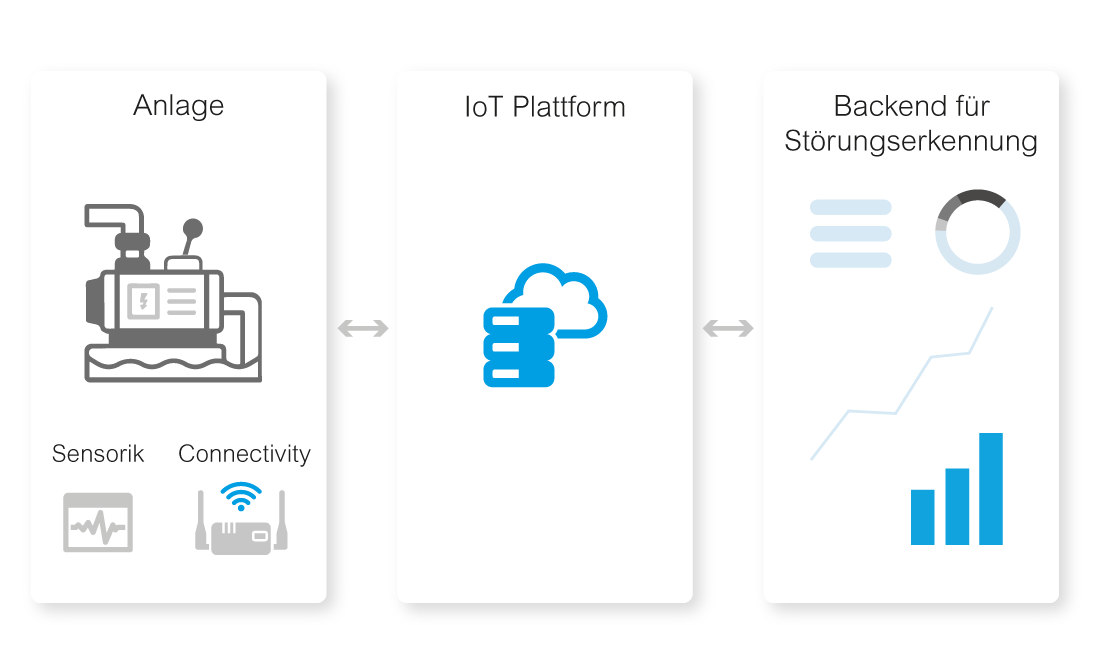
As the manufacturer has connected the pumps in the field to a cloud-based IoT platform via an IoT gateway, this data can now be made available to the trained machine learning model. As soon as a data pattern occurs that indicates major wear, a corresponding maintenance process is triggered.
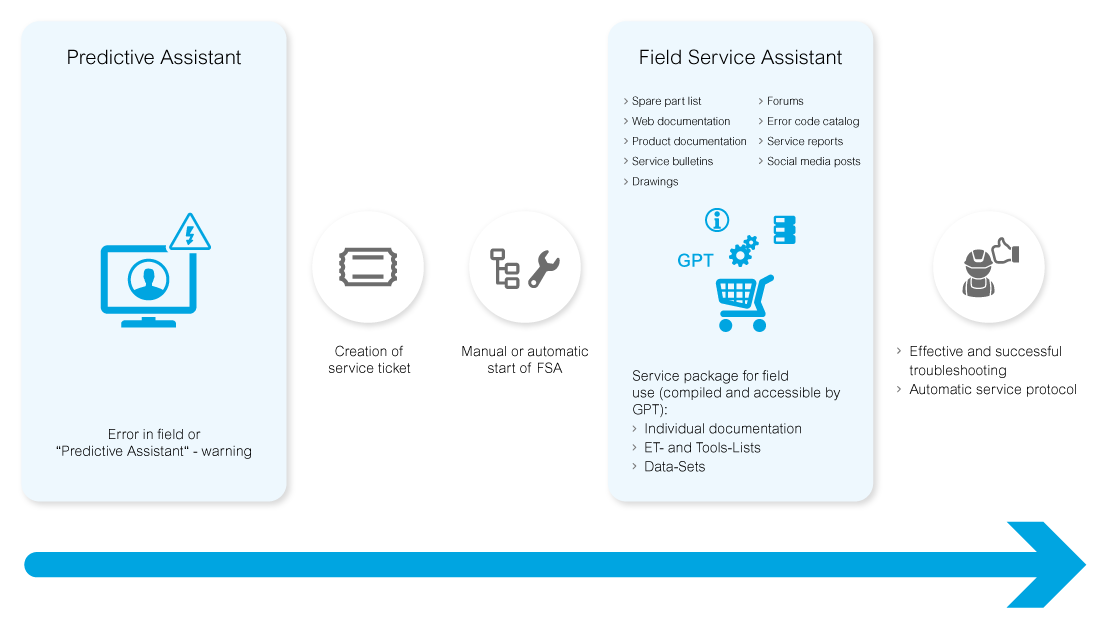
Specifically, a service ticket is created for a maintenance specialist. There, this person receives a corresponding intelligent Field Service Assistant Precise instructions and recommendations for maintenance.
This assistant then runs as a web app on a tablet, for example, and is fed with a wealth of information, e.g. error code descriptions, service reports, documentation and spare parts descriptions. Equipped with this knowledge, the intelligent Field Service Assistant can provide the maintenance technician with the necessary information and make recommendations for action.
Last but not least, the Field Service Assistant can ensure that the documentation standards have been met by the technician and that well-founded feedback has been provided.
Our assessment of field service assistants
The use and combination of (generative) AI and IoT opens up completely new possibilities for the optimization and automation of processes - e.g. in mechanical and plant engineering. In predictive maintenance in particular, the intelligent analysis of sensor data enables faults to be detected at an early stage and targeted maintenance measures to be initiated. The use of intelligent assistants helps to make maintenance processes even more efficient and reliable. The Field Service Assistant presented here is a possible example of this.
In the second part of our blog series Learn more about how you can use GenAI to rectify errors on your IoT device with the help of AI and thus optimize maintenance processes.