
Predictive maintenance - definition and differentiation
On the basis of Measurement and production dataIt is possible to predict when a component will fail and maintenance will be necessary. In contrast to the Preventive maintenance this prediction is always based on the actual condition of the machine. Measurement data such as vibrations, temperatures, pressure fluctuations or flows are recorded with the help of Sensors detected and to a forwarded to the database. Here, the data is stored using analyzed and compared using mathematical algorithms, to achieve the best possible Precise advance planning of maintenance to create. The aim is to Minimize machine downtimes, and their increase service life and safety. Furthermore Resources such as spare parts and people plan better.
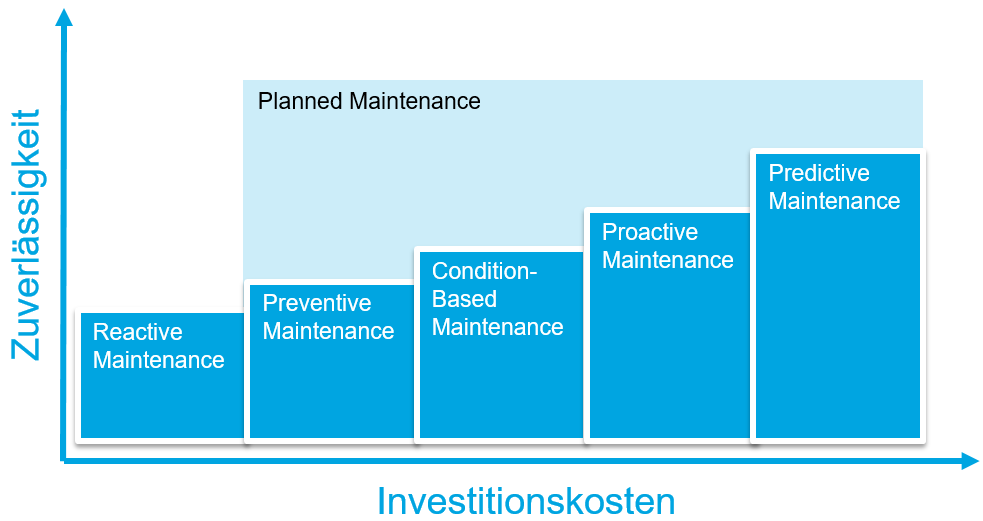
In the industry there are different maintenance strategies, which need to be differentiated from one another. The following graphic shows an overview of individual maintenance strategies, measured in terms of their reliability and investment costs.
Reactive maintenance - maintenance in the event of machine failure
This is one of the most classic maintenance strategies. Maintenance is carried out when a machine breaks down.
In principle, reactive maintenance should only be used for machines that are in the Maintenance and replacement very inexpensive are. This also means that the Spare parts can be procured quickly and can be replaced by anyone. However, machines that are not easily and cheaply accessible, such as satellites, are also maintained using this strategy in practice.
The term Run-to-failure maintenance is used. Some equate it with reactive maintenance and others see it as part of the Planned Maintenance, as, in contrast to reactive maintenance, resources are already available and can be used immediately in the event of a failure.
Although this maintenance strategy has the lowest initial costs, the failure of a machine or component can lead to a cost explosion if machines are down for several days and expensive spare parts or even a new machine have to be purchased.
Planned maintenance - planned maintenance with suitable personnel
Planned Maintenance comprises a variety of planned maintenance strategies. The most important thing here is that maintenance is planned and carried out by a competent and suitable service technician.
Preventive maintenance - maintenance based on experience
Just like Predictive Maintenance, the Preventive maintenance to avoid downtimes. However, the Maintenance not calculated on the basis of measurement data, but according to a fixed pattern or according to experience. This in turn has the disadvantage that Components exchanged that are actually still function smoothly. On the other hand, it is also not recognized if a Component overstressed is delivered. For example, a part may suddenly fail and the entire machine may be at a standstill for a certain period of time until the replacement part arrives, as this should only be delivered shortly before the next maintenance. Both of these factors result in higher costs overall.
Condition-Based Maintenance (CBM) - Condition-oriented maintenance based on measurement data
Condition-based maintenance, Condition-Based Maintenance (CBM) similar to predictive maintenance, uses measurement data to determine the current status of the machine. If a measured value is elevated, the CBM reports this fault, e.g. by illuminating a warning light. This works in a similar way to a car when the check engine light comes on.
Proactive maintenance - actively managing countermeasures
Proactive Maintenance concentrates on potential Main causes of errors and takes countermeasures before they can occur. In addition to the Status checkalso includes a Strict machine inspection by the employees. When inspecting mechanical machines, the causes of faults such as incorrect lubricants, contaminated lubricants, incorrectly carried out repairs or operating errors are identified and rectified.
The Corrective maintenance is used when an unforeseen failure occurs (reactive maintenance) or maintenance is imminent (planned maintenance). The aim is to detect, isolate and rectify faults and thus bring a machine or component back to a state of normal operation. proper operating condition to move.
P-F curve - comparison of machine wear
With the help of the P-F curve (potential error - functional error), the Wear process of machines illustrate.
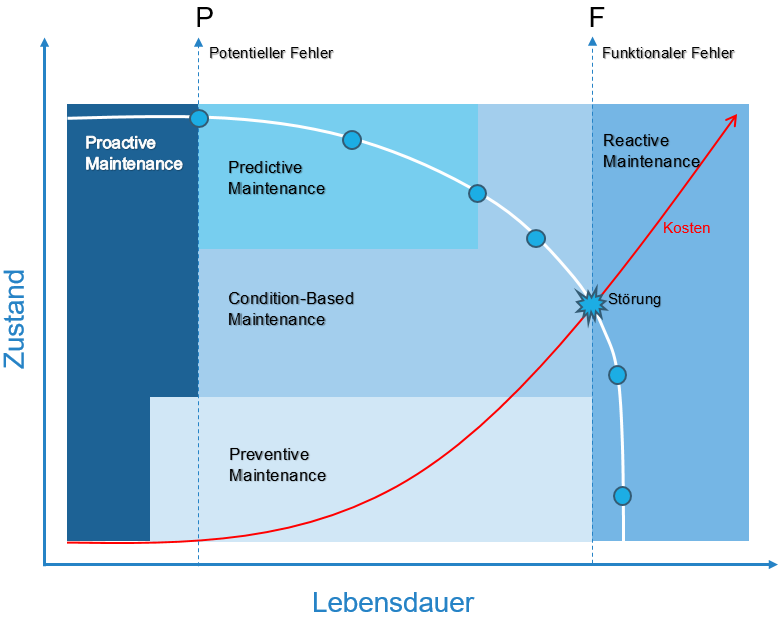
The condition of the machine is indicated on the vertical axis and its service life on the horizontal axis. The Point P gives the first potential error which is recognized and Point F the actual failure of the machine or the component. The points between points P and F indicate further faults. The company now has the opportunity to rectify the problem in the time between the first detected fault and the actual failure. The time between the detection of an error and the failure can vary. For example, the machine may fail within a few minutes of the first fault occurring, or it may take several weeks. The longer the company waits to rectify the fault, the faster the costs increase. As can be seen in the illustration, the maintenance strategies take effect at different times.
An overview of the various maintenance strategies: An example
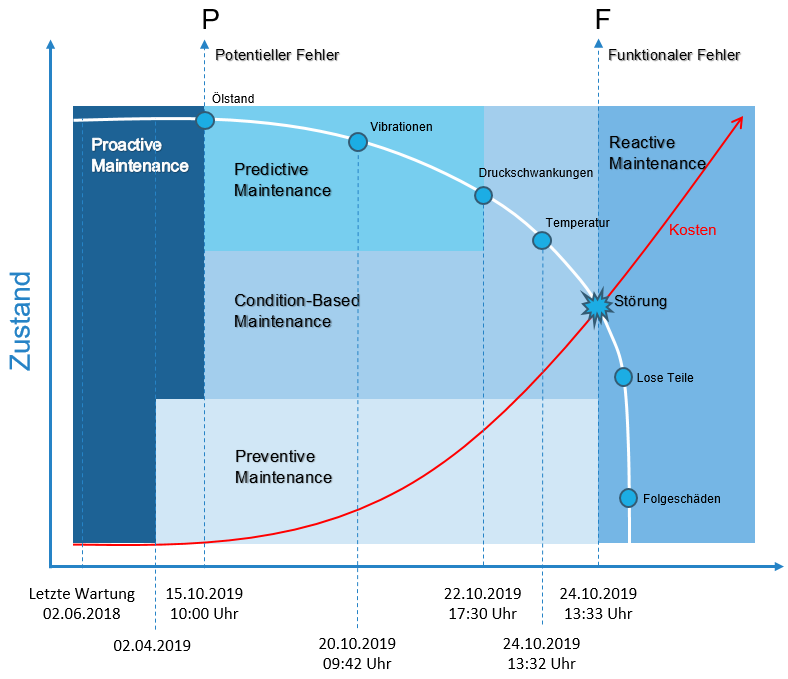
On 02.04.2019 the strategy reports Preventive Maintenance, that the machine is due for maintenance every ten months. This maintenance frequency was determined on the basis of experience. During maintenance, component Y is replaced even though it is still No signs of wear and would continue to function smoothly for several months.
On 15.10.2019 at 10 a.m., the machine reports a Low oil level and on 20.10.2019 at 09:42 a.m. Vibrations. Condition-Based Maintenance reports these errors immediately and a Employees has the possibility to errors and rectify them if necessary. The employee has time to do this until the component or machine actually fails.
One Predictive maintenance strategy in turn collects these messages and calculates a forecast from the data and empirical values, which component fails and when. This means that maintenance can be planned in good time and without increased costs.
On 24.10.2019 there will be a breakdown. React here Reactive Maintenance. At this point, costs increase exponentially as downtime, spare parts and maintenance service costs are incurred.
In principle, it cannot be said that one of these maintenance strategies is the best. It depends very much on the Use case off. To put it bluntly: You won't send a technician into space every time the satellite reports an error. The Maintenance strategy must be adapted to the business process become. This can also mean opting for a middle ground. Experienced IT service providers can help to find the best solution for individual use cases.
Does predictive maintenance fit your use case?
Our Checklist helps you to assess whether it makes sense to start a predictive maintenance project for your specific use case.
You may also be interested in these articles:
Best practices in the implementation of predictive maintenance - a field report
Predictive maintenance: the biggest challenges for companies
Predictive maintenance: the maintenance of tomorrow in Industry 4.0
Image sources:
Image1: Own design
Fig. 2, 3: Own design based on template from https://production-technology.org/tag/p-f-curve/
Sources:
https://www.industry-of-things.de/iot-basics-was-ist-predictive-maintenance-a-693842/
https://www.hannovermesse.de/de/news/top-themen/predictive-maintenance/