The factory of the future is hybrid: IIoT in the cloud, edge at the point of action.
Cloud platforms are the backbone of modern IIoT solutions—they bundle data, enable large-scale analysis, and create transparency across entire plants. But not every decision can be made in the cloud. When every millisecond counts, when sensitive data must not leave the premises, or when networks fail, computing power is needed right where the action is. This is exactly where edge computing complements the cloud—not as a competitor, but as an indispensable partner in a hybrid architecture.
IIoT and Edge explained briefly
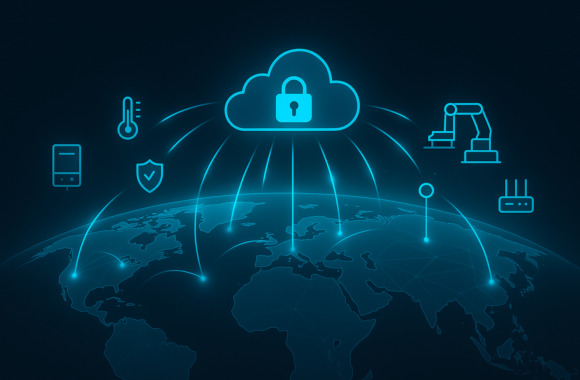
Industrial Internet of Things (IIoT) stands for the networking of machines and sensors with the cloud in order to centrally evaluate data and create added value from it—for example, through transparency in production, better maintenance, or new business models.
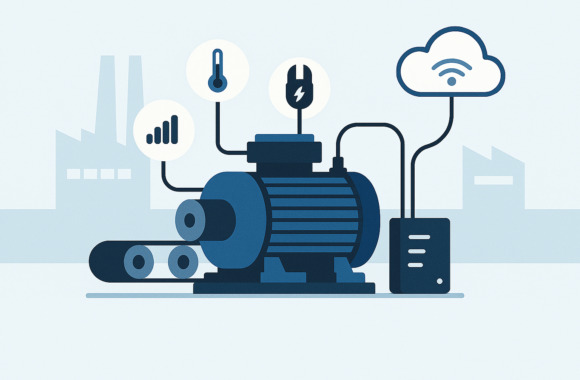
edge computing processes data directly where it is generated: on machines, gateways, or local computing nodes. Analysis takes place in real time on site—with advantages in terms of latency, data sovereignty, and reliability.
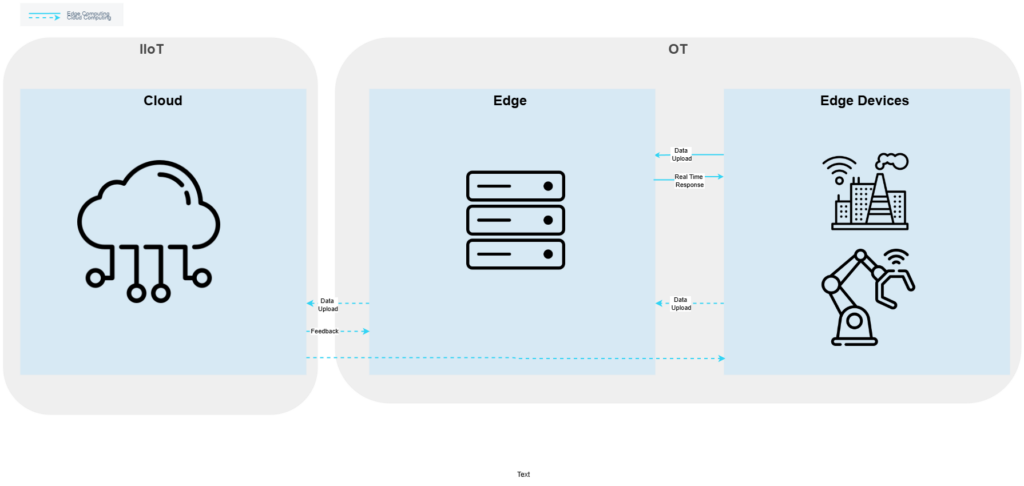
The Industrial Internet of Things (IIoT) is the foundation of many digitization strategies in industry. Standardized protocols such as MQTT or OPC UA enable machine data to be reliably transferred to central platforms. „MQTT offers a lightweight, cloud-friendly communication model, while OPC UA impresses with its comprehensive data model, high security, and support for client-server and pub/sub patterns.“1 Companies can consolidate this data centrally, store it long-term, and use it specifically for analysis. Anyone who wants to delve deeper into the standards MQTT and OPC UA If you would like to get started, you can find our article here: IIoT: The key to the scalable factory of the future – Business software and IT blog – We shape digital value creation
The strength of IIoT lies in its scalability and transparency: companies gain a comprehensive overview of production lines, plants, and supply chains. This is particularly valuable in applications that are not time-critical—such as benchmarking across locations, predictive maintenance based on historical data, or the development of new data-driven business models.
IIoT forms the stable foundation on which edge computing and other solutions are built.
When Edge is the only solution
As powerful as IIoT platforms are, there are scenarios in which the cloud is simply not enough. There are typically three reasons for this:
- Decisions must be made in milliseconds
- Data may not leave the location due to legal or business requirements.
- Systems must continue to run reliably even during power failures.
In precisely such cases, it makes sense to process data directly at the edge level rather than building in a dependency on the cloud.
| quality criterion | Practical examples |
| real time | Quality check: Camera detects errors → immediate correction |
| data sovereignty | Patient data or production recipes remain local |
| offline capability | Offshore wind farm controls turbines even without cloud connection |
| data volume | Video data is filtered at the edge before it goes to the cloud. |
Making conscious architectural decisions
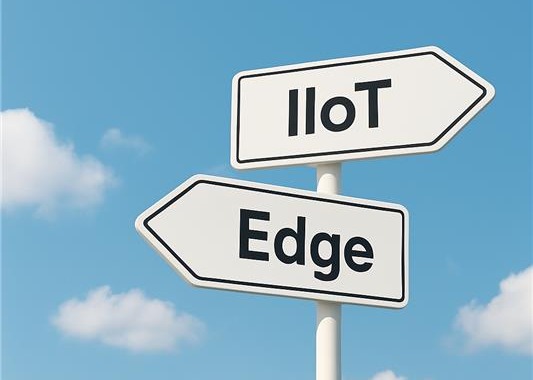
The key question is not „edge or cloud?“ but rather, „Which combination delivers the greatest added value in a specific use case?“ In practice, hybrid scenarios dominate: Data is preprocessed at the edge, while storage, analysis, and AI models take place in the cloud.
Three factors are decisive:
- Use Case → What is to be achieved, what are the primary objectives?
- quality requirements → e.g., latency, security, scalability
- system environment → existing infrastructure and network connection
Anyone who clearly evaluates these aspects will quickly realize that „edge computing reduces latency and protects data sovereignty, while cloud platforms score points for scalability and flexibility. Hybrid architectures offer a promising middle ground here.“2
Template: Prepare architectural decisions
1. Use case & objective
- What goal should be achieved?
- What are the benefits for users or organizations?
2. Evaluate and prioritize quality criteria
- Latency → How quickly must a response be made? What are the consequences of a delay?
- Security/Compliance → What requirements apply? What are the risks of non-compliance?
- Scalability → Can it be used locally or globally? What are the consequences without scaling?
- Costs/bandwidth → How large is the data flood? What are the consequences of unfiltered cloud transmission?
Rank the criteria according to importance (1 = critical, 4 = secondary).
3. Check the system environment
- Network connection: stable or insecure?
- Infrastructure: Edge server or cloud platform available?
- Data types: Sensor values, images, videos?
4. Derive architectural decision
- Edge → when real-time, data sovereignty, or offline capability are top priorities
- Cloud → when scaling, centralized analytics, or cost efficiency are the main priorities
- Hybrid → when several top priorities must be met simultaneously
Outlook from practice
During label printing, an HD image (5 MB) is captured. The Edge Engine analyzes in <50 ms, detects anomalies, and returns „OK/Error.“ Only the result and serial number (<50 KB) are stored in the cloud. This minimizes latency, conserves bandwidth, and ensures compliance.
Decisive quality criteria here:
- Scalability: Cloud stores ~10,000 logs/day for global evaluation.
- Cost/bandwidth: Raw images approx. 5 MB each, Edge reduced to <50 KB metadata.
- Latency (1): < 50 ms for image processing and „OK/error“ decision.
Conclusion: The future is hybrid
IIoT platforms form the foundation for transparency, scalability, and data-driven business models. Edge computing complements this foundation where real-time, data sovereignty, or offline capability are essential.
The key insight: It's not about a either-or, but rather the conscious combination of both approaches. Successful architectures emerge when companies clearly evaluate their goals, quality requirements, and system environments—and use this to make an informed decision in favor of edge, cloud, or hybrid.