
They can be found in many German workshops: faithful, mechanically flawless machines that have been in service for 10, 20 or even 30 years. They are robust and reliable, but they have a problem: they are „dumb“. In a world of Industry 4.0, where data is considered the new gold, these machines seem like a relic from another era.
But do you really have to scrap these valuable assets in order to benefit from digitization? The answer is: No. The solution is called IoT Retrofit.
Why is retrofitting more important today than ever before?
The purchase of a new, networked machine, e.g. an injection molding machine or CNC milling machine, often costs six to seven figures. A retrofit - i.e. retrofitting existing systems with sensors, communication units and software - costs only a fraction of that.
There are three clear reasons in favor of the retrofit approach:
- Sustainability: Existing resources are reused instead of being replaced by energy-intensive new production.
- Cost efficiency: You extend the life cycle of your systems (life cycle extension) and avoid high capital expenditure (CAPEX).
- Homogeneity: Rarely does a machine fleet consist of just one manufacturer or one year of manufacture. Retrofit makes it possible to create a uniform database across the entire mixed fleet.
How does retrofitting work? A „brain“ for the engine
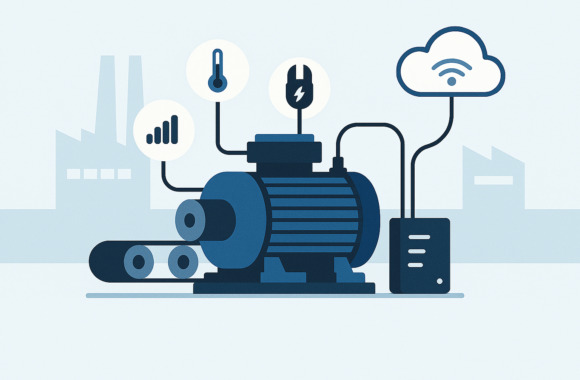
Let's imagine a classic example from practice: A large industrial motor on a conveyor belt. It has been running flawlessly for years, but provides no information about its condition. An IoT retrofit takes place here in a logical step-by-step model:
Step 1: Retrofitting the „senses“ (sensors)
First, we equip the motor with senses. We attach sensors to the outside of the housing that measure vibrations, temperature or the energy flow via current clamps. The motor can now „feel“ whether it is doing well.
Step 2: The „retrofitted brain“ (Edge Gateway)
This is where the real magic happens. The sensors alone are not yet „smart“. We expand the motor with a Edge Gateway. This is the retrofitted brain directly on the machine.
- Interpreter function: The gateway translates the electrical signals from the sensors into modern IT languages such as MQTT or OPC UA.
- Data filtering: The brain decides on the spot: What data is important? Instead of sending a vibration value every millisecond, the gateway only sends a message when a threshold value is exceeded. This saves bandwidth and costs.
- Security: As a digital protective cover, the gateway ensures that the engine remains securely isolated from the rest of the company network.
Step 3: The connection to the outside world (connectivity)
The gateway sends the processed data securely to the cloud or to your local IT. Only now does the machine become visible in the dashboard.
What is important? Best practices
To ensure that the project does not die after the pilot phase, you should consider the following points:
- Security by Design: Rely on hardware that has security certifications such as the IEC 62443 already at its core. This not only protects your data, but also the physical integrity of your systems.
- Start small (MVP): Do not try to read out 500 parameters immediately. Start with the three most important values (e.g. status: running/fault/off).
- Modularity: Choose hardware that is flexible so that you can easily add more sensors later.
The „business value“ trap: where is the real added value in retrofitting?
Critics often say: „A sensor on an old machine won't bring me a penny more in sales.“ From a purely technical point of view, this is true - retrofitting in itself has no direct business value. The value only comes from what you do with the data:
| Potential | Added value in practice |
| Transparency (OEE) | You finally realize why the 20% system is standing still. |
| Predictive maintenance | The engine responds, before the bearing breaks. This saves expensive emergency repairs. |
| Energy management | Identification of „energy guzzlers“ directly reduces operating costs. |
| Compliance & Security | Thanks to IEC 62443 compliant gateways, you meet the highest IT security standards. |
| New business models | Offer your customers „machine-as-a-service“ or data-based maintenance contracts. |
Conclusion
IoT Retrofit shows that the path towards Industry 4.0 does not have to involve replacing tried-and-tested machines. Many systems are mechanically reliable but lack data - and this is exactly where retrofitting comes in. The targeted retrofitting of sensors, edge gateways and secure connectivity makes existing machines digitally connectable.
The approach is cost-efficient, sustainable and particularly suitable for heterogeneous machine parks. It creates a uniform database and lays the foundation for valuable use cases such as greater transparency in production, condition-based maintenance or energy optimization.
Retrofit is therefore less of a technical project and more of an enabler: it makes existing assets fit for the future and opens up new data-based use cases - without having to rethink the machinery.