


As already mentioned in the first part of the blog series "Predictive maintenance: the maintenance of tomorrow in Industry 4.0" the use of predictive maintenance enables unprecedented transparency in the areas of production, aftersales and research & development. It was also reported on how this new technology can be used to identify or avoid disruptions to individual process and control sequences.
In this article, we want to get to the bottom of this question, the challenges that production companies and "data collectors" face before they can generate findings with profitable prospects.
What data provides the necessary information to utilize the added value of predictive maintenance?
One of the most important aspects of this is the Collection of valuable and informative data.
Alongside the ability of companies to innovate, one important aspect has so far been somewhat overshadowed: The Profit or the Added value for the customer. Even if the average consumer in the B2C environment is already very generous with the disclosure of personal data, companies in the B2B sector still have a rocky road ahead of them. They have to win over customers with intensive persuasion. With a focus on a "Win-win situation" by collecting and analyzing data, it is therefore a top priority to dispel existing doubts and fears about the misuse of sensitive company data and to underpin the benefits with the help of empirical values from successful projects on quality and overall efficiency. Not an easy task.
Especially the Variety and quantity of (live) data of similar, location-independent machine types offers the best conditions for a meaningful parameter comparison. Paired with combined and long-term accumulated experience of various service departments this results in a perfect basis for Optimization- and Increased efficiency of processes, products or services. One example of this is the early detection of parameters that deviate from the standard, the shortening of downtimes or the Optimizing the efficiency of machines and systems.
Finding the right method for data analysis
Once qualitative data has been successfully collected, it must be analyzed and processed in the best possible way. The prerequisite for this is corresponding competencies and Methods to master. Examples of this include process analysis management, a maintenance strategy and comprehensive innovation management. And above all: the motivational spirit of the employees. They should have the ability, innovative Technologies such as Big Data, data analytics and machine learning efficiently.
Nevertheless, a comprehensive understanding and knowledge of the latest technologies is essential for their efficient use and application. Algorithmics and Data analysis, which a data scientist, for example, has at their disposal. This is because the quality of the results depends very much on a well thought-out aggregation of the data and the possible enrichment of external data (data enrichment). The better the quality of the data collected from the empirical values, the more Precision and Significance has the diagnosis.
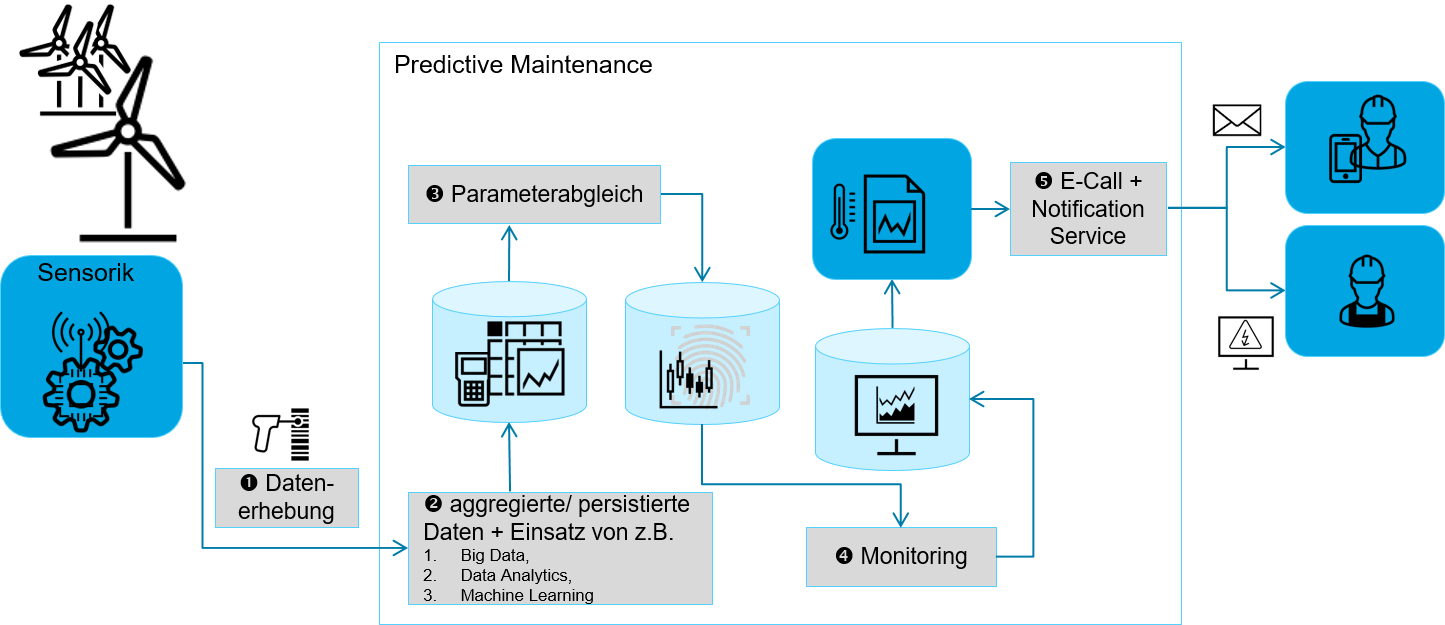
A possible scenario for the challenges mentioned could look as follows:
- Data collection about Sensors
- Aggregation, Persistence and evaluation in the Analysis tool with actual, experience/existing and target values (already frequently carried out in the cloud, as many cloud providers offer corresponding tools for this, e.g. MS Power BI or ThingWorx Analytics)
- Parameter adjustment
- MonitoringCreate test report
- In the event of abnormalities such as an elevated temperature: activate the central Reporting system + Send emergency log
- Depending on the maturity of the system: Diagnostic message with maintenance information on, for example, due lubrication intervals, activation of an order process for wear parts or optimization of efficiency.
Conclusion:
In order to find a constructive solution, a structured comparison of individual software solutions with standard software is an important undertaking on the way to using predictive maintenance. A change from long-established company processes may also be a viable solution here. Preference should be given to holistic approaches in which the software solution used can be integrated into the existing IT landscape. In the long term, this increases the benefits that can be achieved from the interaction of a wide range of experts from the specialist and service areas.
Here are Motivated and unbiased employees with enough open-mindedness for new things and sufficient specialist knowledge to master these challenges.
Find out more about predictive maintenance
Part 1: The maintenance of tomorrow in Industry 4.0