

In order to adhere to compliance guidelines and accounting standards, growth-generating strategies in pricing and sales are being overturned or adapted. Unfortunately, this is not uncommon.
Many product owners are familiar with this moment: you find yourself in the middle of a highly motivated team designing new, innovative digital services which, in addition to flexibility and customer satisfaction, also generate recurring revenue and long-term customer loyalty in the form of subscriptions. But then comes the meeting with colleagues from the finance department. Suddenly, issues come up that have not yet been considered, but which can be very costly and jeopardize the entire go-live plan.
The challenges of revenue recognition
The correct recording of a company's turnover is of crucial importance for the assessment of its financial performance. This is a legal requirement. The following principles must be applied:
Companies must recognize revenue when goods and services are transferred to the customer in an amount that is proportionate to what has already been delivered at that time.
With subscriptions in particular, revenue must be recognized over the entire term of the contract and not just immediately upon purchase. This poses challenges for companies and their finance departments. The different methods of revenue recognition lead to inconsistent accounting results, especially for subscription offers with multiple elements, which makes it difficult to compare companies.
International Accounting Standards have been defined to counteract this and standardize revenue recognition. For companies based in the USA, the
GAAP (General Accepted Accounting Principle) for all other countries of IFRS (International Financial Reporting Standards). IFRS 15 regulates the recognition of revenue generated on the basis of contracts with customers. This is the case with subscription-based models.
The 5-step plan
If a contract now includes a machine, installation, training and consumables, the old accounting standard did not clearly define when and to what extent revenue should be recognized in the course of performance. Under IFRS 15, a so-called 5-step plan is prescribed to solve this problem:
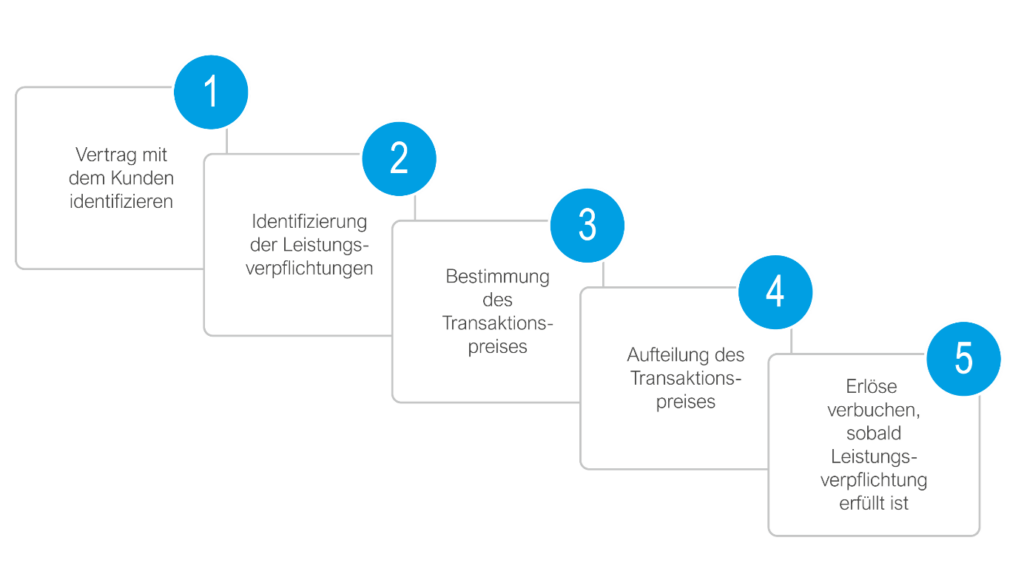
This plan provides a systematic approach to answering questions about recognizing revenue from multiple-element arrangements. It is important to note that one or more contracts as a contract unit form the basis for accounting, but are not the actual accounting object. In fact, it is the separately identifiable performance obligations that can be identified from a contract that are the focus of accounting.
The five-step plan is structured as follows:
Level 1: Identification of contracts with the customer to determine whether revenue needs to be recognized at all.
Level 2: Identification of separately identifiable performance obligations, which represent the actual accounting object after the contracts have been identified.
Level 3: Identification of the consideration, i.e. the transaction price resulting from the contract, in order to answer the question of the "amount".
Level 4: Allocation of this consideration to the previously identified performance obligations in order to clarify the question of the "pro rata amount".
Level 5: Examination of the time or period in which the revenue is to be recognized in order to answer the question of "when".
At first glance, it seems quite simple. So why does this present so many finance departments with such major challenges? Isn't everything regulated in a structured way in IFRS?
If we now look at the points that make up successful subscription models, these include
- Individual, transparent pricing
- Flexibility in provision (flexible terms and billing cycles, options for pausing, etc.)
- Scalability (simple expansion of user accounts, upgrades, etc.)
Contract amendments are therefore the rule in the subscription business. The 5-step plan must therefore not only be run through once when the contract is concluded, but instead individually for each customer and with each change throughout the entire customer journey.
Flexible terms and billing cycles may change during the term of the contract, which requires an adjustment to step 5 for revenue recognition. For offers such as Pay-per-use or Graduated prices the transaction price may not yet be fixed at the beginning of the accounting period, making adjustments necessary in steps 2 and 3 of the revenue recognition plan.
Similar adjustments also apply to upgrades and downgrades, as they can make it more difficult to identify the contract in step 1. Depending on the situation, contract modifications are either treated as a modification of the existing contract or a separate contract is created. All of this has a corresponding effect on revenue recognition.
If such cases are now managed manually in the finance team, it becomes clear that this cannot be implemented in a stable and scalable way, which leads to frustration and rejection.
When looking for a solution, a legacy system may have already been adapted for recurring billing, perhaps even with unsightly special solutions. This reaches its limits at the latest when it comes to correct and compliant revenue recognition. As a result, even the smallest adjustments, such as new pricing models, are only implemented with great effort and delays, which is correspondingly expensive.
The solution: automation and the use of professional subscription management software
Financial systems must be fully automated in the customer journey in the Subscription Management be integrated. The strategic use of specialized, automated subscription management products is crucial here.
At doubleSlash, we support our customers in the selection of these products and ensure that, at the latest when scaling the business model, subscription management products are used that already provide out-of-the-box compliance with revenue recognition regulations.
Our partner network includes product providers who offer Deferred Revenue Recognition for simple prepaid business models as standard for subledger management, as well as product partners who offer entire product add-ons for revenue recognition.
We help you to find the right provider, also with regard to costs, and ensure that adherence to compliance regulations can also be seen as an opportunity for growth.
An automated subscription management system minimizes legal risks, strengthens customer confidence and ensures smooth business operations. It is important to emphasize that compliance and growth go hand in hand: An effective compliance strategy promotes growth by creating trust with customers and building solid business relationships.
In the vibrant world of the subscription economy, compliance and growth are inextricably linked. Our expertise in software development and integration enables us to understand the specific needs of our clients and deliver effective solutions that contribute to sustainable growth.