
The corona pandemic has found its way into our lives and everything that we took for granted in everyday life - the commute to work, the weekend getaway, even business trips - has become an exception. Only fuel costs have fallen, but the leasing rate remains the same. How good it would be if this cost item could be adjusted to my life - right now and not in four years' time.
Success is often equated with ownership. But what good are these status symbols if they don't fit in with my current life and cling to me stolidly?
The shift to the subscription model was already there - now it's just being accelerated
Here, too, the pandemic is merely accelerating the Market upheaval and rethinking. For some years now, ownership has been declining while the number of users has been rising. What does that mean? Sales figures are falling in the industry, but consumption is rising. Nevertheless, these industries are doing well and continue to grow. One example of this is the music industry. Sales of CDs and music downloads have been falling for years, and yet the industry is growing1. This can be explained by music subscriptions, which already accounted for 56% of total music sales in 2019.
We are buying fewer and fewer newspapers.2 However, the consumption of digital news has increased by 20 percent compared to the previous year. It's exactly the same in the film industry: film sales are down, but video streams are up. According to statista, the number of subscribers to the online video service Netflix rose to 200 million last year - an annual increase of 21%3 from.
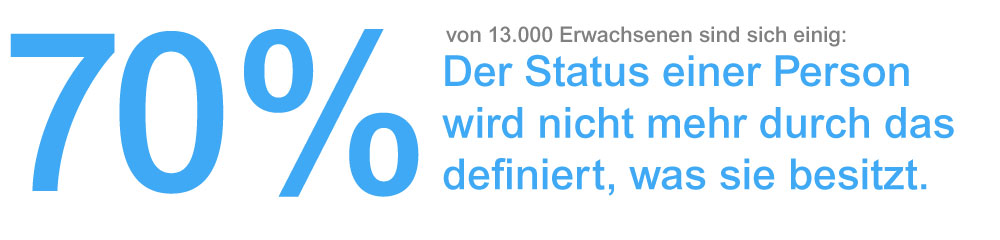
The market research company "Harry's Group" recently surveyed more than 13,000 adults in twelve countries worldwide on the subject of ownership vs. subscriptions4: Almost three quarters of adults believe that the people will subscribe to more services and own fewer physical products in the future become. More than 70 percent of adults have subscription services - compared to just 50 percent five years ago. Product ownership is increasingly becoming a thing of the past. Over 70% of adults believe that a person's status is no longer defined by what they own. The same number agree that subscribing to services provides a decisive advantage: You don't have to worry about maintenance and upkeep.
More than just customization - Abo models make products strong and sustainable
But there is more to the shift from ownership to subscription models. Initially, we as consumers in the ownership model benefit from the user-friendliness, as we can access the services directly: Music from CDs, mobility from cars, software from servers.
However supports a subscription - in contrast to ownership - Sustainability. In the subscription model, the margin incentive shifts from "units" to "utilization". Manufacturers must ensure that their product lasts as long as possible or can be effectively reused in order to achieve high utilization. Providing a service therefore makes a company more efficient. When revenue is tied to utilization, vendors cannot afford downtime.
What does this mean for companies in the future? Companies will have to focus on the use of their product and not just on sales figures. This means that the provider must not only be convincing up to the point of purchase, but over the entire period of use. This results in a New economic model around these new services. Quick and easy access, sustainability and the ability to adapt quickly play a decisive role here. It is important that the entire customer journey process is considered when implementing a subscription model and that the Early priority for billing is given.
"As a consultant in the areas of connected mobility and IoT, I have an insight into a large number of innovative and forward-looking digital services. What strikes me is that the monetization and billing of the services of such a subscription-enabled business model are often designed far too late in the project"
Matthias Sekinger, IoT Consultant for Connected Mobility
And what role does digitalization play in successful subscription models?
The transformation from a traditional product provider to a service provider with a subscription model, also known as a subscription business model, has an impact on all areas of a company.
On the one hand, the mindset is changing, with an even stronger focus on the customer. On the other hand, new processes are being developed and existing processes are being adapted. The main focus here is on Automation takes center stage. They allow services to be provided in real time without high processing costs.
This also places new demands on the IT landscape. The range of systems required for smooth data exchange and the corresponding customer experience must work together. Important here are Subscription management systems with components for automated invoicing, individual pricing and tariff design and contract processing based on this. Traditional ERP and CRM systems often do not offer the necessary high number of automated transactions to quickly and individually map this wide range of information. However, companies save neither money nor time if they develop an alternative subscription management system themselves from scratch. Instead, they should rely on established products for the various components and invest in smooth integration.
The smooth integration of a subscription model into your own IT landscape then requires foresight and experience. It's good to have access to a partner and system integrator with these qualities. This gives you the speed and security you need for the next level of digitalization.
Conclusion
As a car owner, the last few months have clearly shown me that I want to become more independent in the future. And independence now means much more than just being able to quickly get into a fancy car and drive off.
I work for an IT company that has a lot of experience in the Integration of subscription management systems and I am therefore delighted to have gained an insight into the market and the changes that this entails.
Which car manufacturer has already recognized this change? Or are there perhaps even completely different providers who will shake up the market? Which ownership products will I soon be able to swap for a subscription model?
I'll keep my eyes open. You too? Or perhaps you have a tip for me?
Our offers for your subscription product
Sources
1 https://www.musikindustrie.de/wie-musik-zur-karriere-werden-kann/musikindustrie-in-zahlen/ein-blick-zurueck-2021#c1716 ^
2 https://de.statista.com/themen/176/zeitung/ ^
3 https://de.statista.com/infografik/2951/anzahl-der-streaming-abonnenten-von-netflix-weltweit/ ^
4 https://www.zuora.com/press-release/new-international-survey-reports-on-the-end-of-ownership-and-the-rise-of-subscriptions ^