
The offer-to-cash process: an overview
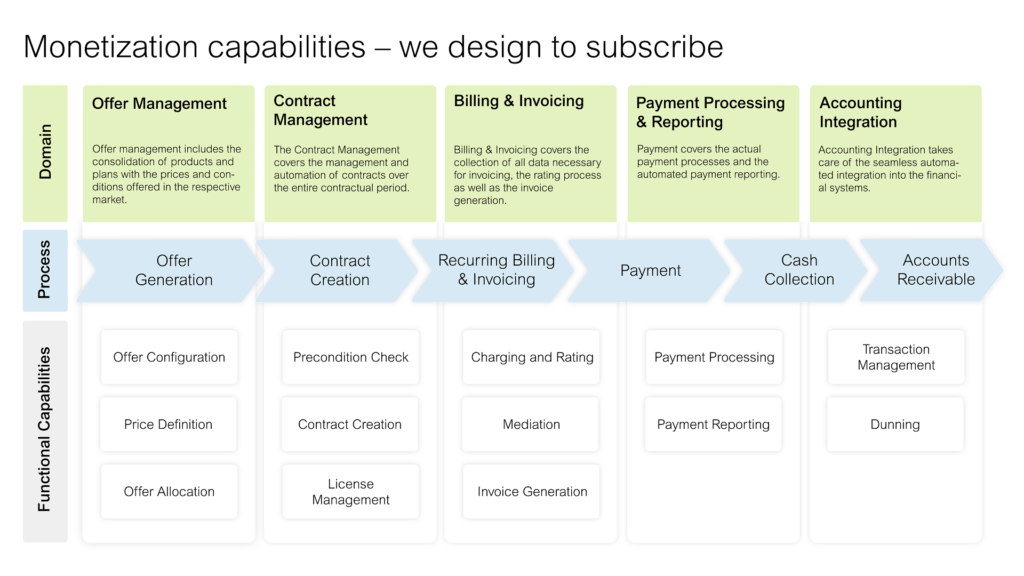
The offer-to-cash process begins with the display of prices at the charging station and includes all steps from the preparation of the offer and billing to the recording of incoming payments and the correct accounting integration into the financial systems. The aim of this process is to automate all relevant customer interactions in order to increase efficiency and become scalable. The process is divided into several functional areas:
- Offer Management (Offer management)
- Contract Management (contract management)
- Billing & Invoicing (settlement)
- Payment Processing & Reporting (Payment processing)
- Accounting Integration (Accounting)
This shows that the process goes beyond mere billing and is strongly integrated into the company's workflows. In order to successfully scale the offer-to-cash process, companies must clearly define which capabilities they need, which processes should be automated and how they design their vertical integration.
Special challenges in the offer-to-cash process for energy suppliers and OEMs (original equipment manufacturers)
When scaling, these companies often encounter recurring challenges in the new different roles of CPO and EMSP. Some of these issues are due to the specific requirements of the eMobility-industry has become even more acute:
1. dynamic pricing
Dynamic pricing is a pricing strategy in which the costs for services, such as charging electric vehicles, are flexibly adapted to current market conditions. The challenge lies in finding a balance between cost efficiency and customer acceptance. While dynamic pricing can support grid stability and balance load peaks, transparency must be maintained in order to retain user trust. In addition, the implementation of algorithms that use real-time data is technically demanding and requires robust IT infrastructures. Other challenges include regulatory requirements to ensure fair access, transparency and consumer protection. These requirements often vary from region to region and must be carefully considered by operators when setting prices. Taking into account the different expectations of user groups is an additional complexity in order to offer customized pricing models. This requires highly configurable billing systems and seamless integration into the O2C process.
| Potentials and motivations for dynamic pricing | |
| Increased efficiency | Pricing can steer charging at times of low demand and relieve the power grid. |
| Cost savings for customers | Lower prices at off-peak times make charging cheaper. |
| Sustainability | Dynamic prices promote charging during periods of high availability of renewable energies. |
| Competitive advantage and customer loyalty | Individual price offers can strengthen customer loyalty. |
| Optimized use of resources | Better distribution of charging capacity maximizes infrastructure utilization. |
2. ad-hoc charging and payment
Ad-hoc charging and payment refers to the possibility of using charging stations without prior registration or a contract and paying directly. As a rule, payment is made exclusively via a separate terminal at the charging station, which allows contactless payment.
The challenge for companies is to implement payment systems that are both secure and user-friendly, while being seamlessly integrated into the O2C process. Various payment methods must be reliably supported and a high level of data security must be guaranteed. It is also crucial that the additional payment flow is correctly integrated into the financial systems for accounting purposes in order to ensure transparent and compliant processing.
3. margin assurance
To ensure profitability, companies need comprehensive control mechanisms to ensure that charging processes are recorded correctly and billed using the right pricing model. In this context, Margin Assurance ensures a qualitative billing process and secures the company's margin and profitability.
4. fraud management
In the course of digitalization, the risk of fraud is also increasing. Companies must ensure that they design their processes in such a way that potential vulnerabilities are eliminated. These vulnerabilities must be identified along the entire offer-to-cash process, as fraud detection is used in almost all areas (capabilities). This includes, for example, security measures against unauthorized loading processes or manipulated payment methods. A particular challenge is the preventive detection of fraud attempts in order to prevent attacks at an early stage and not only when financial damage has already occurred. In addition, protective measures must cover the entire ecosystem - from the charging station to the payment provider.
5 Incentivization and voucher management
Incentives and voucher programs are playing an increasingly important role in attracting new customers, retaining customers or motivating them to carry out more charging processes. Companies need to be able to efficiently integrate such programs into their O2C process to ensure that customers reap the full benefits without skyrocketing administrative costs. You can get a deeper insight into the topic of incentives in in this blog post.
6. user-centered processes
With the variety of payment service providers (PSPs) available, it is crucial for energy suppliers to integrate them seamlessly into their systems. Customers expect a wide range of payment options, and the integration of different providers must ensure that transactions can be processed smoothly and securely.
Efficiency through clear process architecture
To make the offer-to-cash process efficient, companies need to take a strategic approach. One possible approach is to divide the process into four clearly defined steps:
Step 1: Analysis of the necessary capabilities
The first challenge is to get an overview of the required functionalities. What does a company need to have a scalable and efficient O2C process? This includes the management of tariffs, contract automation and payment processes as well as financial integration.
Step 2: Target process design
Based on these capabilities, a target process is developed that covers all aspects of monetization. The automation capability of the individual process components is crucial here in order to ensure scalability at a later date.
Step 3: Depth of added value and architecture
A crucial point in scaling the offer-to-cash process is the question of which components a company should develop itself and which should be covered by external partners or products. Best-of-breed approaches have often proven themselves in the combination of product purchasing and in-house development, as they make it possible to use specialized solutions from external providers and supplement these with company-specific adaptations. This leads to greater flexibility and efficiency in the implementation of complex processes. This is where the Monetization ecosystem from doubleSlash which enables seamless integration of all digital services in order to make monetization processes efficient and promote long-term customer relationships.
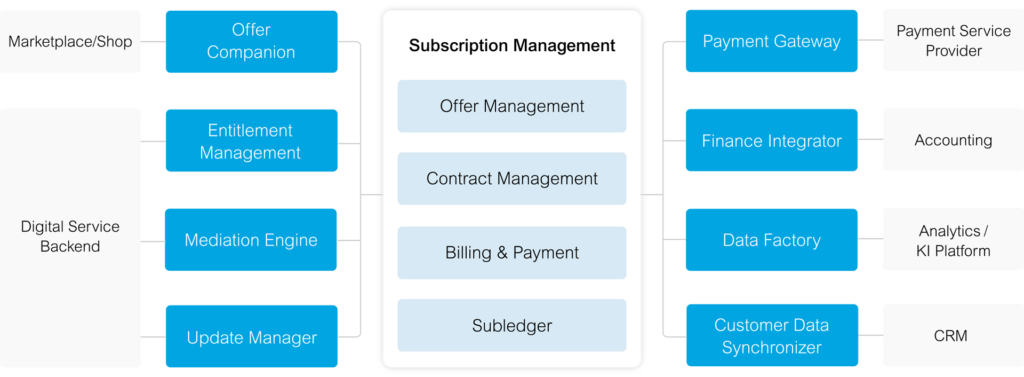
By implementing the key components from the monetization ecosystem, companies can optimize their vertical integration and at the same time respond flexibly to the needs of their customers. It provides the necessary infrastructure to make the O2C process scalable and efficient.
Step 4: Implementation
The technical implementation is then carried out either by internal resources or by partners such as doubleSlash, who can support companies in the implementation and scaling of the O2C process. Large OEMs or energy suppliers in particular have the opportunity to benefit from the expertise of specialized service providers and develop tailor-made solutions.
Conclusion: Successful scaling in the eMobility sector
Energy providers and OEMs face major challenges in the management of charging infrastructures and the monetization of services. The offer-to-cash process plays a key role here, as it forms the basis for the efficiency and scalability of business models. With a clear target process definition, the right choice of technology partners and a focus on integrating current trends such as dynamic pricing and ad-hoc payment, companies can master the challenges and grow successfully.

Do you have questions about the offer-to-cash process or do you need support with implementation? We support companies with our expertise and look forward to exchanging ideas.